It all boils down to a simple, fundamental difference: toner is a dry powder, and an ink cartridge is filled with liquid ink. People often say "cartridge" to mean both, but what's inside and how it works couldn't be more different.
Toner is the workhorse of laser printers, perfect for cranking out thousands of text-heavy pages like reports and invoices. Ink, on the other hand, is the artist of the printing world, used in inkjet printers to produce vibrant, high-quality color prints like photos and marketing flyers. Getting this distinction right is the first step for any office manager trying to control printing costs or a reseller figuring out the value of surplus inventory. For example, a law firm printing hundreds of contracts daily would choose a laser printer for speed and cost-efficiency, while a photographer would rely on an inkjet printer to produce gallery-quality prints.
Understanding The Core Differences
To make smart decisions about buying or selling printer supplies, you have to look past the name on the box. The choice between a laser printer (which uses toner) and an inkjet printer (which uses ink) has a ripple effect on everything—from the upfront cost of the machine to the long-term cost per page, and even what those leftover supplies are worth.
Let's clear up one common mix-up: the term "toner cartridge." It’s just the container that holds the toner powder; it's the large, replaceable unit you snap into a laser printer. An "ink cartridge" is its much smaller cousin, holding liquid ink for an inkjet printer. The two are worlds apart in both size and technology.
This quick visual breaks down the key distinctions.
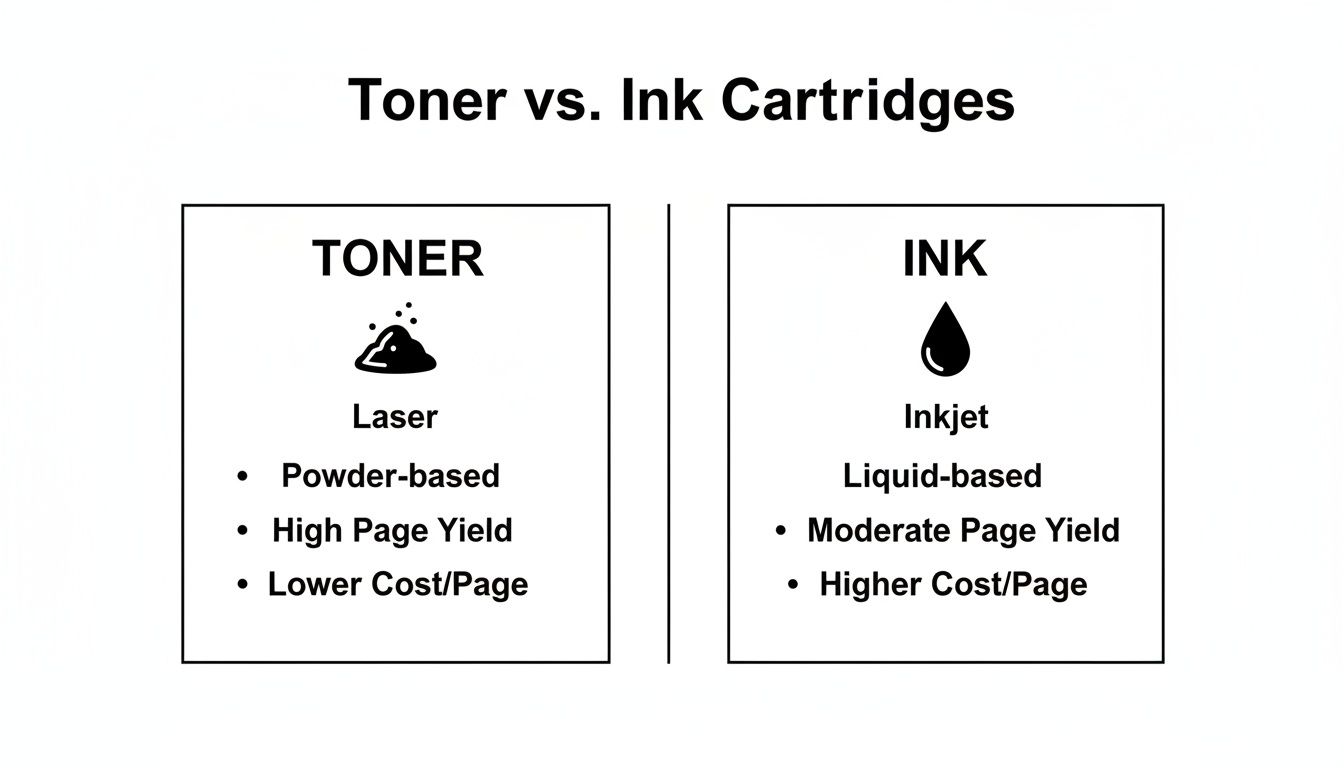
As the chart shows, one is a powder for laser printers, the other a liquid for inkjets. This basic difference dictates what each is good at and how they perform.
At-a-Glance Differences Toner vs Ink Cartridge
For anyone managing office supplies or sorting through a closet full of old inventory, knowing these details can save a lot of time and money. Here’s a straightforward table to help you see the differences in a flash.
| Characteristic | Toner (Laser Printers) | Ink Cartridge (Inkjet Printers) |
|---|---|---|
| Technology | Electrophotography (fuses dry powder to paper with heat) | Inkjet (sprays microscopic liquid ink droplets onto paper) |
| Composition | Fine, dry polymer powder (plastic particles, pigments) | Water-based or pigment-based liquid ink |
| Best For | High-volume text documents, reports, invoices | High-resolution photos, color-rich marketing materials |
| Page Yield | High (typically 2,000 to 20,000+ pages per cartridge) | Low (typically 150 to 800 pages per cartridge) |
| Print Speed | Faster, ideal for large print jobs | Slower, especially for high-quality color prints |
| Shelf Life | Very long; powder does not dry out | Shorter; ink can dry out or expire (often within 18-24 months) |
In short, a toner cartridge is generally bigger, heavier, and built to last for thousands of pages, which is why it's the go-to for busy offices. An ink cartridge is compact, good for a few hundred pages, and shines when it comes to detailed color work.
The most practical takeaway is this: toner is built for volume and speed, while ink is designed for vibrant color and detail. Your printing needs should always guide your choice.
Comparing the Core Technology
If you're managing or selling printer supplies, you need to get one thing straight: the difference between toner and ink isn't just about powder versus liquid. It's about two completely different ways of getting an image onto paper, and each method has its own set of strengths. Grasping this helps you understand the real value of the products you're handling and talk about your inventory like a pro.
The market trends reflect this distinction. The global toner market was valued at $667.363 million in 2021 and is expected to climb to $829.884 million by 2025. This growth is largely fueled by demand in offices and commercial settings where efficiency is king. You can dig deeper into the numbers in the full toner market research.
How Toner and Laser Printers Work
Laser printing is all about precision and speed, built on the principles of static electricity and heat. You can think of it as a super-fast, microscopic stamping system that uses a fine powder instead of wet ink.
Here’s a quick breakdown of what happens when you hit "print":
- Charging: First, a component called a drum unit gets a positive electrical charge.
- Imaging: A laser beam zaps the drum, precisely "drawing" your text and images by neutralizing the charge in those specific spots. This creates an invisible electrostatic blueprint of your page.
- Developing: The drum then rolls past the toner cartridge. The toner, which is essentially a fine plastic powder, gets attracted to the neutralized areas, sticking to the drum to form the image.
- Fusing: Finally, the paper travels through a set of heated rollers, called a fuser unit. This part of the process melts the toner powder, permanently bonding it to the paper fibers. What comes out is a crisp, dry, and smudge-resistant document, ready to go in seconds.
Practical Example: An accounting firm is printing a massive 500-page year-end financial report. A laser printer is the obvious choice. Its electrophotographic process can churn out hundreds of sharp, smudge-proof pages quickly, ensuring the text stays perfectly clear even if someone immediately takes a highlighter to it.
This efficient, heat-based method is exactly why laser printers dominate in environments that require high-volume, text-heavy printing where speed and clarity are non-negotiable.
How Ink and Inkjet Printers Work
Inkjet technology takes a completely different approach. Forget static and heat; this is all about spraying microscopic droplets of liquid ink directly onto the page.
Picture a high-tech painter with an impossibly fine brush. The printer's printhead, which is packed with thousands of tiny nozzles, glides back and forth across the paper, shooting out minuscule drops of ink in precise patterns. These dots layer and combine to create your text and images.
There are two main ways inkjet printers get this done:
- Thermal Inkjet: A tiny resistor heats the ink inside a nozzle, which creates a vapor bubble that pushes a droplet out onto the paper. It's a common method you’ll find in most consumer-grade printers.
- Piezoelectric Inkjet: An electric current is sent to a crystal in the printhead, causing it to vibrate. This vibration forces a precise amount of ink out of the nozzle, offering greater control over the droplet size.
Practical Example: A marketing agency needs to print a client proposal filled with vibrant charts, high-resolution photos, and subtle color gradients. An inkjet printer is perfect for this. Its ability to blend colors seamlessly by layering tiny ink droplets allows it to accurately reproduce the rich blues of a logo or the delicate shading in a photograph, resulting in a visually stunning document.
This meticulous, droplet-by-droplet process is why inkjet printers are the go-to for printing high-quality photos and any material where color fidelity is a top priority.
When you’re weighing toner against an ink cartridge, the real story isn't about the price on the box. It’s about performance and long-term cost, especially if you're managing office inventory or looking to sell surplus stock. The total cost of ownership—which includes everything from page yield to how long it can sit on a shelf—is what truly defines its value.
These practical differences are exactly why a big, clunky toner cartridge often holds its value far better than a small, sleek ink cartridge.
Page Yield and Cost Per Page
The most glaring difference between toner and ink comes down to cost per page (CPP). An ink cartridge might look like the cheaper option at checkout, but it runs out so quickly that it often becomes the more expensive choice in the long run.
Think about it: a standard black ink cartridge might give you around 200 pages. A standard toner cartridge, on the other hand, can easily deliver 2,000 pages or more. And if you spring for a high-yield toner, you could be looking at over 10,000 pages. This huge gap in page yield is where the long-term value really becomes clear.
Let's put this into a real-world context.
Business Scenario: Printing 10,000 Monthly Invoices
Imagine a small e-commerce business printing 10,000 customer invoices every month.
- Inkjet Printer (Ink Cartridge): A high-yield ink cartridge costs about $40 and prints 800 pages. To get through 10,000 invoices, they'd need to buy 13 cartridges, setting them back $520 per month.
- Laser Printer (Toner Cartridge): A high-yield toner cartridge costs $120 and prints the full 10,000 pages. They only need one cartridge, for a total cost of $120 per month.
In this case, switching to a laser printer saves the business $400 every single month. That’s $4,800 a year in savings on supplies alone. This is why, for any kind of high-volume printing, toner is the undisputed champion.
Print Speed and Quality Nuances
Beyond the raw numbers, performance in a busy office is crucial. Laser printers are built for speed. They can churn out 20 to 40 pages per minute (PPM) without breaking a sweat, which is perfect for big print jobs. Inkjet printers are just plain slower, especially when printing in high-quality color.
But when it comes to quality, "better" really depends on what you're printing.
- Toner Quality: Toner produces incredibly sharp, crisp text that won't smudge, even fresh off the printer. This makes it ideal for professional documents, contracts, and reports where you need absolute clarity.
- Ink Quality: Ink is the master of color. It excels at blending colors to create vibrant, photo-realistic images. The liquid ink allows for subtle gradients and deep saturation that toner just can't replicate, making it the go-to for marketing materials and photographs.
Shelf Life: A Key Differentiator for Resellers
For anyone managing surplus inventory, shelf life is everything. It's a critical factor that directly impacts a product's resale value, and it's a major point of difference between toner and ink.
Because toner is a dry powder, it has an incredibly long shelf life. A sealed toner cartridge, stored correctly, can sit for years and still work perfectly. This stability means that even older or discontinued toner models can hold significant value on the resale market.
Ink cartridges, on the other hand, are filled with liquid and are far more perishable. They can dry out, clog print heads, and almost always come with an expiration date—typically 18-24 months after manufacturing. Once an ink cartridge is expired, its resale value plummets to almost zero.
This long-term stability is a big reason why toner dominates the professional world. The global printing toner market was valued at $5.27 billion in 2024 and is expected to grow to $8.5 billion by 2032. In North America, businesses rely on toner for high-volume commercial jobs like printing catalogs and manuals—tasks where speed and reliability are non-negotiable. While ink cartridges still make up a huge portion of the market thanks to home printers, toner is gaining more ground in institutional settings because its cost-per-page simply can't be beaten. You can dig deeper into these trends in this analysis of the printing toners market.
Maximizing Your Resale Value
Knowing the difference between toner and an ink cartridge is one thing, but figuring out how to turn that surplus inventory into cash is what really counts. For office managers and resellers, the value of these items can swing wildly. Getting top dollar for your stock boils down to a few key things that any reputable buyback company will look for.
The biggest factor, hands down, is whether the product is OEM (Original Equipment Manufacturer). Genuine OEM products from brands like HP, Canon, or Brother are always the most sought-after. They guarantee quality and printer compatibility, which is why they consistently fetch the highest prices on the resale market compared to any third-party or remanufactured alternatives.
While being an OEM product gets you in the door, the path to a great payout looks very different for toner versus ink.
Key Resale Factors for Toner Cartridges
Toner's biggest advantage on the resale market is its incredible stability. Since it's just a dry powder, a factory-sealed toner cartridge has a virtually endless shelf life. This is great news because it means even toner for older, discontinued printer models can still be worth a good amount of money.
When we evaluate toner, we're almost entirely focused on the condition of the box. A pristine, factory-sealed box is worth far more than one that's been knocked around.
Here’s a quick checklist to run through when looking at your toner boxes:
- Is the box factory sealed? The original manufacturer's seal must be intact and unbroken.
- Is the box free of writing? Any pen marks, old shipping labels, or other graffiti will drag the value down.
- Is the box in good shape? Major tears, dents, or any signs of water damage will likely get your offer rejected.
A minor scuff or a slightly dinged corner might be okay, but the closer the box is to brand-new condition, the more cash you'll get. Simple as that.
Key Resale Factors for Ink Cartridges
With ink cartridges, it's a completely different story. Because they're filled with liquid ink, they are perishable items. This makes their expiration date the single most important factor determining what they're worth.
Most ink cartridges have an expiration date printed right on the box, which is usually 18 to 24 months from the day it was made. Buyback companies need enough time to receive your inventory, process it, and then resell it to a customer before that date passes.
Resale Guideline: Most buyback programs, including ours at Toner Connect, require ink cartridges to have at least one year left before they expire. An expired or nearly expired ink cartridge has almost no resale value.
A Practical Resale Scenario
Let’s walk through a common situation to see how this all plays out in the real world.
Imagine you're clearing out a supply closet and you find two sealed, genuine OEM HP products:
- A toner cartridge for a laser printer the company got rid of five years ago. The box looks perfect and has never been opened.
- An ink cartridge for a desktop inkjet printer. The box is also in great shape, but the expiration date is only eight months away.
When you submit these for a quote, you’ll see a massive difference in value. The toner cartridge has significant resale value. Its long shelf life means there are still businesses out there using that older printer model who need it, making your old stock a valuable asset.
The ink cartridge, however, will likely be rejected. With only eight months left on the clock, there just isn't enough time for a buyback company to find it a new home. This really highlights the fundamental financial difference between toner and ink when you're dealing with surplus. For those looking to partner with a reliable buyer, you can explore opportunities with our dealer program to ensure you get the best value for your inventory.
Turning Surplus Supplies Into Cash
So, you understand the differences between toner and ink. Great. But how do you actually turn that closet full of surplus supplies into real money? The right process should be fast, simple, and totally dependable. Let’s walk through a real-world scenario to see just how easy it is to monetize those unused assets.
Picture this: David, an IT manager, just finished a massive, company-wide printer upgrade. Now he's stuck with a supply closet packed with 30 assorted, unopened OEM toner and ink cartridges his new machines can't use. Instead of letting them collect dust and become a liability, David decides to sell them.
From Dusty Shelf To Quick Cash
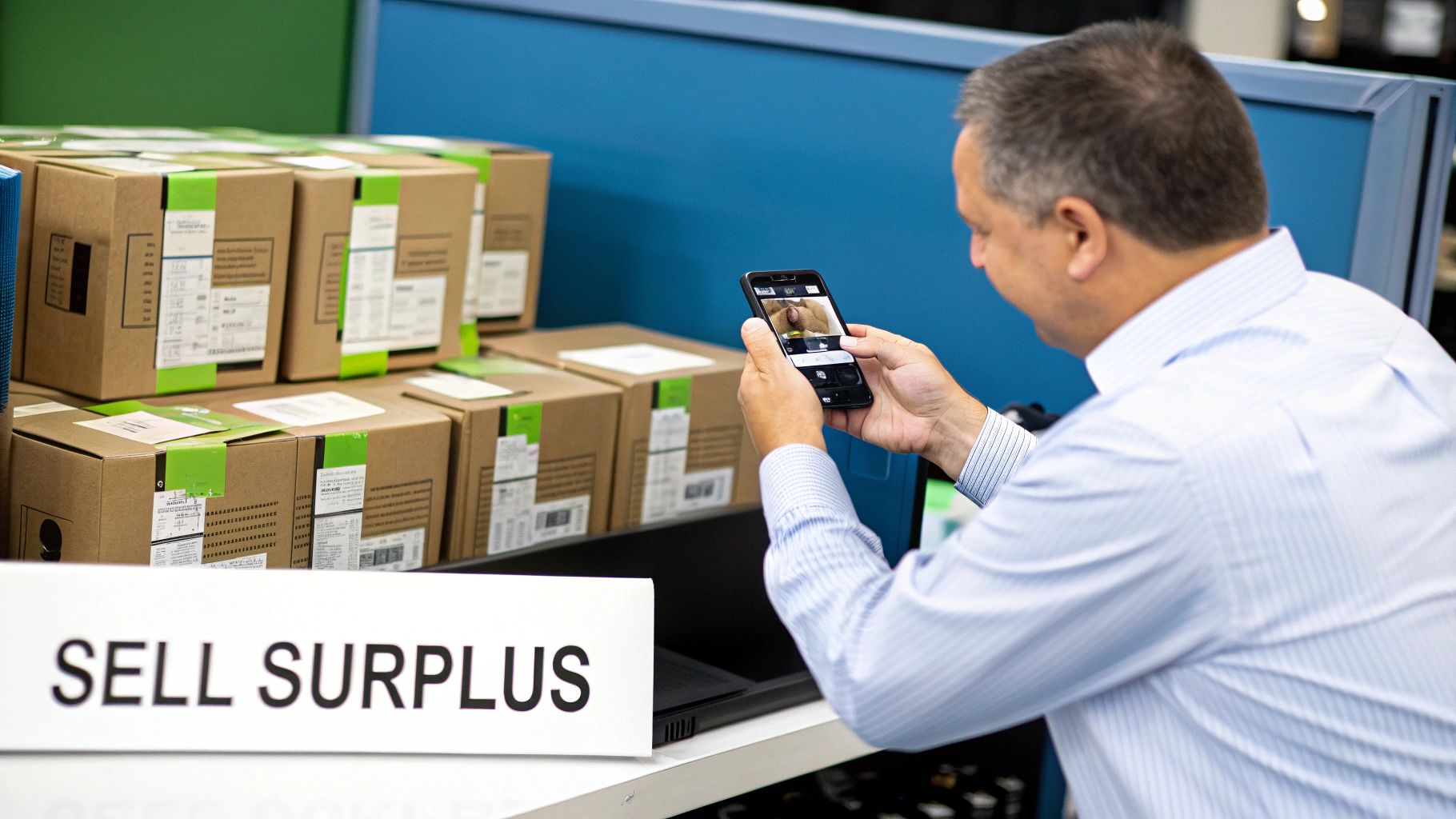
First things first, David pulls together all the surplus supplies. He does a quick sort, separating the high-value toner from the ink cartridges and checking their expiration dates. He lines everything up on a table and snaps a few clear photos with his phone, making sure the box and part numbers are easy to see.
Next, he hops on the Toner Connect website. Rather than tediously typing out a long list of model numbers, he just uploads the pictures he took directly to the online submission form at https://tonerconnect.net/sell-unused-toners/submit-form. The whole thing takes him less than five minutes.
A couple of hours later, an email hits David's inbox. It's a competitive, no-obligation quote from Toner Connect, breaking down the exact buyback price for every single item. He's happy with the numbers and accepts the offer.
Shipping And Getting Paid
As soon as he accepts, another email arrives with prepaid and insured FedEx shipping labels. David prints them, grabs a sturdy box, and packs the cartridges carefully to keep them safe. He seals it up, slaps the label on, and drops it at his local FedEx spot—shipping is completely covered, so it costs him nothing.
David needs the money for his department’s budget pretty quickly, so he chooses a PayPal prepayment. The cash lands in his account before the box has even left his city. He also had the option of Zelle, a digital check, or a traditional paper check, all of which get processed the same business day the shipment arrives for inspection.
The entire process was painless. From finding the old cartridges to getting paid, David turned dormant assets into cash and freed up precious storage space. To avoid this happening again, it's smart to look into strategies to turn excess inventory into profit and keep supplies from becoming a financial headache in the first place.
Frequently Asked Questions
When you're looking to sell surplus printing supplies, a few questions always pop up, especially when you're sorting through toner and ink. I've handled these queries for years, so here are some straight answers to help office managers and resellers like you get the most value from your inventory.
Why Do You Only Buy OEM Toner And Ink?
It really comes down to a matter of trust and quality. We only purchase OEM (Original Equipment Manufacturer) supplies because they offer the reliability and performance our buyers count on. Think about it: when a business invests in a genuine HP toner, they expect it to work perfectly every time without damaging their equipment.
Third-party and remanufactured cartridges just don't offer that same guarantee. Their performance can be all over the map, sometimes causing poor print quality or even printer errors. This is exactly why genuine OEM products command a much higher resale value.
What If My Cartridge Box Is Slightly Damaged?
We get it—not every box that's been sitting in a supply closet is going to look brand new. We review box conditions on a case-by-case basis. Minor cosmetic flaws, like a scuff from being moved or a slightly dinged corner, are usually fine as long as the factory seal is still completely intact.
The line is drawn at major damage. If a box has significant tears, water damage, heavy writing on it, or a broken seal, we can't accept it. At that point, it’s no longer considered a new item.
Here’s a real-world example: A box with a small crease from being at the bottom of a stack? Probably okay. A box with a big, ugly shipping label ripped off, taking the product details with it? That’s going to get a lower offer or be rejected. Sending us clear photos is the best way to get an accurate quote upfront.
How Is The Buyback Price Determined?
Our offers are based on real-time market conditions to make sure you’re getting a competitive price. For both toner and ink, the biggest factor is the current market demand for that specific model number.
For ink cartridges, the expiration date is king. The further out that date is, the more the cartridge is worth. An ink cartridge expiring in 18 months will always fetch a higher price than one that expires in just 12 months.
With toner, the expiration date isn't an issue, so its value depends more on the age of the printer it fits and the overall condition of the box.
For a deeper look into the industry and what drives value, you can Read articles on toner and cartridge insights. If you have questions about our specific process, our company's comprehensive FAQ page has more details.
Ready to turn your surplus toner and ink into cash? At Toner Connect LLC, we make the process simple, fast, and profitable. Submit your list today for a free, no-obligation quote and see how much your unused supplies are worth. https://tonerconnect.net