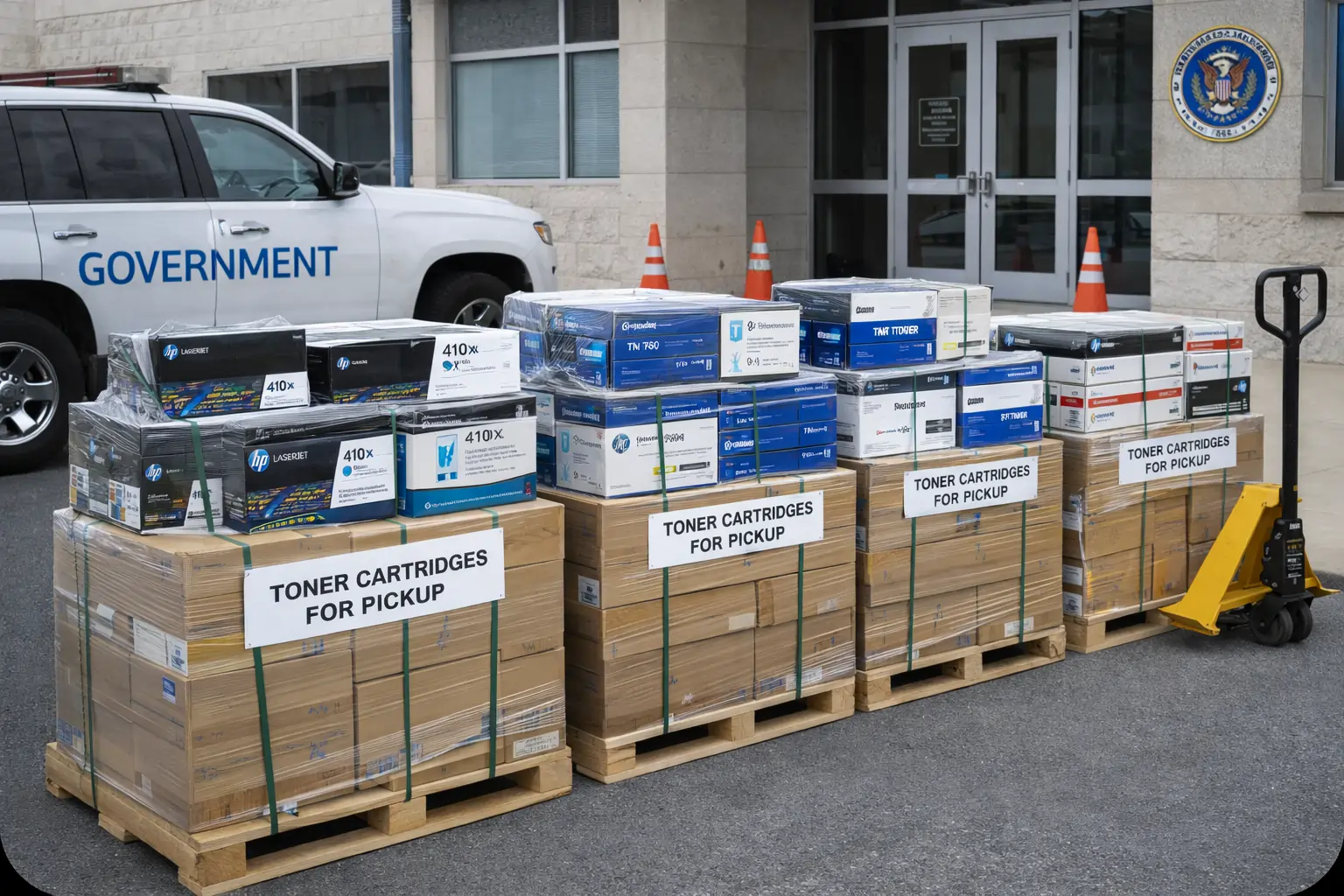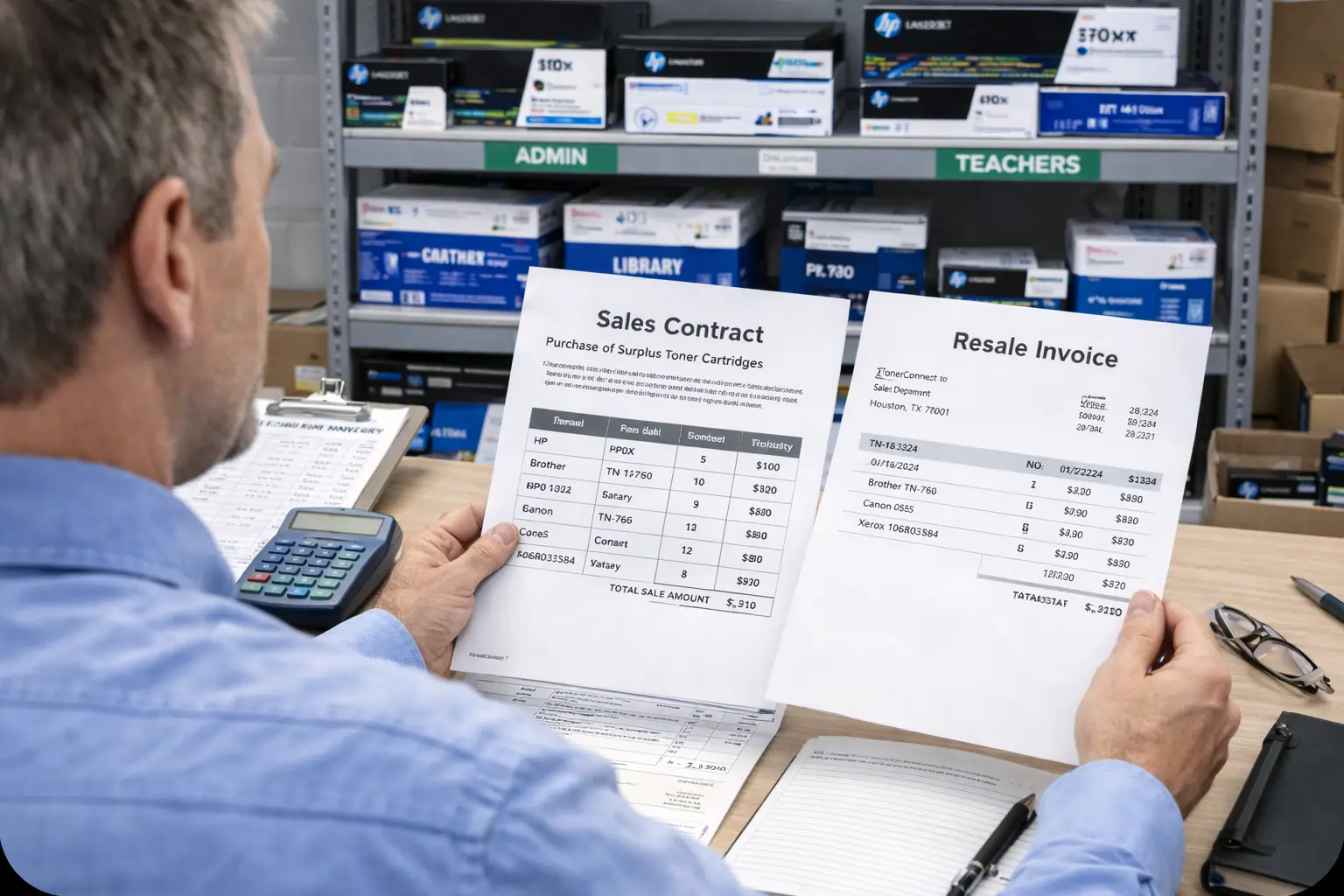
Selling your surplus toner the right way starts with a formal, documented policy. For any school or government agency, this is your roadmap—it makes sure every step is transparent, compliant, and actually designed to get the most money back from assets you’d otherwise just throw away. A solid policy can turn a cluttered supply closet into a predictable source of cash.
Every school district and government office has one: that overflowing supply closet, packed to the gills with unused toner cartridges. This isn’t just a storage headache; it’s a real financial drain and a potential compliance nightmare. Without a formal plan, those valuable assets just sit there, quietly losing value until they’re worthless.
This kind of surplus piles up in predictable ways. Maybe a scheduled printer fleet upgrade makes hundreds of old cartridges obsolete overnight. Or perhaps a well-meaning purchasing agent buys in bulk to get a discount, only for printing needs to shift a few months later. I’ve seen it happen time and again, leaving behind a stockpile of valuable inventory.
Just ignoring this pile of surplus toner has very real consequences. I’ve worked with school districts that discovered thousands of dollars in obsolete cartridges after a technology refresh—a direct hit to an already tight budget. That’s money that could have bought new textbooks, supported a sports team, or funded teacher training.
And it’s not just about the money you’re losing. There are serious regulatory pressures to consider. Government policies are cracking down on how electronic waste is handled. Globally, around 1.3 billion toner and inkjet cartridges are used each year, but less than 30% actually get recycled, which contributes to a massive landfill problem.
Laws like the Resource Conservation and Recovery Act (RCRA) in the U.S. require public entities to manage this type of universal waste properly, so just tossing them out can be a compliance violation. You can explore more data on recycling impacts to see the bigger picture.
The real risk isn’t just the money you lose by not selling—it’s the potential liability from improper disposal and the operational drag of managing dead inventory. A formal policy mitigates both.
A clear, actionable policy is the essential first step to managing these assets responsibly and, most importantly, profitably. It creates a standardized process for identifying, inventorying, and selling surplus toner, turning a forgotten liability into a reliable revenue stream.
Taking the time to build a structured approach offers some significant wins:
The table below starkly contrasts the two approaches. It’s not just about making money; it’s about avoiding real operational and financial headaches.
| Area of Concern | Risk without a Policy | Benefit with a Formal Policy |
|---|---|---|
| Financial | Significant revenue loss from depreciating assets. Potential for theft or unrecorded disposal. | Maximizes return on assets. Creates a predictable, supplementary revenue stream. |
| Compliance | Risk of violating environmental regulations (e.g., RCRA) and incurring fines for improper disposal. | Ensures adherence to all local, state, and federal disposal and recycling mandates. |
| Accountability | No clear audit trail. Public assets “disappear” without documentation, raising questions of mismanagement. | Provides a transparent, documented process that satisfies auditors and stakeholders. |
| Operational | Wasted storage space. Staff time consumed by managing disorganized, obsolete inventory. | Frees up physical space and streamlines inventory management, improving efficiency. |
| Environmental | Cartridges likely end up in landfills, contributing to e-waste and violating sustainability goals. | Promotes a circular economy by ensuring cartridges are reused or properly recycled. |
Without a policy, the fate of surplus toner is left to chance—and it often ends badly, usually in a dumpster. With a policy, it becomes a strategic asset you can put to good use.
Let’s get down to brass tacks. A great idea for selling surplus toner is just that—an idea. To make it happen, you need a practical, working policy. This isn’t about creating more red tape; it’s about building a clear, functional roadmap that empowers your team to turn those dusty boxes of toner into real revenue.
Without a solid plan, even the best intentions can fizzle out into a disorganized mess, leading to lost income and, even worse, compliance headaches down the road. It all comes down to creating a process that’s simple enough for people to follow but strong enough to pass an audit.

First things first: what are you actually trying to accomplish here? Writing down your objectives gives your policy a clear purpose and makes it easy to measure success later on. Is this purely about getting the most cash back, or is being environmentally responsible just as important?
Most organizations I’ve worked with land on a few key goals:
Once you know your “why,” you need to define the scope. This just clarifies who and what the policy covers, which heads off a lot of confusion. A school district, for example, might state the policy applies to every school and administrative building.
A government agency could specify that it covers all departments, except those with unique disposal protocols already in place for sensitive items. Getting specific here is your best friend.
A policy is useless if no one follows it. For schools and government agencies, the approval process needs to be logical and transparent, pulling in the right people at the right time. If it’s too complicated, people will find workarounds. Too simple, and you risk a lack of oversight.
Think about a practical, multi-step chain of approval that makes sense for your structure:
This three-part check-in creates a natural separation of duties—a cornerstone of strong internal controls. The people on the ground confirm the physical assets, and the financial folks provide the necessary oversight. Understanding the strict rules in public sector transactions is vital. For instance, policies around federal grant compliance requirements show just how critical it is to follow the letter of the law.
Pro-Tip: Ditch the paper forms. Create a simple shared spreadsheet or a digital form for this workflow. The IT manager enters the initial details, facilities adds verification notes, and the business office marks it “Approved.” Boom—you’ve got an instant, time-stamped audit trail.
Listen, not every old cartridge sitting in a closet is a goldmine. You have to set clear acceptance standards to manage expectations and make sure your team only spends time on items that will actually sell. One of the biggest mistakes I see is organizations wasting time trying to offload unsellable inventory.
Your standards need to be black and white, leaving no room for guesswork. These rules will help your staff quickly decide what to set aside for sale versus what goes straight to recycling.
Core Acceptance Criteria
By setting these ground rules, you make the inventory process a whole lot smoother. A department can quickly sort its surplus into two piles: “sellable” and “recycle.” This simple filter ensures the inventory list you send to a buyback partner is full of items they actually want to buy. This is a crucial part of selling surplus toner the right way and not just spinning your wheels.
Once your surplus toner policy is in place, you’ve reached what is arguably the most critical step: choosing the right buyback partner. For any public institution, this isn’t just about offloading extra toner. It’s about finding a vendor whose entire process aligns with the strict standards of accountability, security, and reliability that govern the public sector.
The right partner makes everything smooth, compliant, and profitable. The wrong one? They can create a world of compliance headaches, audit flags, and financial losses. Your selection process has to be thorough, and just as importantly, it needs to be documented every step of the way. This diligence protects your institution, ensures you’re getting fair market value for your assets, and creates a transparent record that will stand up to any scrutiny.
Before you even think about contacting a potential partner, you need to build your scorecard. What really matters to your organization? A standardized checklist is the only way to compare different vendors objectively, letting you make a decision based on facts, not a slick sales pitch.
While every school district or government agency has its own unique priorities, your checklist should cover these non-negotiables:
Comparing these factors side-by-side will quickly separate the serious contenders from the rest. For instance, a vendor offering immediate payment provides a clear cash flow advantage for a school budget, which can be a game-changer compared to one that makes you wait weeks for a check.
A polished website and a friendly voice on the phone are nice, but they don’t tell the whole story. Real due diligence means you have to verify a company’s claims and operational integrity for yourself. Once you’ve shortlisted a few potential vendors from your checklist, it’s time to start digging.
First, ask for references. Be specific. Tell them you want to speak with other schools, municipalities, or government agencies they’ve worked with. When you call those references, ask direct questions. Were payments on time? Did the final payout consistently match the initial quote? Was communication professional and clear throughout the process?
Next, get your hands on their contract or terms of service and scrutinize it. You’re looking for specific clauses that protect your interests, not theirs.
A solid buyback agreement should explicitly detail the process for handling discrepancies. If the vendor’s inspection finds fewer items or different conditions than you reported, the contract must outline a clear and fair dispute resolution process.
Look for crystal-clear language covering insured shipping, liability for the goods while they’re in transit, and a precise timeline for inspection and payment. Any ambiguity in a contract is a major red flag. A transparent, trustworthy partner will have absolutely no problem putting their promises in writing.
After you’ve compared vendors on your scorecard, checked their references, and reviewed their contracts, the right choice should be pretty clear. The ideal partner won’t just dangle the highest price in front of you; they’ll provide a secure, transparent, and hassle-free process from the first call to the final payment. They should feel less like a simple buyer and more like a trusted service provider who genuinely understands the unique operational needs of public institutions.
If you’re looking to better understand the broader landscape of supply chain partners, you can learn more about toner distributors and how they operate, which provides some helpful context.
By documenting each step of your vetting process—from your initial checklist to your reference check notes and contract review—you create an unshakeable audit trail. This careful, methodical approach ensures that your surplus toner program is not only profitable but also fully compliant and built on a foundation of trust.
You’ve done the hard work of creating a solid policy and picking the right partner. Now it’s time to turn those boxes of surplus toner into actual revenue. This is where the rubber meets the road, and a well-defined process is your best friend. Having a clear, repeatable system removes the guesswork and ensures every action lines up with the transparency and accountability required in the public sector.
From the first inventory count to the final payment, the entire process should feel straightforward. This operational consistency is what makes a surplus program last. It ensures that even with staff changes or new department needs, you won’t miss a beat.
The first real step is figuring out exactly what you have. Honestly, you don’t need a complex system for this; a simple spreadsheet usually does the trick perfectly.
Let’s say a state agency’s IT department just upgraded its entire printer fleet. The facilities manager can create a shared spreadsheet with just four key columns: Model Number, Quantity, Box Condition, and Expiration Date (for inkjets). Team members from different floors can then jump in and log the surplus cartridges from their supply closets. In just a few minutes, you have a single, accurate list.
With your inventory list complete, you’re ready to get a quote. A reputable buyback partner will make this part easy. Usually, all you have to do is upload your list through an online form to get a fast, no-obligation offer. This is a crucial part of selling surplus toner the right way because it creates a documented starting point for the transaction. For instance, you can submit your surplus toner list for a quick quote to get an immediate sense of your inventory’s value.
This infographic gives a bird’s-eye view of how to evaluate partners before you even get to this stage.

As the visual shows, a good outcome starts with a methodical approach: use a checklist, compare your options, and then lock in the contract.
How you pack those cartridges matters more than you’d think. Toner cartridges can be surprisingly delicate. One bad drop can crack the casing or damage internal parts, turning a valuable item into a worthless one.
To avoid this, pack the cartridges snugly inside sturdy, double-walled cardboard boxes. Use packing material like bubble wrap or crumpled paper to fill any gaps so nothing can shift around in transit. A common mistake is shipping cartridges in just their original boxes—they simply aren’t designed to hold up to the abuse of modern shipping. Sometimes, institutions find it useful to look into commercial storage solutions to safely hold surplus items before they’re ready to be shipped out.
The most critical part of the shipping process? Your vendor must provide prepaid, fully insured shipping labels. This is absolutely non-negotiable. If the shipment isn’t insured, your institution is on the hook for any loss or damage, which could easily wipe out its entire value.
A trustworthy partner takes all that risk off your plate. They’ll email you prepaid FedEx or UPS labels that are fully insured. All your team needs to do is print them, stick them on the securely packed boxes, and schedule a pickup.
For any school or government agency, the paper trail is everything. Your documentation has to be perfect to pass an audit and show complete transparency. You need a record of every single step, from that first inventory spreadsheet to the final payment hitting your account.
This isn’t just about internal policy. Globally, government initiatives promoting responsible surplus management are driving major market growth. The ink and toner cartridge market is projected to grow at a 10.36% CAGR through 2032. Selling your surplus to a vetted buyer ensures you’re part of a legitimate, sustainable ecosystem that aligns with public accountability and environmental goals, such as UN Sustainable Development Goal 12.
To make sure your records are airtight, keep a dedicated file for every surplus sale. It should include these five documents:
By organizing these five key documents for every sale, you create a clear, chronological record that will stand up to any scrutiny. This meticulous documentation is the final, crucial step in executing your surplus toner policy the right way.
Even with a solid policy in place, the real test comes down to execution. We’ve seen firsthand where things can go sideways, and avoiding these common pitfalls is the best way to protect your school or agency’s time, money, and reputation. A small oversight can easily snowball into a major financial loss or a compliance nightmare.
By learning from where others have stumbled, you can build smarter safeguards directly into your own process. This turns potential problems into simple checkpoints, making sure your surplus toner program is both secure and profitable from day one.
One of the most common and costly mistakes is jumping on the first offer that lands in your inbox. Public accountability is a big deal, and that means you have to prove you did your homework to get the best value for public assets. Accepting a single, unvetted offer fails this critical test and almost always means you’re leaving money on the table.
We once worked with a municipal clerk’s office that was just eager to clear out two pallets of surplus toner. They accepted an offer from a local electronics buyer without checking anywhere else. It wasn’t until later they found out their toner was worth nearly 40% more than what they were paid. That lack of a competitive process led to a direct, and completely avoidable, loss of public funds.
The Fix: Your policy needs to be firm on this: mandate at least two to three competing quotes from reputable buyback vendors for any sale. This simple step creates competition, documents your effort to get the best price, and gives you a clear, audit-proof justification for the vendor you choose.
Shipping logistics often get treated as an afterthought, but this is a huge point of risk. If a vendor doesn’t provide fully insured shipping, your institution is on the hook for anything that happens to those goods in transit. Think about it—one damaged pallet or a lost shipment could wipe out the entire value of your sale in an instant.
Imagine a school district ships out $5,000 worth of surplus toner. The truck gets into an accident, and the entire shipment is a total loss. Because the vendor’s shipping label was uninsured, the district got zero. That loss falls 100% on them.
The Fix: Make free, prepaid, and fully insured shipping a non-negotiable term when vetting partners. This needs to be spelled out clearly in your agreement. A trustworthy partner will always assume all liability the moment the carrier picks up your boxes, protecting your assets completely.
The excitement of clearing out a packed storeroom can lead people to just box everything up without a second glance. But sending expired ink, cartridges in beat-up boxes, or non-genuine products to a buyback partner just wastes everyone’s time. It can even cost you money if the vendor has to handle disposal.
We saw this happen with a county office that spent hours packing what they thought was a high-value shipment. They were shocked when the vendor rejected nearly a third of it. The culprit? A big batch of inkjet cartridges had expired six months earlier, making them completely worthless. Their staff’s time was wasted, and the final payout was a huge disappointment.
The Fix: You need a strict pre-inventory screening process based on your policy’s acceptance standards. Train your staff to specifically look for:
This quick check ensures the inventory list you send out for quotes is accurate and reflects the real sellable value. It’s a fundamental step in selling surplus toner the right way and prevents those frustrating surprises when the check arrives.
Even with the best policy in place, real-world questions always pop up. It’s one thing to have a process on paper, but another to handle the little details that come with selling surplus assets in the public sector. Let’s walk through some of the most common questions we hear from schools and government agencies.
Getting these details right builds confidence and makes sure your program runs smoothly from start to finish. We’ll cover everything from mixed inventories to what to do when a shipment doesn’t go exactly as planned.
It’s completely normal to have a mix of both. Any good buyback partner can handle them, but your team needs to understand one critical difference: inkjets have expiration dates.
When you’re putting together your inventory list, make a note of the expiration date printed on every single inkjet box. Most buyers won’t touch ink that has less than 12 months of shelf life remaining. Toner, being a dry powder, doesn’t expire, which makes it much easier to deal with.
Imagine your school’s IT closet has 50 HP toner cartridges and 30 HP inkjet cartridges. The toners are good to go as long as they’re sealed. But for the inkjets, someone needs to physically check all 30 boxes. If 10 of them expire in six months, you’ll want to pull those out and only request a quote for the remaining 20.
This is a big one for the business office. For a public school, city, or state agency, the revenue you generate from selling surplus assets is generally not considered taxable income.
That said, you absolutely must run this by your institution’s financial advisor or legal counsel. They’ll confirm exactly how to classify and record the funds, which is crucial for staying audit-proof.
Usually, the money is treated as cost recovery or miscellaneous revenue. It should be deposited straight into the institution’s general fund, just as your surplus policy likely dictates.
Transparency is non-negotiable in public sector dealings. So, what happens if you ship 100 cartridges, but the vendor’s receiving report says only 98 were in sellable condition? This is where having a solid partner and a clear contract really pays off.
A reputable buyback company will provide a detailed inspection report, complete with photos, explaining exactly what happened. Maybe a couple of boxes were crushed in transit, or an open-box item was accidentally included.
Your policy should have a simple workflow for this:
This is precisely why insured shipping is a must. If the damage happened in transit, you can file a claim and recover the loss, protecting the value of your assets. For more answers to common questions, you can always check out a detailed surplus toner FAQ page.
Ready to turn your surplus toner into revenue with a partner that understands the needs of public institutions? Toner Connect LLC provides a simple, secure, and transparent buyback process. We offer fast quotes, free insured shipping, and prompt payment, ensuring your school or agency maximizes its return while staying fully compliant. Request your free, no-obligation quote today!