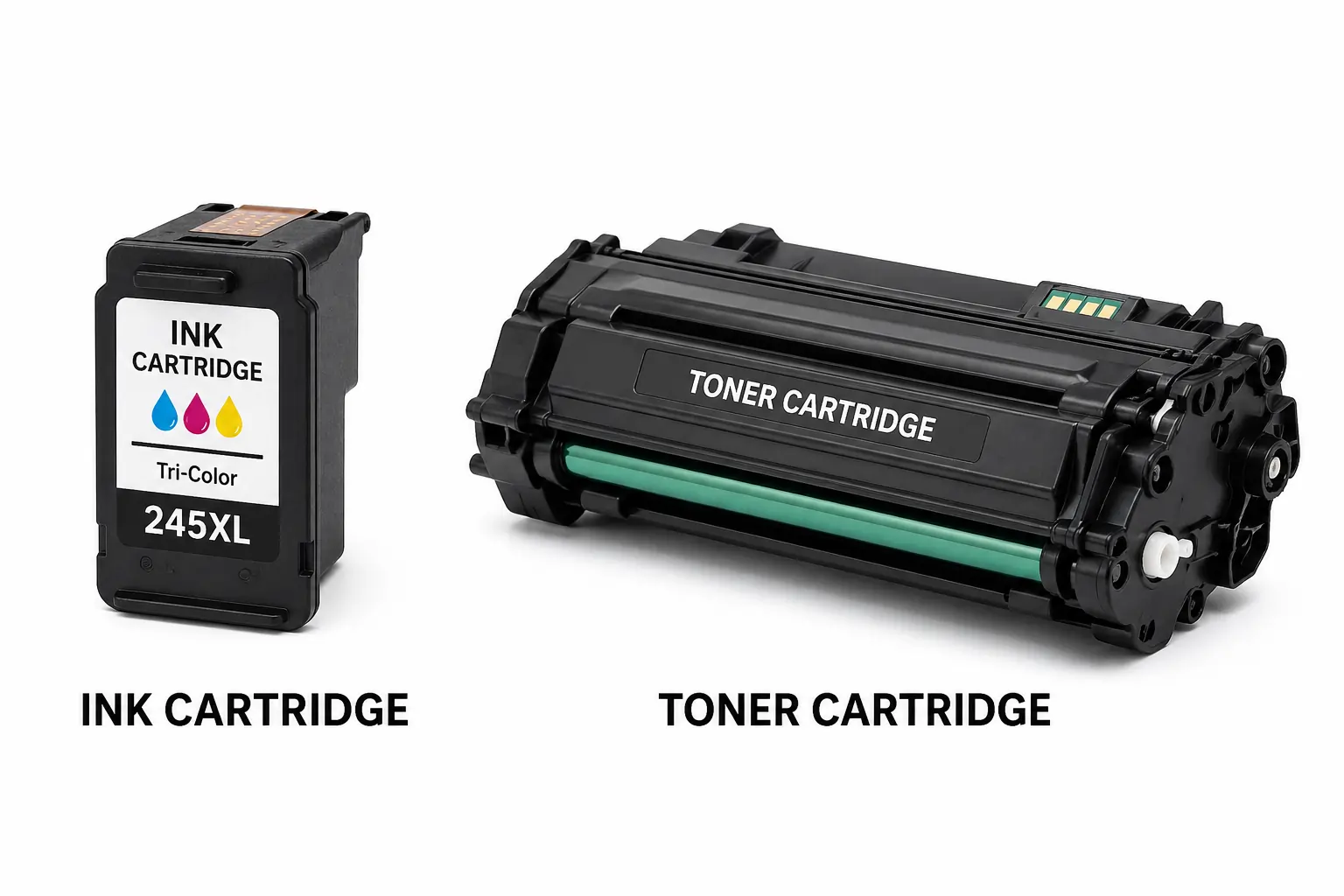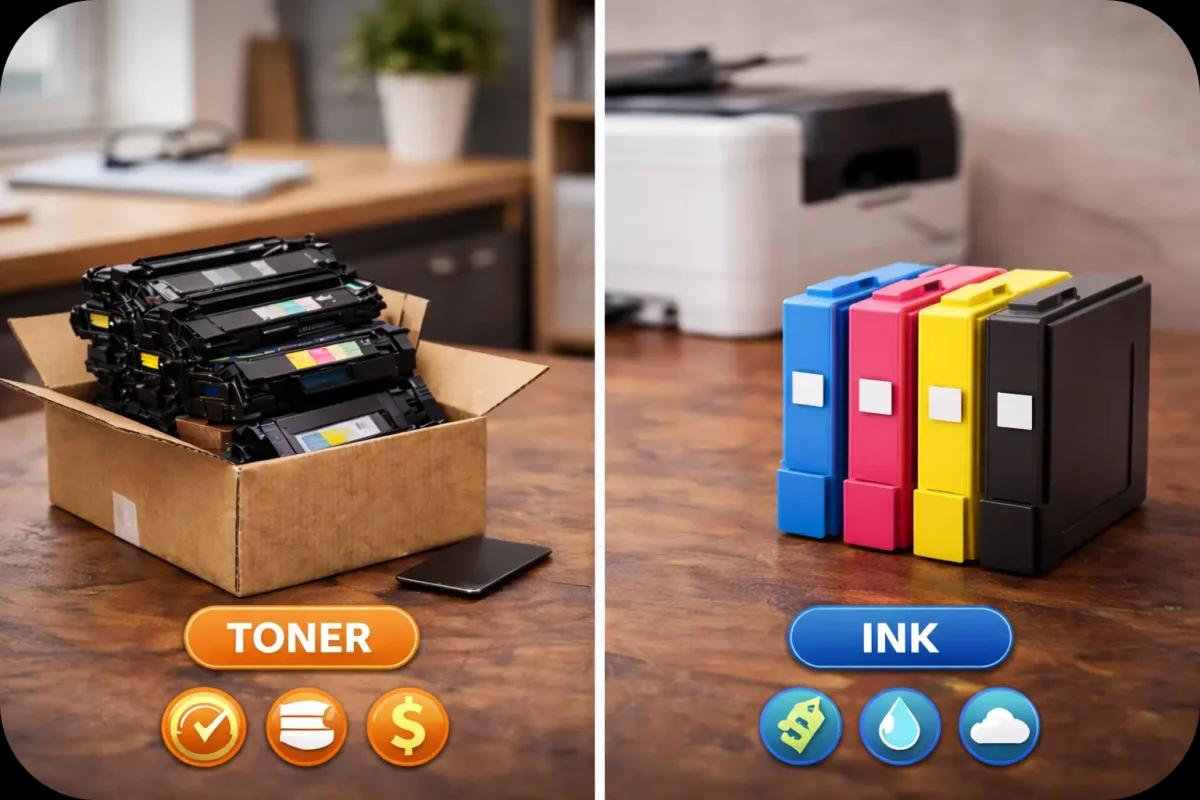
The whole toner cartridge vs ink debate really boils down to one thing: ink cartridges contain liquid for inkjet printers, while toner cartridges use a fine powder for laser printers. It seems simple, but that one difference changes everything—from how fast a page prints to what it costs you in the long run.

Choosing between toner and ink isn't just about the cartridge; it's about picking the right printing technology for the job. Each one is built for different needs. For example, are you a photographer printing a vibrant photo book for a client, or are you an office manager churning out a 500-page report that needs to be done now? Understanding how they work is the first step to making a smart, cost-effective decision.
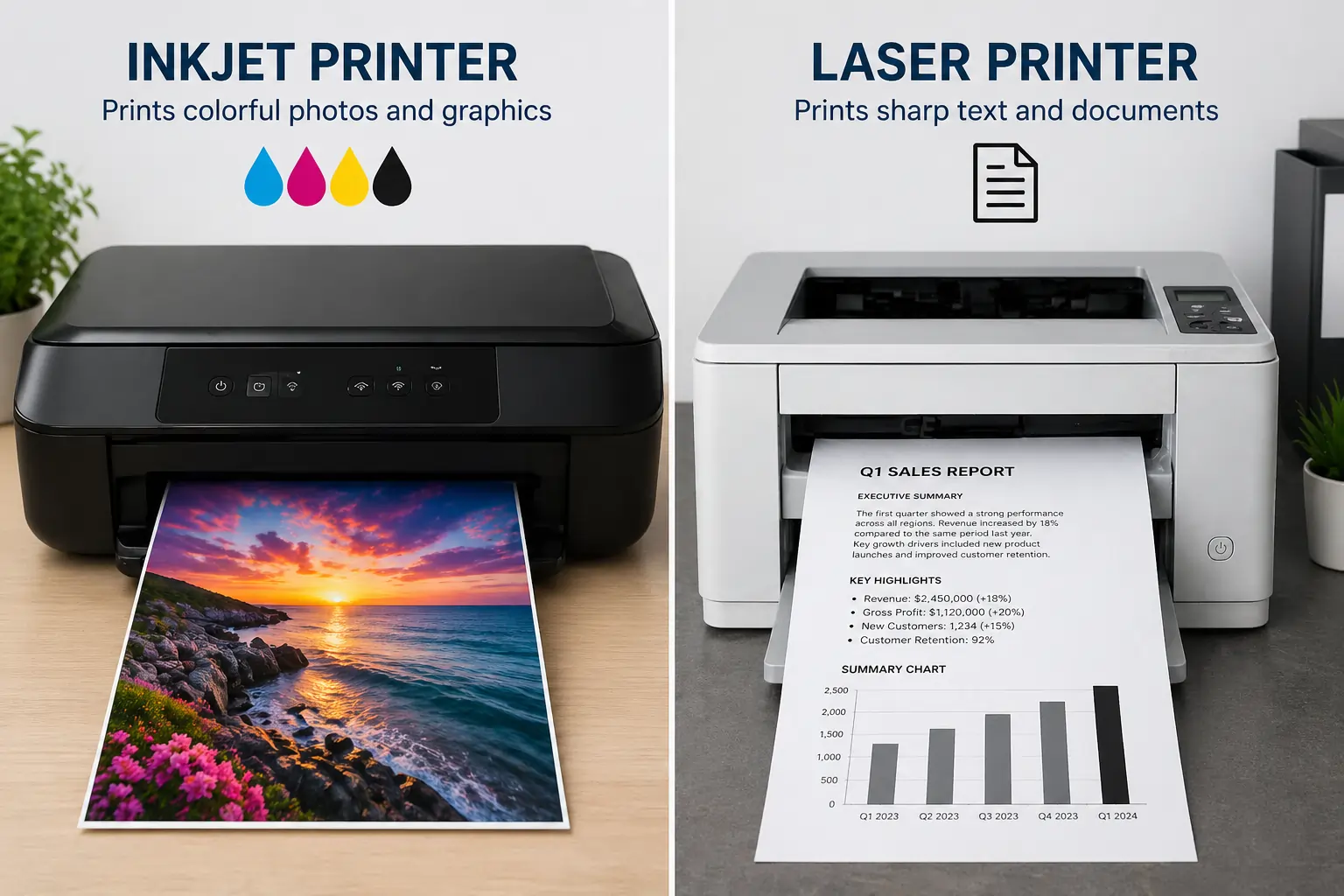
Inkjet printers operate like incredibly precise artists. They spray thousands of microscopic droplets of liquid ink onto the paper, building your image dot by dot. This process is perfect for blending colors seamlessly, which is why inkjets are the go-to for printing detailed, high-resolution photographs. For instance, a graphic designer printing a final proof of a brochure needs that level of color fidelity to ensure brand colors are perfect.
Laser printers, on the other hand, take a completely different approach. They use toner, a dry powder, along with static electricity and heat. A laser etches an image onto a rotating drum, creating a static charge that attracts the toner particles. As the paper passes by, the toner is transferred and then instantly fused to the page by a hot fuser unit. That’s why pages come out of a laser printer warm, dry, and completely smudge-proof. A practical example is a law firm printing contracts where a smeared signature is unacceptable.
This technological split is a huge factor in the global printing supplies industry. The market for ink and toner cartridges hit an impressive USD 19.116 billion in 2023. Ink still holds the larger share, mainly due to its popularity for home use and photo printing. However, toner is making serious headway in business environments where speed and high-volume output are non-negotiable. You can learn more about the latest ink and toner market trends to see where things are headed.
Key Takeaway: Think of it this way: Ink is for detailed, vibrant color work like professional photos and marketing materials. Toner is the workhorse for speed, efficiency, and crisp text, making it ideal for any busy office printing hundreds of invoices.
For a clearer picture, let's break down the main differences side-by-side. The table below gives you a quick snapshot to help you decide which technology fits your needs.
| Feature | Ink Cartridge (Inkjet) | Toner Cartridge (Laser) |
|---|---|---|
| Technology | Sprays liquid ink through micro-nozzles | Fuses dry powder onto paper with heat |
| Initial Cost | Printer and cartridges are generally cheaper | Printer and cartridges have a higher upfront cost |
| Cost-Per-Page | Higher due to lower page yield | Significantly lower, especially for high-yield cartridges |
| Print Speed | Slower, especially for high-quality color prints | Much faster, ideal for high-volume jobs |
| Best For | High-quality photos, color graphics, low-volume use | Sharp text documents, high-volume printing, office reports |
| Smudging Risk | Higher; prints can smudge if they get wet | Very low; prints are durable and water-resistant |
| Shelf Life | Shorter; ink can dry out or clog print heads | Longer; powder is stable and does not dry out |
Ultimately, choosing between ink and toner depends entirely on what you print, how often you print, and your budget. Both have their place, but one is almost always a better fit for a specific situation.

When you get down to it, the toner cartridge vs ink debate starts with one simple fact: one uses a dry powder, and the other uses a liquid. That single difference is the foundation for everything that follows—from how sharp your text looks to how long your prints will last. Before you can pick the right one, you have to know what’s happening inside the machine.
Inkjet printers are masters of precision. They shoot thousands of incredibly small droplets of liquid ink right onto the page through microscopic nozzles. This process is perfect for blending colors seamlessly, which is why inkjets excel at creating the vibrant images and subtle gradients you see in high-quality photos.
Think of a marketing agency that needs to print a glossy brochure for a client. For them, an inkjet is the only way to go. It’s all about hitting those exact brand colors and making product photos pop off the page.
Laser printers take a completely different route called electrophotography. It’s a fascinating process. A laser beam etches an electrostatic blueprint of your document onto a light-sensitive drum. As this drum rotates, it picks up toner—a fine powder made of plastic particles—which sticks only to the electrostatically charged areas the laser just "drew."
Next, the paper rolls past the drum, and the toner image is transferred onto it. The final step is crucial: the paper zips through a fuser, which is essentially a pair of hot rollers. This heat melts the toner, fusing it permanently into the fibers of the paper.
This fusion process is the secret to why laser-printed pages come out of the machine dry, sharp, and smudge-proof. For an office printing stacks of legal contracts where a smeared signature is a non-starter, laser technology is the undisputed champion.
If you're interested in the bigger picture of print technology, exploring the differences between digital vs. offset printing can give you a wider view of the quality and cost trade-offs in the industry.
The technology inside the printer has real-world consequences that you'll notice immediately. These differences are what should guide your decision.
Durability and Water Resistance: An inkjet print is vulnerable to water. A single drop of moisture can cause the water-based ink to bleed and run. For example, a student’s homework assignment can be ruined by a single spilled drink. A toner print, on the other hand, is basically melted plastic bonded to paper, making it inherently water-resistant and much tougher for important documents like invoices or archival records.
Cartridge Clogging and Maintenance: Here’s the Achilles' heel of ink: it dries out. If you don’t use your inkjet printer often enough, the ink can clog the tiny printhead nozzles. This leads to streaky prints and forces you to run wasteful cleaning cycles. It's a real pain for a home user who only prints concert tickets every few months.
Toner Stability: Toner, being a dry powder, has no such problem. A toner cartridge can sit unused in a printer or on a shelf for months—even years—and still work perfectly when you need it. This reliability makes it the go-to for offices with both high-volume and occasional printing needs, like a school that prints heavily during the semester but is idle over the summer.
Getting a handle on these technical basics is the key to making a smart buy. For more practical advice on managing your office's print supplies, check out the Toner Connect blog at https://tonerconnect.net/blog, where our team shares industry insights. In the end, choosing between toner and ink is all about matching the right technology to what you actually print.

When you’re weighing a toner cartridge vs ink, performance is where the rubber really meets the road. The technical differences between a dry powder and a wet liquid aren't just academic—they directly impact what you see on the page and how long you have to wait for it.
When it comes to print quality, the "better" choice truly depends on the job at hand. For anything that demands gorgeous color and fine detail, inkjet printers are the hands-down winners. They work by spraying microscopic droplets of liquid ink, allowing them to blend colors and create smooth gradients with incredible precision.
This makes them indispensable for creative work. A professional photographer needs an inkjet to produce portfolio prints that do justice to the richness and depth of their images. Likewise, a graphic designer printing a final proof of a brochure needs that level of color fidelity.
Flip the coin, and you'll find laser printers and their toner cartridges excel at producing impeccably sharp text. The process of fusing toner powder onto the page creates crisp, clean letterforms with no bleeding, even at tiny font sizes.
This is a massive advantage in any professional environment. Picture a law firm printing out a 100-page contract; the smudge-proof text from a laser printer ensures every clause is perfectly legible and the document looks sharp from beginning to end. Another practical example is a pharmacy printing prescription labels where tiny text must be perfectly clear.
Key Differentiator: Ink owns photo printing and complex color work, delivering vibrant, true-to-life images. Toner dominates text-based documents, providing unmatched sharpness and durability for professional use.
The market has clearly split along these lines. The global ink-cartridge market, valued at USD 21.8 billion in 2025, is expected to nearly double by 2035. This growth is largely fueled by sectors like finance and healthcare that need a mix of sharp text and some color capability. You can find more insights on the ink cartridge market's expansion to see how it stacks up against toner.
In the speed department, the comparison isn't nearly as nuanced—laser printers are in a different league entirely. Even a basic laser printer can easily churn out 20-30 pages per minute (PPM), and high-end office models can scream past 100 PPM. For any high-volume setting, this is a game-changer.
Think about a busy accounting firm during tax season. Printing multi-page client returns demands speed. A laser printer can get a 50-page document printed in just a couple of minutes, freeing up staff to move on to the next critical task.
Inkjet printers, on the other hand, are much more methodical. While they've gotten faster over the years, a typical home inkjet might only manage 5-10 color pages per minute. That pace is fine for printing a homework assignment or a few photos here and there.
But for a small business printing daily invoices and shipping labels, the lag from an inkjet can quickly create a productivity bottleneck. The time spent waiting for documents really adds up, making a laser printer a far more practical choice for business operations.
Let’s look at how this plays out in the real world:
High-Volume Office: A university admissions office printing thousands of acceptance letters.
Home User: Printing a 10-page color school project.
Ultimately, your choice boils down to balancing visual richness against the need for rapid output. If your work hinges on flawless color, the slower pace of an inkjet is a trade-off you’ll gladly make. But if getting documents printed quickly is the priority, nothing beats the raw speed of a toner-based laser printer.
Don't be fooled by the sticker price on a printer cartridge. Whether you're comparing toner cartridges vs. ink, the initial purchase is just the first expense in a much longer financial story. To really get a handle on what you'll spend over the life of a printer, you have to look past the upfront cost and dig into the long-term economics.
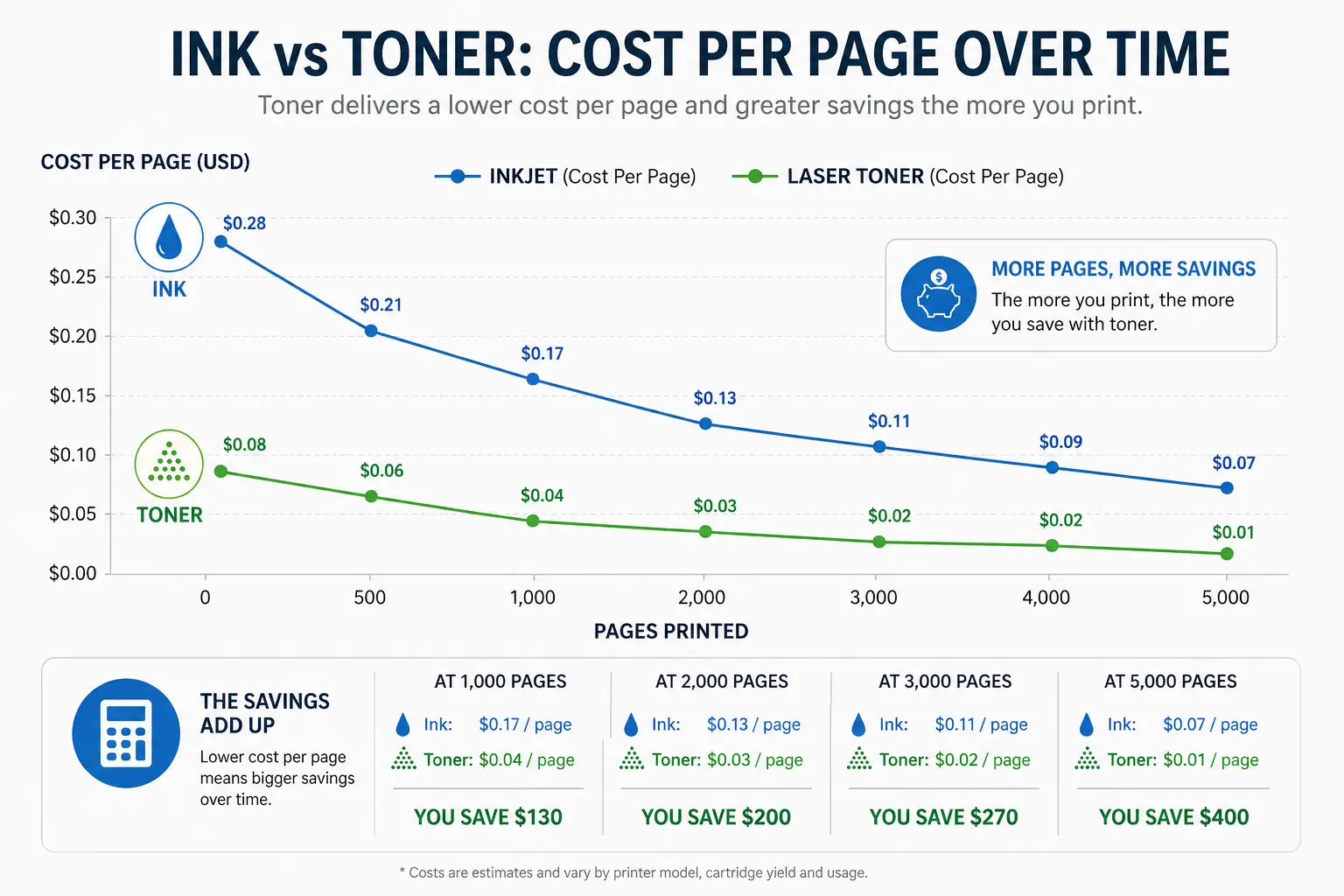
The single most important number to know here is page yield. It’s just what it sounds like: the total number of pages a single cartridge can print before it’s empty. A higher page yield almost always means a lower cost for every page you print, and that’s where the real savings kick in.
This is where the financial gap between toner and ink becomes a chasm. The numbers don't lie, and they heavily favor toner for anyone printing more than a handful of pages a month.
Let's walk through a practical, real-world scenario. Imagine you're choosing between two printers for your small business.
At a quick glance, the $25 ink cartridge looks like the smart, budget-friendly choice. But for a business that's printing daily invoices, shipping labels, and reports, the long-term savings with the laser printer are undeniable. Printing those 3,000 pages would cost $300 with ink but only $90 with toner—that's $210 saved on just one cartridge cycle.
The Hidden Cost of Infrequent Printing: Ink's liquid nature is its biggest downfall for sporadic users. If a printer sits idle for weeks, the ink can dry out, clog the delicate nozzles, and become totally useless. You're then forced to buy a replacement, even if the old cartridge was nearly full.
This dynamic is well-established in the market. While commercial sectors are the biggest consumers of both ink and toner, inkjet printers dominate the overall market share because their low initial cost and strong color performance make them popular for homes and small offices. Still, laser printers are the go-to for high-volume environments for one simple reason: their low per-page cost delivers far better value over time. You can discover more insights about the ink and toner market to see how these trends play out.
The "use it or lose it" reality of ink is a major hidden expense that most people don't think about until it's too late. An inkjet printer needs to be run regularly—at least once a week is a good rule of thumb—just to keep the ink flowing and prevent the print heads from clogging.
This is a huge headache for a student who only prints a term paper once a month or a family that just needs to print concert tickets every now and then. They often end up running wasteful cleaning cycles (which burn through a surprising amount of ink) or replacing expensive, dried-up cartridges that were barely used. A practical example is someone trying to print a tax return in April, only to find the ink cartridges they bought at Christmas have dried out completely.
Toner, on the other hand, is a dry, stable polymer powder, which means it completely avoids this problem. A toner cartridge can sit in a printer for a year or more without any loss in quality. For a business that needs a printer to work perfectly every single time, even after a long holiday weekend, toner offers a level of reliability that ink just can't match. That peace of mind is a critical, though often unmeasured, part of the total cost of ownership.
When you're comparing toner and ink, it's easy to get fixated on the upfront cost and page yield. But one of the most practical, and often overlooked, differences is how well these cartridges hold up over time. What happens to a cartridge sitting on a shelf is a huge factor in its true cost, and the physical nature of liquid ink versus dry toner powder creates a massive gap in their long-term stability and value.
Ink cartridges are notoriously sensitive. Because they're filled with a liquid, water-based solution, they have a limited shelf life and are highly susceptible to drying out. If you don't use an inkjet printer regularly—at least once a week—the ink can evaporate inside the cartridge. Even worse, it can dry up in the printhead's microscopic nozzles, causing clogs that result in streaky prints or total print failure.
For anyone who only prints a few pages a month, this is a classic recipe for frustration. For example, you buy a new ink cartridge for a school project, use it once, and when you try to print again three months later, it’s completely unusable. You end up throwing away a cartridge that's nearly full.
Toner cartridges, on the other hand, are built for the long haul. Toner is a dry powder made of fine plastic particles, so there's nothing to evaporate or dry out. This inherent stability gives toner an exceptionally long shelf life. A genuine, factory-sealed toner cartridge can sit in a supply closet for two years or more and work perfectly when you finally need it.
This reliability makes toner the clear winner for businesses that buy supplies in bulk to get better pricing or to ensure they never run out mid-project. You can stock up on toner without worrying that your investment will be worthless in six months.
Real-World Scenario: An accounting firm stocks up on toner for its laser printers before tax season begins. A cartridge bought in January will perform just as reliably in December. A similar stockpile of ink cartridges would be a gamble, with a high risk of some drying out before they're ever used.
This is where toner’s stability really pays off. It creates a significant advantage that most people don't consider: resale value. Companies frequently upgrade their printer fleets, often leaving behind a surplus of sealed, unused cartridges for machines they no longer have. While old ink cartridges are essentially worthless, sealed OEM toner cartridges are a genuine asset.
Buyback companies actively purchase this surplus inventory. Because toner is so durable, as long as a cartridge is a genuine OEM product in good condition, it holds its value and can be resold to another business.
For any business managing an inventory of supplies, this is a crucial financial point. That box of unused toner in the back of the closet isn't just taking up space—it's cash you can reclaim. A practical example is a company that closes one of its branch offices; they can sell the leftover toner from that location instead of just throwing it away.
If your business has surplus printer supplies, you can easily get a quote for your unused toner cartridges at https://tonerconnect.net/sell-unused-toners/submit-form and turn that dormant inventory back into working capital. It’s a straightforward way to reduce waste and recover funds that would otherwise be completely lost.
Making the final call in the toner cartridge vs ink debate really comes down to one simple question: what are you actually printing day-to-day? If you set aside the technical specs for a moment and just focus on your real-world needs, the right choice usually becomes pretty clear.
For some people, the answer is obvious. For others, it's about striking the right balance between the initial cost of the printer and the long-term value you get from its supplies. Let's walk through a few common scenarios to see how these differences actually play out.
If you're a student printing essays, research papers, and the occasional color photo for a school project, an inkjet printer is almost always the right fit. Why? Because the upfront cost for both the printer and the ink cartridges is significantly lower, making it an easy, budget-friendly choice to get started.
Sure, the cost-per-page is higher than a laser printer, but if your print volume is low, you won't feel that pinch nearly as much as a busy office would. Just remember that liquid ink can dry out over time, so it’s smart to print a page at least once a week to keep the printhead nozzles clear and working properly.
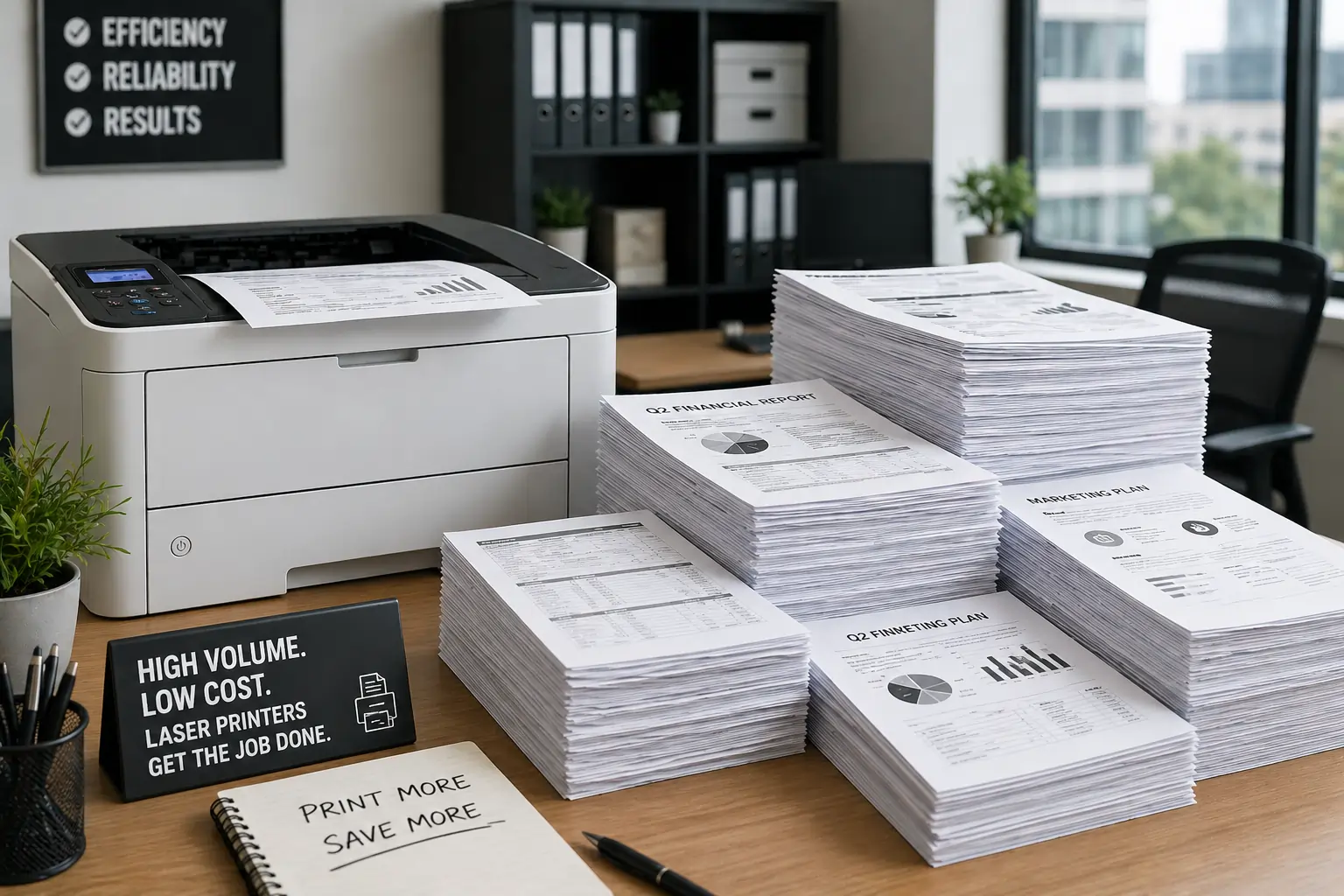
Now, picture a home office that's churning out hundreds of black-and-white shipping labels, invoices, and contracts every month. In this situation, a monochrome laser printer that uses toner is the undisputed champion. The printer itself might cost a bit more upfront, but the long-term savings are massive.
A toner cartridge's cost-per-page is just a fraction of what you'd pay for ink, and its incredibly high page yield means you’ll be swapping out cartridges far less often. On top of that, the lightning-fast print speeds are a huge productivity booster when you’re trying to get orders out the door.
Practical Example: An Etsy seller who prints 50 shipping labels a day will easily save hundreds of dollars a year with a laser printer. The speed and smudge-proof text are absolutely essential for a smooth and professional workflow.
When print quality is non-negotiable, high-end inkjet printers are the go-to tool for the job. Think about a marketing team producing glossy, full-color brochures or a photographer printing portfolio images—they need the vibrant colors and subtle gradients that only liquid ink can deliver.
These professional-grade inkjets are built from the ground up for superior color accuracy and fine detail. While they are definitely more expensive to operate, the stunning visual results more than justify the investment for any business where a powerful image is paramount.
This decision tree breaks down the key storage differences between ink and toner, which are rooted in their unique physical properties.

As the infographic shows, toner's stable powder form gives it a major advantage for long-term storage. Ink, on the other hand, requires more careful management to keep it from drying out.
To make it even simpler, here’s a quick-reference table that matches common printing needs with the technology best suited for the task.
| User Profile or Primary Need | Recommended Technology | Key Reason |
|---|---|---|
| Students & Home Users | Inkjet | Low upfront cost for infrequent, mixed-use printing. |
| High-Volume Text Printing | Laser (Monochrome) | Unbeatable cost-per-page and speed for documents. |
| Small Business Operations | Laser | High page yield and reliability for daily business needs. |
| Photo & Graphics Professionals | Inkjet (High-End) | Superior color accuracy and image detail are essential. |
| Scrapbooking & Crafts | Inkjet | Versatility to print on various paper types and sizes. |
| Archiving & Records | Laser | Toner doesn't smudge or fade, ensuring document longevity. |
Ultimately, by aligning your actual printing habits with the right technology, you can make sure you’re getting the best possible performance, quality, and value for your specific needs.
When you're dealing with printer supplies day in and day out, a few practical questions always seem to pop up. Let's clear up some of the most common ones that come up in the toner cartridge vs. ink debate.
Absolutely not. It's like trying to put diesel in a gasoline engine—the two systems are fundamentally different and completely incompatible.
Inkjet printers are designed to spray tiny droplets of liquid ink. Laser printers, on the other hand, use a sophisticated process involving static electricity and heat to melt and fuse dry toner powder onto the page. Trying to jam one into the other is a recipe for disaster and will likely cause serious, permanent damage to your printer.
They certainly can be, but it’s a path you should walk with caution. Remanufactured cartridges—both ink and toner—are often significantly cheaper than their OEM (Original Equipment Manufacturer) counterparts, which is a big draw. The trade-off, however, is a lack of consistency.
You might run into a few headaches:
If you go the remanufactured route, stick with a highly-rated supplier that stands behind their product with a solid warranty. For any printing that’s critical to your business, though, OEM cartridges are still the safest bet for dependable performance. A practical example is an architecture firm printing blueprints; they would almost certainly use OEM toner to guarantee precision and avoid costly re-prints.
Understanding the finer points of printer supplies is crucial for any business managing inventory. If you've got more questions, you can probably find what you're looking for on our comprehensive FAQ page.
Both types of cartridges have an environmental impact, but they differ in scale and frequency. A toner cartridge is physically larger, but its high page yield means you'll use and dispose of fewer units over the printer's lifetime, which cuts down on plastic waste. For example, replacing one toner cartridge that yields 3,000 pages is better than replacing twelve ink cartridges that yield 250 pages each.
Ink cartridges are smaller, but for anyone printing in volume, they need to be replaced far more often. This can lead to a surprising amount of plastic heading to the landfill. The best eco-friendly move? Always choose high-yield cartridges, whether you're buying ink or toner, and make sure to recycle them through a manufacturer or third-party program.
Do you have a surplus of unused, genuine OEM printer cartridges? Toner Connect can help you turn that dormant inventory into cash. We offer competitive pricing, free prepaid shipping, and fast, reliable payments, making it easy to recover value from your excess office supplies. Get a free quote from Toner Connect today!