
Think of a toner cartridge recycling program as a smart system for dealing with all those empty printer cartridges that pile up. Instead of just tossing them in the bin and sending them to a landfill, these programs collect, reuse, and remanufacture them. For a business, this is a game-changer: you can turn what was once just electronic waste into a real financial asset, getting cash or credit for your used cartridges. It's a simple switch in your office routine that helps the planet and your bottom line. For example, a small law firm might collect 30 empty HP cartridges and receive a check for $150, effectively turning their office waste into a budget for new supplies.
Why Your Office Needs a Toner Recycling Program
Take a peek into the back closet of almost any busy office. You’ll probably find it cluttered with old files, forgotten tech, and a steadily growing stack of empty toner cartridges. An office manager doesn't just see a mess; they see a logistical nightmare and valuable space being wasted. What are you even supposed to do with them? Throwing them out feels irresponsible—and in many areas, it's actually against regulations. A practical example would be a healthcare clinic that, due to space constraints, has to store boxes of used cartridges in a hallway, creating both a clutter and a safety issue.
This is a familiar scene for countless businesses, but the fix is surprisingly simple. A formal toner cartridge recycling program gives you a clear, organized way to manage this specific kind of e-waste. It takes the problem out of the "I'll deal with it later" pile and turns it into a structured business process with real, tangible benefits.
Here's the best part: instead of you paying for disposal, these programs often pay you. Specialized companies will buy back certain types of used cartridges, refurbish them, and put them back on the market. This creates a circular economy where your office's waste becomes a crucial raw material for another product.
The Growing E-Waste Problem
Let's be clear, the environmental cost of doing nothing is huge. Despite more awareness around recycling, the global recycling rate for printer cartridges is still shockingly low. It’s estimated that in the United States alone, over 400 million cartridges are thrown away every year, while only about 120 million actually get recycled. You can find more eye-opening cartridge recycling facts on ecyclegroup.com that show how even small changes can add up to a massive impact.
A well-run recycling program does more than just clear out a storage closet. It's a powerful tool for cutting costs, improving efficiency, and building a brand that customers and employees are proud to get behind.
Turning Waste into a Strategic Advantage
Putting a toner cartridge recycling program in place is one of the easiest first steps a business can take to operate more efficiently and responsibly. The upsides go way beyond just earning environmental brownie points. Think of it as an upgrade that touches several key parts of your business. For instance, an architecture firm can use the revenue from recycling to help fund its annual team-building event.
To give you a quick overview, here's a table summarizing the core benefits we'll dive into throughout this guide.
Key Benefits of a Toner Recycling Program at a Glance
| Benefit Category | Description | Practical Example |
|---|---|---|
| Financial Gain | Turns used cartridges from a disposal cost into a source of revenue or credit. | A marketing agency sells 50 empty cartridges and receives a $250 check, offsetting office supply costs. |
| Operational Simplicity | Frees up physical storage space and reduces the time spent managing office clutter. | A law firm clears out an entire cabinet once filled with used cartridges, creating room for new file storage. |
| Enhanced Brand Reputation | Demonstrates a tangible commitment to sustainability, appealing to eco-conscious clients and employees. | A tech startup highlights its recycling program on its "About Us" page, attracting top talent who value corporate responsibility. |
As you can see, the value is clear and direct.
This guide will walk you through the essential steps to transform that pile of used cartridges into a genuine asset for your company.
The Real Payoff of Recycling Toner Cartridges
Joining a toner cartridge recycling program isn't just a feel-good gesture; it's a smart business move with real, measurable returns. Forget the buzzwords for a moment. The true value here touches on what experts call the “triple bottom line”—a framework that looks at success through three different lenses: Profit, Planet, and People. When you look at it this way, you start to see why those empty cartridges are a hidden asset.
Profit: Turning Trash into Cash
Let's start with the most straightforward benefit: money. Those empty toner cartridges that are currently taking up space or costing you money to dispose of can actually become a new revenue stream. Specialized buyback programs will pay good money for your used OEM (Original Equipment Manufacturer) cartridges, putting cash right back into your budget.
Think about it this way: a mid-sized marketing agency might burn through 40 high-yield OEM cartridges every quarter. If those are worth $5-$15 each, that’s an extra $800-$2,400 a year. It’s found money that can easily cover office supplies, pay for a team lunch, or fund another small project. You’re turning an environmental task into a financial win.
But the financial upside doesn't stop with direct payments. You're also cutting hidden costs. Say goodbye to e-waste disposal fees and hello to reclaimed storage space. For example, a school district might be paying a waste management company extra for e-waste pickup; recycling eliminates that fee entirely. Clearing out those stacks of empty boxes is a small change that makes your operations more efficient and tidies up the balance sheet.
Planet: Shrinking Your Environmental Footprint
The environmental impact of recycling toner is massive. It takes a surprising amount of resources to make a new toner cartridge from scratch—about 3.5 quarts of oil for a single unit, not to mention the greenhouse gases released during production. When you recycle, you sidestep that entire process, saving resources and keeping bulky plastic and metal out of landfills where they'd sit for centuries.
To give you a clearer picture, the plastic found in just 100 recycled toner cartridges is the same amount used to produce over 2,000 single-use water bottles. By choosing to recycle, you're making a direct contribution to conserving oil, water, and energy. A practical example of this impact is a single large corporation that recycles 10,000 cartridges a year, saving approximately 8,750 gallons of oil.
Every cartridge recycled is a step toward a circular economy. Instead of the old "take-make-dispose" model, recycling allows valuable materials to be recovered, remanufactured, and put back into use, dramatically cutting the need for new raw materials.
This proactive choice helps shrink your company’s carbon footprint. It’s one of the most practical sustainable and green printing solutions available and shows a real commitment to running a responsible business.
People: Boosting Morale and Your Brand's Image
The ripple effects of a good recycling program reach your team and your customers, too. Today’s workforce, especially younger generations, wants to be part of companies that share their values. A simple, well-run recycling initiative is a tangible sign that your company cares, which can do wonders for team morale.
When your staff sees the company taking real action to protect the environment, it builds a sense of shared purpose. For instance, an internal newsletter could announce, "Thanks to your efforts, our recycling program kept 500 lbs of plastic out of landfills last quarter!" It’s not just another task; it's a collective effort everyone can get behind. This kind of positive culture is exactly what helps keep great employees around and attracts new talent.
On the outside, that commitment polishes your brand. In a crowded marketplace, customers and partners increasingly prefer to work with businesses that are socially responsible. Highlighting your recycling program on your website or social media isn’t just bragging—it’s smart marketing that can set you apart and build a reputation as a forward-thinking, conscientious company.
Real-World Impact: A Case Study
Let’s look at a regional accounting firm with 75 employees. They kicked off a toner recycling program and tracked the results for one year. Here’s what happened:
- Profit: They collected and sold 220 OEM cartridges, generating $1,980 in unexpected revenue. They also cleared out an entire storage closet, which they estimated saved them $300 in equivalent commercial storage costs.
- Planet: By recycling those cartridges, they saved roughly 192 gallons of oil from being used to manufacture new ones.
- People: An internal survey showed that 85% of employees saw the recycling program as a positive company initiative. The firm also featured it in their annual community report, earning praise from clients.
How Toner Recycling Programs Actually Work
So, you've decided to stop letting empty toner cartridges pile up and collect dust. Good call. But what really happens between pulling a used cartridge from your printer and getting something back for it? It’s a lot more straightforward than you might imagine. A good toner cartridge recycling program boils down to a simple, five-step process that turns office clutter into a genuine asset.
Let’s walk through it with a fictional small business, "Innovate Inc." They’ve got a stack of about 30 empty cartridges and are ready to see what they're worth.
Step 1: Sort Your Cartridges
First things first: you need to sort what you have. In the recycling world, not all cartridges are created equal. The most valuable by far are OEM (Original Equipment Manufacturer) cartridges that have only been used once. We call these "virgin" cartridges, and they’re perfect for remanufacturing, which is why they fetch the best prices.
The team at Innovate Inc. gets to work and divides their stash into three piles:
- 20 Virgin OEM HP Cartridges: This is the gold. They were bought new and have never been refilled or tampered with.
- 5 Generic/Compatible Cartridges: These were cheaper, third-party cartridges. Most buyback programs won't pay for these, but a good partner might still recycle them for you at no cost.
- 5 Damaged OEM Cartridges: A few took a tumble or were stored badly, leaving them with cracked casings. Sadly, these have no cash value.
By sorting from the get-go, Innovate Inc. immediately understands what they can sell versus what needs to be disposed of through other channels.
Step 2: Find a Recycling Partner
With their valuable cartridges set aside, it's time to find a company that will actually buy them. A quick search for "sell used toner cartridges" brings up a handful of buyback companies. To do their due diligence, Innovate Inc. asks for quotes from three different partners to see who offers the best deal.
They're looking for a few specific things:
- A clear price list: The partner should have transparent pricing for the exact HP models they have. For example, the price for an HP 414A might be $4 while an HP 26A is $1.
- Free shipping: Any reputable program will cover the cost of shipping. This is a must.
- A simple quote process: Getting a quote shouldn't be a chore. A quick email with a list or photos of the cartridges should be all it takes.
After weighing their options, they pick a partner with competitive prices for their HP models who also provides prepaid shipping labels. That's a huge time-saver.
This infographic lays out the key benefits a business like Innovate Inc. can expect when they partner with the right program.
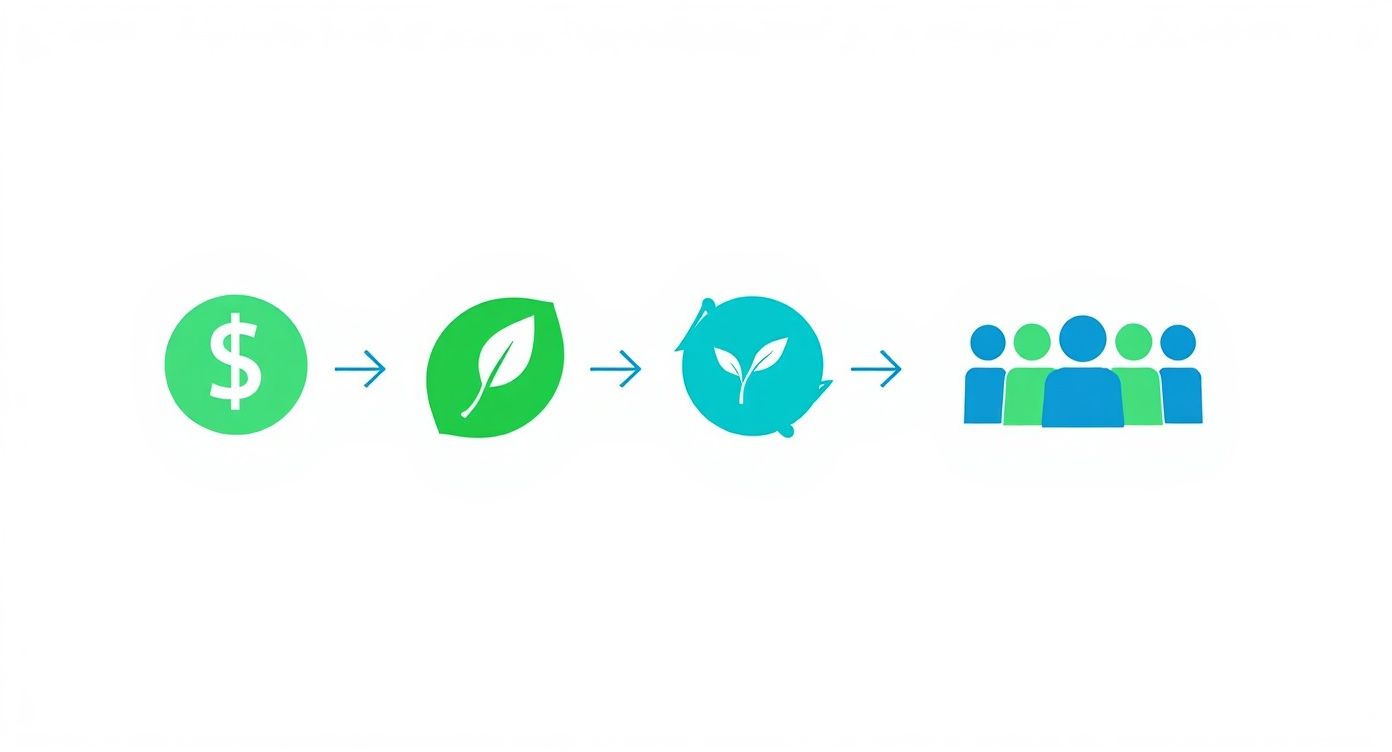
As you can see, it's a true win-win, creating value financially, environmentally, and even socially.
Step 3: Prepare Your Shipment
This part is absolutely critical. If your cartridges get damaged on their way to the facility, they become worthless. The best-case scenario is to place the used cartridge right back into the box and packaging the new one came in. That packaging is specifically designed to protect all the sensitive electronic bits.
Innovate Inc. didn’t save all the original boxes, so they have to get a little creative. They carefully wrap each of their 20 valuable HP cartridges in bubble wrap. Then, they place them snugly into a sturdy cardboard box, using packing paper to fill any gaps so nothing can rattle around during transit. As a practical tip, they use a standard 18x18x16 shipping box which comfortably fits their 20 wrapped cartridges.
Key Takeaway: Never, ever just toss loose cartridges into a box. The drum and electronic contacts are incredibly delicate. A single scratch or crack can take a valuable cartridge and make it worthless.
Step 4: Shipping and Logistics
This is usually the easiest step of all. Most buyback programs will email you prepaid shipping labels. All Innovate Inc. has to do is print the label their partner sent, tape it securely onto their packed box, and schedule a pickup with the shipping carrier.
For anyone new to this, it's worth getting the logistics right. You can find everything you need to know by reviewing guides on shipping toner cartridges securely. The whole system is designed to be as hands-off for you as possible. Once that box is picked up, it's insured and tracked all the way to the recycling facility.
Step 5: Getting Paid
Once your shipment arrives, the final stage kicks in. The partner’s inspection team will look over every single cartridge, confirming the model, its condition, and that it's a virgin OEM. They'll check the 20 cartridges from Innovate Inc. to make sure they match the quote and aren't damaged. For instance, they might find one cartridge has a deep scratch on the drum, reducing the final payout by a few dollars.
After the inspection is done, it's payday. Timelines and payment methods can differ, but solid partners work fast—many will issue payment the same day the inspection is complete. Innovate Inc. chose a partner offering direct deposit and got their money within 24 hours of the shipment's approval. Just like that, they turned office clutter into cash and kept a pile of e-waste out of a landfill.
Choosing the Right Recycling Partner for Your Business
Picking the right partner for your toner recycling program is a lot like choosing any other vendor for your business. The best fit really comes down to your company's specific needs, how many cartridges you have, and what you’re trying to accomplish.
Not all programs are created equal. Some offer cash, others offer convenience, and the goal is to find one that slots right into your existing workflow without creating extra headaches. Your decision will probably land on one of three main types of recycling partners. Let's break down how each one works so you can make a smart choice.
Direct Buyback Companies
Think of these as the specialists. Direct buyback companies are in the business of purchasing unused OEM toner cartridges to be remanufactured and resold. If you want to turn your surplus supplies into actual cash, this is the route to take. They offer the highest financial return and usually make the process straightforward with free shipping labels and a clear system for getting a quote, sending your items, and getting paid.
This option is a perfect match for businesses that have a consistent flow of valuable, unused OEM cartridges in their original boxes. A practical example is a real estate office that upgrades its printers and has 50 brand-new, now-obsolete toner cartridges to sell.
- Best For: Companies with 10+ OEM cartridges per shipment who want to maximize their cash payout.
- Payout Method: Direct payment, usually via check, PayPal, Zelle, or direct deposit.
- Key Advantage: You get the most money back for your used supplies.
For businesses looking to build a reliable, long-term revenue stream from their surplus, it pays to find a partner who understands the commercial side of things. To get a better sense of what sets a great buyback company apart, check out our guide on working with toner distributors and resellers.
Manufacturer Take-Back Programs
The big printer brands like HP, Xerox, and Lexmark all have their own recycling initiatives, often called "take-back" programs. You’ve probably heard of the most well-known one, HP Planet Partners.
These programs are designed first and foremost as an environmental service, not a way to make money. They make it incredibly easy to dispose of used cartridges responsibly by providing free mail-in labels or collection boxes. For example, a new HP cartridge often comes with a prepaid mailing sticker right in the box, so you can put the old one in, seal it, and drop it in the mail. The trade-off for this convenience? You won't see a dime. The real value is the free, manufacturer-approved recycling service.
- Best For: Businesses of any size that care more about easy, responsible disposal than getting a payout.
- Payout Method: None. This is a free recycling service, not a buyback program.
- Key Advantage: It’s simple, brand-supported, and a reliable way to get rid of cartridges from that specific manufacturer.
Retail Drop-Off Points
For sheer, no-fuss convenience, especially for small offices or businesses with just a handful of cartridges, retail drop-off points are a fantastic option. Big office supply chains like Staples and Office Depot have collection bins right in their stores. You can just walk in and drop off any used cartridge, no matter the brand or condition. A freelance graphic designer, for instance, might only have two or three empty cartridges every few months, making a quick trip to Office Depot the most efficient solution. No shipping, no forms, no fuss.
While you won't get paid, this is the simplest way to ensure your cartridges don't end up in a landfill. It's a perfect solution for getting rid of the occasional generic or damaged cartridge that buyback programs won't accept.
This simple approach is part of a much bigger trend. The global market for printer cartridge recycling was estimated at $2.5 billion in 2025 and is expected to keep growing as more businesses get serious about sustainability. If you're looking at your office's overall waste, it can be helpful to explore a range of commercial recycling services that handle more than just toner.
Comparison of Toner Recycling Program Types
So, how do you decide? The table below lays out the key differences between these program types to help you find the right fit for your business goals.
| Program Type | Best For | Payout Method | Convenience Level | Typical Cartridge Types |
|---|---|---|---|---|
| Direct Buyback | Businesses with 10+ OEM cartridges looking for cash | Direct Payment (Check, PayPal, etc.) | High (Free shipping provided) | New, unused OEM cartridges in good condition |
| Manufacturer Take-Back | Any business prioritizing eco-friendly disposal | None (Free service) | High (Mail-back labels) | Used cartridges from that specific brand |
| Retail Drop-Off | Small offices with low/mixed volume | None (Free service) | Very High (In-store bins) | Any used cartridge, regardless of brand or condition |
Ultimately, choosing the right partner comes down to a quick analysis of your situation. A large corporation with a pallet of identical OEM cartridges from a recent printer fleet upgrade will get the most value from a direct buyback partner. On the other hand, a small nonprofit with a random assortment of different brands and models would be better served by the simple convenience of a retail drop-off point.
Launching a Successful Program in Your Office
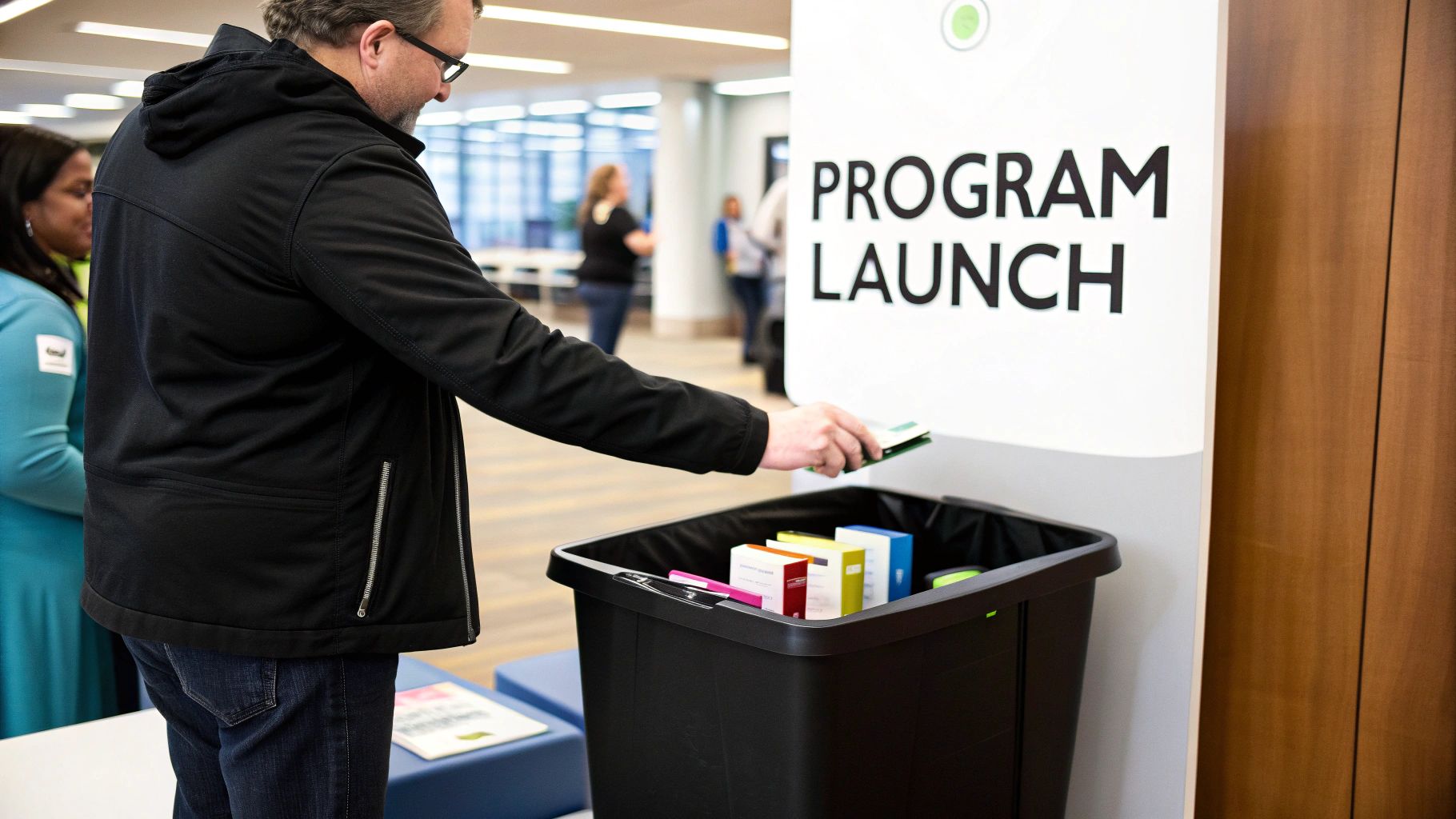
Choosing the right recycling partner is a huge step, but a truly successful toner cartridge recycling program lives or dies by how you roll it out in the office. A great plan needs a great launch. This means setting up a simple collection system, clearly explaining the process to your team, and sidestepping the common little issues that can trip you up.
The goal is to make recycling the path of least resistance. When an employee pulls an empty cartridge from a printer, what they do next should be second nature, not a puzzle. By getting the logistics right from the start, you guarantee more people will participate, which directly boosts your financial and environmental returns.
Setting Up a Designated Collection Station
Your program's success hinges on having a central, impossible-to-miss collection spot. Don't shove it in a back closet where it'll be forgotten. Pick a place everyone passes by or uses, like a corner in the mailroom or right next to the main office copier.
The station itself can be simple. A sturdy, clearly labeled box or a dedicated bin is all it takes. The real magic is in the signage—clear instructions right where they're needed most.
Example Collection Station Signage:
- Main Title: Used Toner Cartridge Recycling
- Instruction 1: Please put used cartridges back in their original box before placing them here.
- Instruction 2: Only OEM cartridges (HP, Canon, Brother, etc.) in this bin, please!
- Contact: Questions? Ask [Office Manager's Name].
This kind of direct, simple instruction prevents confusion and keeps non-valuable items out of your collection.
Communicating the Program to Your Team
You can't expect people to get on board with a program they don't know exists. A clear, upbeat launch announcement is a must. Send out an email or post a message on your company's chat channel that explains the "why" behind it all and the "how" to participate. For example, an email could start with: "Good news! We're launching a new program to turn our empty toner cartridges into cash for our next team outing."
A successful launch is all about team buy-in. When employees see that their small action helps the company’s budget and its green initiatives, they're much more likely to get involved.
This communication is critical when you consider how many cartridges are simply trashed out of habit. In the UK alone, over 65 million printer cartridges are sold each year, but only about 15% make it to a recycling or reuse facility. That’s a staggering 55 million cartridges ending up in landfills, often because people just don't know there's a better way.
Program Launch Checklist
To keep your rollout smooth and stress-free, use this checklist. It breaks the whole process down into manageable steps, making it easy for any office manager to coordinate a fantastic launch.
-
Phase 1: Prep Work (1-2 Weeks Before Launch)
- Select Your Recycling Partner: Finalize the buyback company or take-back program you'll be using.
- Designate a Collection Area: Pick a high-traffic, easy-to-access spot for your collection bin.
- Create Clear Signage: Design and print simple, direct instructions for the station.
- Draft Your Launch Memo: Write the email or internal post that will announce the new program to all staff.
-
Phase 2: Launch Day
- Set Up the Station: Place the collection bin and signage in its new home.
- Send the Announcement: Hit "send" on that email or post the memo explaining the benefits and instructions.
- Brief Key Personnel: Give department heads or receptionists a quick heads-up so they can field questions.
-
Phase 3: Keeping the Momentum
- Schedule Regular Check-ins: Peek in the bin weekly to monitor how full it's getting.
- Manage Shipments: Once it's full, follow your partner’s guidelines for packing and shipping the cartridges.
- Share the Success: Keep the team motivated by sharing the results (e.g., "Great job, team! We earned $150 from our first box of toners!").
Common Questions About Toner Recycling
Even with a solid plan, you're bound to run into a few tricky situations or have some questions pop up as you get your toner cartridge recycling program off the ground. Think of this as your field guide for handling the most common curveballs businesses face. Getting these details right is the difference between a smooth, profitable program and a frustrating one.
We've pulled together the real-world scenarios that can trip people up and affect their payout. The answers are straightforward and practical, designed to help you confidently manage every cartridge that crosses your desk. Let's clear up the confusion and get you ready for those edge cases.
Can I Recycle Generic or Non-OEM Cartridges?
This is easily the most common question we hear, and the answer really comes down to who you're working with. Most buyback companies offering cash for cartridges are only interested in Original Equipment Manufacturer (OEM) products. These are the cartridges made by the big names—HP, Canon, Brother, and so on—because they're built with high-quality parts perfect for remanufacturing.
Generic or compatible cartridges, on the other hand, are often built with cheaper components that just don't stand up to being reused. Because of this, they usually have no resale value.
- If you want cash: You'll need to stick exclusively to OEM cartridges. Tossing generics into your shipment can sometimes cause the whole box to be devalued or rejected.
- If you just want to dispose of them responsibly: Some partners might take generics for materials recycling (without payment) as a courtesy. An even easier option is to use the drop-off bins at stores like Staples, which is a great, no-cost way to handle these non-valuable items. A practical example is an office that uses both OEM and generic cartridges; they would have one box for "cash back" OEMs and a separate pile to take to Staples on a monthly supply run.
Before you pack anything, always check your partner's list of accepted models. Sorting everything correctly upfront is the secret to a fast, successful transaction.
What’s the Difference Between a Virgin and a Non-Virgin Cartridge?
Understanding the difference between "virgin" and "non-virgin" is absolutely critical, especially when you're getting paid for empty cartridges. It's a pretty simple concept.
A virgin cartridge is an OEM cartridge that has been used just once. It still has all its original factory parts and has never been refilled, rebuilt, or messed with in any way. These are the gold standard for remanufacturers and are worth the most.
A non-virgin cartridge, as you might guess, has already been through the recycling process at least once. Someone has refilled it, replaced parts, or otherwise reconditioned it. While it might still work, the wear and tear on its components make it a poor candidate for another round of remanufacturing. That’s why nearly all cash-for-toner programs only want virgin cartridges. Before you ship, give your cartridges a quick look for tell-tale signs like drill holes, glue residue, or strange-looking labels—those are dead giveaways that it's non-virgin.
What Should I Do with Damaged or Obsolete Cartridges?
It’s inevitable. Sooner or later, you'll find a cartridge that has no buyback value. Maybe it got dropped and the plastic casing is cracked, or perhaps it’s for a printer that was discontinued a decade ago. You can't sell them, but you definitely shouldn't just toss them in the trash.
These items are still e-waste, full of plastics and metals that need to be dealt with properly. You have a few good options:
- Retail Drop-Off Bins: This is the easiest route. Office supply stores usually have free collection bins right at the front of the store for any cartridge, no questions asked.
- Local E-Waste Events: Keep an eye out for e-waste collection days in your city or county. They'll make sure everything is recovered correctly. For example, many towns host a free e-waste drive in the spring where you can bring old electronics.
- Manufacturer Programs: Big brands like HP have their own take-back programs (like HP Planet Partners) and will often accept their own cartridges back, no matter their age or condition.
You won't get a check in the mail, but you will be doing the right thing for the environment and upholding your company's sustainability goals. If you're ever unsure, your partner's website is a great resource.
How Should I Store Used Cartridges Before Shipping?
Proper storage isn't just a suggestion—it's what protects the value of your cartridges. A damaged cartridge is a worthless one. The imaging drum and other electronic parts are incredibly sensitive and can be easily scratched or broken, making them impossible to remanufacture.
The best practice is also the simplest: put the used cartridge right back into the box and protective packaging the new one came in. That packaging was literally designed to keep it safe.
If you've already tossed the original box, no worries. Just follow these steps:
- Wrap it well: Use bubble wrap or something similar to create a nice cushion around the entire cartridge.
- Find a good box: Place the wrapped cartridge into a sturdy cardboard box where it fits snugly.
- Eliminate wiggle room: Use packing paper or air pillows to fill any empty space so it can't rattle around. A practical trick is to use crumpled-up old newspaper to fill the gaps.
- Store it safely: Keep the box in a dry, room-temperature spot, away from busy hallways, until you're ready to ship.
Whatever you do, don't just toss loose cartridges into a big bin together. They'll bang against each other, and you'll be watching their value disappear before they even leave your building.
Ready to turn your surplus toner into cash? At Toner Connect LLC, we make it easy with competitive quotes, free prepaid shipping, and fast, reliable payments. Stop letting valuable assets take up space—get a risk-free quote today and see how much your unused cartridges are worth.