
Yes, you can absolutely get money for recycled ink cartridges. For most businesses, it's a simple process that turns what looks like everyday office trash into a surprisingly consistent source of cash. You just collect your used, empty ink and toner cartridges and sell them to a buyback company. It's that straightforward.
Think about that box of empty ink and toner cartridges collecting dust in your supply closet. It's more than just clutter—it's untapped cash. For businesses, schools, or any organization, selling them isn't some complicated environmental project. It's a direct, simple transaction. You have items of value, and we want to buy them.
So, what makes an empty piece of plastic worth money? The answer is demand, specifically for Original Equipment Manufacturer (OEM) cartridges.
Buyback companies like us are looking for "virgin" cartridges—the ones that have never been refilled before. We buy these empties to professionally clean, restore, and refill them in a process called remanufacturing. This gives a high-quality cartridge a second life.
These remanufactured cartridges are then sold to consumers looking for a reliable, cheaper alternative to buying brand new. Your empty cartridges are the essential raw material that fuels this entire industry, creating a circular economy where your "waste" becomes our valuable asset.
It’s a smart business move. Instead of paying someone to haul away your trash, you’re getting paid to supply the core components for a green industry. You’re actively participating in a sustainable business model that also benefits your bottom line.
This isn't just a niche market, either. The ink cartridge recycling and remanufacturing sector is projected to grow toward $2.5 billion by 2028, thanks to a bigger push for corporate sustainability and tighter environmental rules. This strong market is what keeps your empty cartridges valuable.
Honestly, almost any organization with a printer can turn its empties into cash. The system is designed to scale, whether you have a handful of cartridges or a truckload.
We see it all the time.
By selling your used ink cartridges, you’re doing more than just earning extra money. You're taking a practical step toward the future of sustainable consumption through recommerce, adding to your budget while doing something environmentally responsible.
Before you can turn those empty cartridges into cash, a little prep work can make a huge difference. Honestly, the gap between a high-value quote and a disappointing one often comes down to how well you sort, document, and present what you have. A well-organized list transforms a random box of empties into a clear, valuable asset for any buyer.
This isn't complicated stuff. It’s just about knowing what buyback companies look for and making their job—and yours—a whole lot easier. Spending a few minutes on these steps is the surest way to get the maximum payout you deserve.
First things first, you need to sort your cartridges. This is the most critical step. Buyback companies are almost exclusively interested in Original Equipment Manufacturer (OEM) cartridges. These are the genuine, brand-name products made by companies like HP, Canon, Brother, and Epson.
On the other hand, compatible, generic, or remanufactured cartridges—the ones made by third-party companies—typically have little to no buyback value. Mixing them in with your valuable OEMs just slows down the whole process and can even result in a lower offer if the buyer has to do the sorting for you.
Here’s a quick guide to telling them apart:
Think about it from a real-world perspective. An office manager might find a supply closet with 20 HP 952XL cartridges and 15 no-name replacements. By pulling out just those 20 valuable OEM cartridges, they've instantly created an inventory that will get a strong cash offer.
To clarify, here's a simple breakdown of what buyers are looking for:
This table illustrates the key differences in buyback potential between Original Equipment Manufacturer (OEM) cartridges and third-party compatible or remanufactured cartridges.
| Attribute | OEM Cartridges (e.g., HP, Canon, Epson) | Compatible/Remanufactured Cartridges |
|---|---|---|
| Buyback Value | High demand and significant cash value. | Typically little to no monetary value. |
| Buyer Interest | Actively sought by nearly all buyback companies. | Rarely accepted by buyback programs. |
| Remanufacturing | Ideal core for high-quality remanufacturing. | Often cannot be remanufactured again. |
| Identification | Clearly marked with the original brand's logo. | Labeled as "compatible," "remanufactured," or generic. |
Ultimately, focusing your efforts on the OEM cartridges is what brings in the money. It's best to simply set the compatibles aside for your local electronics recycling.
Once you've got your pile of OEM cartridges, take a moment to look them over. A cartridge's value is directly tied to its potential to be successfully remanufactured, so any significant damage can make it worthless.
You're looking for obvious deal-breakers: cracks in the plastic casing, broken clips, or a badly damaged electronic chip or printhead. A small scuff mark is usually no big deal, but a cracked housing means the cartridge probably can't be reused.
Pro Tip: Keep a running list as you sort. A simple spreadsheet or even a handwritten note with the brand, model number, and quantity is perfect. For example:
HP 952XL - 8 units,Brother TN760 - 5 units,Canon 280XXL - 12 units. This inventory list is exactly what you’ll need to get a fast, accurate quote from a buyer.
Finally, pictures are your best friend for getting a quick quote. Most reputable buyers let you submit photos of your inventory instead of typing out a long list, which saves a ton of time. Good photos are instant proof of what you have, its condition, and its authenticity.
Here’s how to take pictures that work:
HP 67XL) is facing the camera.You don't need to be a professional photographer; a clear picture from your smartphone is all it takes. If you need some examples, check out our simple guide on how to submit images for a fast toner quote. Following these steps shows you're an organized seller and helps guarantee a smooth, profitable transaction from the start.
Once you've got your cartridges sorted and documented, it's time to find the right partner to buy them. The internet is flooded with options, but getting top money for recycled ink cartridges really comes down to finding a reputable, transparent buyer. Knowing where to look—and what to look for—is the key to avoiding lowball offers and a whole lot of frustration.
Your search will almost certainly start online. The trick is to use specific, targeted search terms to find companies that actually specialize in what you're selling.
Instead of just searching for "recycling," try getting more specific:
Using phrases like these will cut through the noise of general recycling info and connect you directly with commercial buyers.
With a list of potential buyers in hand, it's time to do a little homework. A trustworthy company won’t hide its process; it will be clear and straightforward.
Here are the green flags you should be looking for:
A reputable buyer isn't just looking for a one-time transaction; they want your repeat business. They know that a fair, transparent process is the only way to earn your trust. If a company's website is vague on pricing or shipping details, consider it a red flag.
The goal here is to find a partner who values both your time and your inventory. For more tips on this, you can find helpful resources that cover identifying legitimate shops that buy electronics.
Getting a quote should be easy. Most buyback companies give you a few ways to submit your list, usually through an online form, an email with an attached inventory sheet, or even by sending a few quick photos.
Let's look at a real-world example. Say an IT coordinator at a marketing firm has collected 45 empty OEM cartridges over the last six months. Here’s how they can get the best possible offer:
This level of detail makes all the difference. It shows the buyer you're organized and tells them exactly what you have, which allows them to give you a fast, accurate quote—often in just a couple of hours. A vague request like, "I have about 40 HP cartridges," will only get you a generic, non-committal response and slow everything down.
You'll quickly notice there are two main types of buyers out there: huge national recyclers and smaller, more specialized companies. Each has its pros and cons, depending on what you're selling.
| Buyer Type | Best For | Pros | Cons |
|---|---|---|---|
| Large National Recyclers | Extremely high volumes (hundreds of cartridges) and mixed lots. | Can handle massive quantities; have established logistics. | May offer lower per-cartridge prices; can be less flexible. |
| Specialized/Niche Buyers | Small to medium businesses, schools, and other organizations. | Often offer higher, more competitive prices for specific models. | May have a more focused list of accepted cartridges. |
For most businesses and organizations, a specialized buyer like Toner Connect hits the sweet spot, offering a great balance of competitive pricing and personal service. We're focused on acquiring the most in-demand models, so our process is built to give fast, fair quotes for typical business volumes. That specialized approach often means you get a higher payout for your inventory.
If you’re a printer and copier dealer, understanding the benefits of working with a focused buyback partner can be a game-changer for your bottom line. You can learn more about our dedicated program for dealers at https://tonerconnect.net/learn-more-dealers and see how a specialized partnership works.
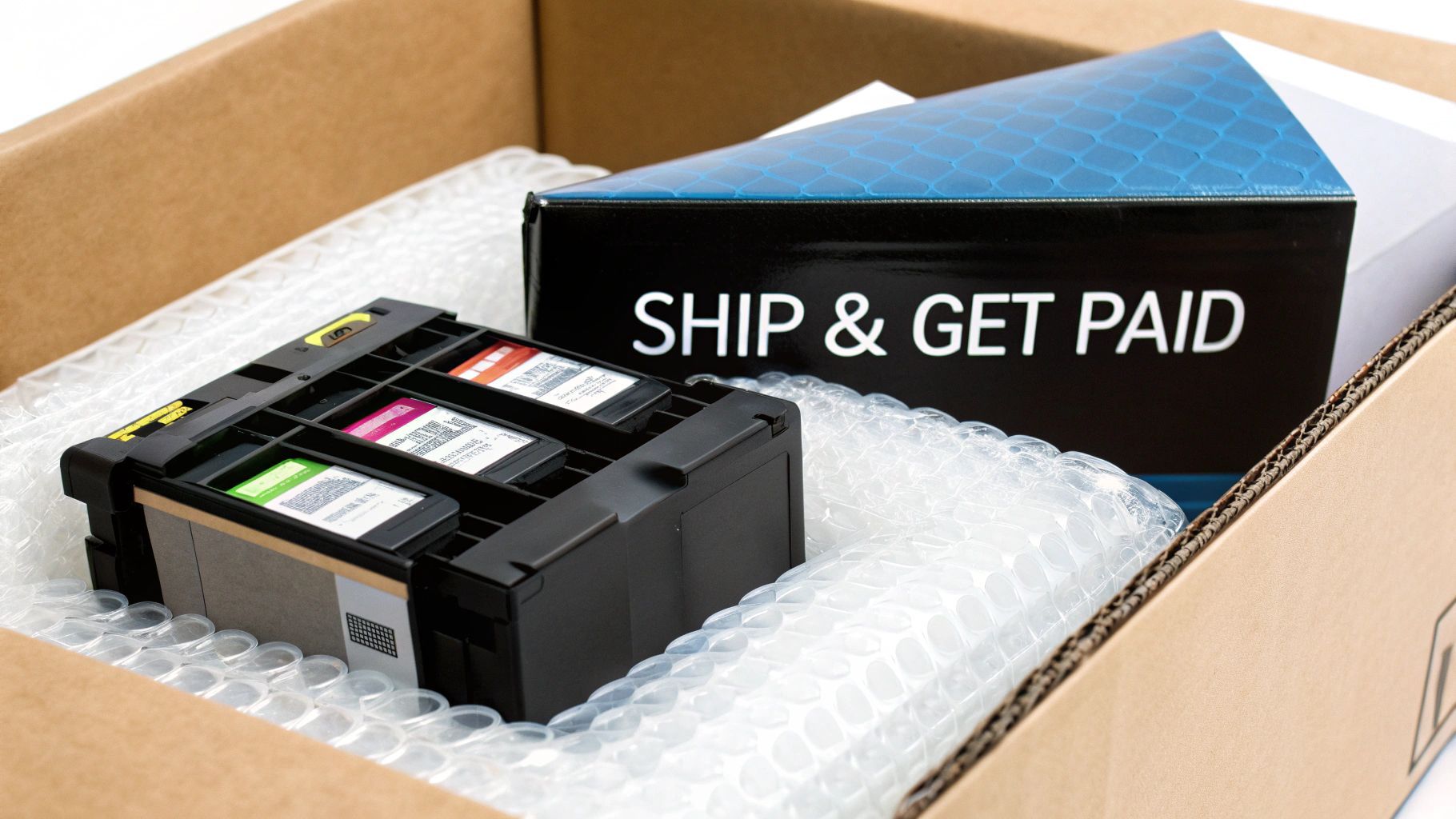
Once you've accepted a quote, the final steps should be just as straightforward: ship the cartridges and collect your cash. Any reputable buyback program will make this part a breeze, taking the logistical headaches off your plate. They’ll ensure your items arrive safely and that you get paid quickly.
A huge perk to look for is a company that provides free, prepaid shipping labels. Honestly, this should be non-negotiable. It means you won’t spend a penny sending your inventory in, which maximizes the cash you pocket for your recycled ink.
I can't stress this enough: how you pack your cartridges directly affects your final payment. If items show up cracked, chipped, or damaged because they were bouncing around in transit, they'll likely be rejected. Just like that, a valuable asset turns into worthless plastic. Good packaging is your best insurance against this.
The main goal is to stop the cartridges from rattling around and knocking into each other. Here are a few simple methods that I’ve seen work time and time again:
Think about a school shipping 50 mixed OEM cartridges. Instead of just tossing them into a big box, the facilities manager could have students wrap each one in old newspaper. It’s a simple, no-cost step that ensures every single cartridge arrives intact and ready for inspection.
A securely packed box sends a clear signal to the buyer that you’re a professional who cares about your inventory. It builds trust, smooths out the inspection process, and ultimately leads to a faster, full payout.
The financial incentive for these programs is only getting bigger, largely driven by corporate sustainability goals. In fact, market analyses show the printer-cartridge recycling market is expected to jump from around $2.5 billion in 2023 to nearly $4.8 billion by the early 2030s. This growth means companies will keep funding solid buyback programs that pay real cash for your empties.
After your package is in the mail, the big question is always, "When do I get paid?" A transparent buyer will have this information laid out clearly on their website. The whole process usually follows a pretty standard path.
First, your shipment arrives and heads to inspection. The buyer’s team will check the models, count everything, and verify the condition of your cartridges against the original quote. This part is usually wrapped up within a few business days.
Once the inspection is complete, your payment is issued. All in all, you can typically expect to see your money within 7-14 business days from the time they receive your box.
You should also have a few different payment options to choose from. The most common methods are:
Some companies, like Toner Connect, even offer a PayPal prepay option for trusted, repeat sellers, sending payment before you even ship your items. One last thing—always confirm that the prepaid shipping labels are insured. This protects your investment if the package gets lost or damaged by the carrier, which is a crucial safeguard. You can learn more about the specific protections for shippers and see why it’s so important.
Knowing the right steps to sell your old cartridges is one thing. But honestly, where people lose the most money is in the simple, avoidable mistakes. A few small oversights can turn what should be a nice payout into a real disappointment.
We’ve seen it all over the years. The costliest errors aren't complex; they’re basic slip-ups in how people sort, pack, and communicate. If you can steer clear of these common pitfalls, you'll not only protect your profit but also build a great reputation with buyers for smooth, easy transactions.
This is hands-down the number one mistake we see. A business gets excited, packs a box with 50 cartridges, and expects a big check. But when we open it, we find only 30 are the valuable OEM “virgin” cores we can actually buy. The other 20 are a jumble of third-party compatibles, previously refilled units, and starter cartridges.
Mixing these in doesn't just waste your time—it costs you. Your buyer has to pay their team to sort through your shipment and pick out the duds. This often leads to sorting fees or a lower overall offer to make up for that extra labor.
Think about this real-life scenario:
The best way to handle this is to be ruthless during your initial sort. If you aren't sure about a cartridge, just set it aside. A clean shipment of only qualifying items always gets the best offer, and you get paid faster.
Not all genuine OEM cartridges have value. Their entire worth is based on whether they can be successfully remanufactured. A toner cartridge with a cracked case or an inkjet with a damaged electronic chip is completely useless to a remanufacturer—it has zero buyback value. The same goes for inkjet cartridges that are well past their expiration date.
It’s so important to be upfront about the condition of your inventory. If you know a cartridge has been baking in a hot warehouse for five years or got dropped on the floor, don't include it. Trying to slip damaged goods into a shipment just doesn't work.
Buyers inspect every single cartridge that comes through the door. Any attempt to include damaged items will just result in those units being rejected, which lowers your payment and can hurt your reputation as a reliable seller.
Your job isn't done once the cartridges are in the box. How you pack them is absolutely critical. We once got a shipment where all the toner cartridges were just thrown into a big box with no padding at all. By the time it got to us, nearly half of them were cracked or had parts broken off from banging into each other.
Their potential payout was cut in half, all because of a packing error that would have taken five extra minutes to prevent.
To make sure this doesn't happen to you:
Think of it this way: every cartridge you protect is money in your bank account. A few minutes spent on secure packaging is probably the best return on investment you'll make in this whole process.
At the end of the day, this is all about building a good business relationship. If your cartridges have been refilled before or you just aren't sure about their history, say so when you ask for a quote. Any reputable buyer will appreciate the honesty and work with you.
A small accounting firm once sent us a list of 20 high-value HP toner cartridges. We gave them a great quote, and they shipped them in. But when our techs looked at them, they found all 20 had been "drilled and filled" by a local service. They couldn't be remanufactured again, so their value was zero.
The firm was upset, and a relationship that could have been great got off to a rocky start. If they had just told us the history upfront, we could have saved everyone time, money, and frustration.
When you're dealing with a buyback company, full transparency always leads to the best results.
To help you navigate some of these issues, here’s a quick-reference table to troubleshoot common problems you might encounter.
This table can help you quickly identify why a cartridge might be rejected or an offer adjusted, and what you can do about it.
| Problem | Potential Cause | Solution |
|---|---|---|
| Lower Final Payout Than Quote | Inclusion of non-qualifying (compatible/refilled) or damaged cartridges that were rejected during inspection. | Sort your inventory carefully before requesting a quote. Only list genuine, undamaged OEM cartridges. |
| Delayed Payment | Inaccurate inventory list or a shipment with many rejected items, requiring extra time for manual sorting and verification. | Double-check your list against what you pack. A clean, accurate shipment gets processed and paid much faster. |
| "Rejected – Damaged in Transit" | Insufficient padding, oversized box, or items packed too loosely, causing them to break during shipping. | Use a sturdy box, wrap individual items, and fill all empty space with packing material to prevent movement. |
| "Rejected – Non-Qualifying Model" | The model is a starter cartridge, is too old, or has very low market demand for remanufacturing. | Check the buyer's "accepted models" list before including items. When in doubt, leave it out or ask first. |
By keeping these points in mind, you put yourself in the best position to have a smooth, profitable, and successful transaction every time.
Even when the process seems simple, it's smart to have a few questions before you start boxing up old cartridges. Turning empty ink and toner into cash is pretty straightforward, but a few details can make all the difference. Let's tackle the four most common questions we hear from businesses getting started.
This is always the first question, and the honest answer is: it really depends. The value of an empty cartridge comes down to market demand for that specific model.
A popular, newer model toner cartridge can fetch $10 to $20, sometimes even more. On the other end of the spectrum, a common inkjet cartridge might only be worth $0.50 to $4. Some older or less common models, unfortunately, might have no cash value at all. For a real-world example, a used HP 414X toner cartridge will always be worth significantly more than an old HP 61 inkjet. The size, complexity, and current demand for the 414X just put it in a different league.
The only way to know for sure is to check a buyer's price list or, better yet, send them your inventory for a custom quote. That's how you'll get a precise, up-to-the-minute value for what you've got on hand.
We stick to Original Equipment Manufacturer (OEM) cartridges because they are the gold standard for remanufacturing. Think of an OEM cartridge as a factory-original car part—it’s built to last and can be reliably refurbished. Since it’s a "virgin" core (meaning it has never been refilled), its internal components and electronics are in perfect shape.
Compatible or third-party cartridges are a different story. They're more like aftermarket knock-offs, often built with cheaper materials and not designed to be used more than once. They simply don't hold up, and they fail quality control tests far too often. For a remanufacturer, they're a risky investment.
By only accepting virgin OEM cartridges, reputable buyers can guarantee the final remanufactured product will work just like a new one. That commitment to quality is what makes the whole circular economy for cartridges work.
Any legitimate buyback company will handle the shipping costs. Period. This is an industry standard, and you should never have to pay out of your own pocket to send your cartridges in.
Here’s how it usually goes down:
These labels aren't just prepaid; they should also be insured. This is your safety net. It protects you if the box gets lost or roughed up in transit, ensuring you don't lose the value of your inventory. If any company asks you to front the shipping costs, that's a huge red flag—walk away.
It happens. It's actually pretty common for a few cartridges in a shipment to not make the final cut. The reasons are usually predictable: a cartridge was damaged in shipping, it turned out to be a non-qualifying compatible model you missed, or an inkjet was simply past its expiration date.
When this occurs, a trustworthy buyer will adjust the final payment and give you a clear, itemized report explaining exactly why each one was rejected. For instance, if you sent 50 cartridges but two were cracked on arrival, your payment would be for the 48 accepted units.
Rejected cartridges aren't shipped back, as the cost just wouldn't make sense. Instead, the buyback company will make sure they are recycled responsibly. This is exactly why careful sorting and packing on your end are so important—it's the best way to make sure the final check matches your initial quote.
Ready to turn your surplus printer supplies into cash? The team at Toner Connect LLC makes it easy with fast quotes, free prepaid shipping, and prompt payments. We buy a wide range of OEM ink and toner, helping thousands of businesses clear out clutter and boost their bottom line. Get your free quote today and see how much your unused cartridges are worth.
