
Chances are, your office supply closet has a hidden stash of cash sitting on a shelf. Those unused, brand-name toner and ink cartridges you've accumulated aren't just taking up space—they're a valuable asset you can easily convert back into revenue. The key is to sell your surplus toner through a clear, organized process.
It’s all about knowing what you have, finding a buyer you can trust, and packing everything up securely.

Most businesses I've worked with end up with extra toner for all sorts of reasons—a big printer upgrade, accidental over-ordering, or just simple changes in office needs. That forgotten stack of boxes collecting dust is a real opportunity to recover costs and reclaim valuable storage space.
This guide will give you a no-nonsense, practical game plan for selling that excess inventory. We’ll walk through everything from creating a detailed inventory and grading your boxes to finding reputable buyers and handling the shipping. Trust me, it’s a more common (and profitable) situation than you might think.
The demand for genuine printing supplies is huge and isn't going anywhere. The printer toner cartridge market is currently valued at around $15.5 billion and is expected to balloon to $25.2 billion by 2032. This isn't just a niche market; it's a massive industry, which means your surplus cartridges have real, tangible value. You can dig into the numbers and trends over at Verified Market Research.
A mid-sized marketing firm I know recently recovered over $3,000 by selling 50 genuine toner cartridges left after an office-wide printer upgrade. They turned right around and reinvested that cash into new equipment for their design team.
This story isn't a one-off. Turning unused assets into working capital is just good business sense. It directly benefits your bottom line and cuts down on waste. Instead of letting those cartridges expire or become obsolete, you can put that money back to work for your company.
Turning that clutter into cash can be broken down into a few straightforward phases. Each step is designed to get you the best possible payout with the least amount of headache.
Here's a quick look at how the process works from start to finish.
Here is a summary of the key phases involved in turning your surplus toner into cash, from initial inventory to final payment.
| Phase | Action Required | Key Outcome |
|---|---|---|
| Inventory & Assess | Document part numbers, quantities, and box conditions for all surplus items. | A clear, detailed list ready to be sent out for quotes. |
| Quote & Agreement | Submit your inventory list to reputable buyback companies and compare offers. | An accepted offer from a trusted buyer locking in your payout amount. |
| Pack & Ship | Securely pack your cartridges using the provided prepaid shipping labels. | Your items are safely on their way to the buyer at no cost to you. |
| Inspection & Pay | The buyer receives, inspects, and verifies your shipment against the quote. | Prompt payment is issued to you via your chosen method. |
This table gives you a bird's-eye view, but now let's dive into the specifics of each step. By following this workflow, you'll be well on your way to cashing in on those supplies.
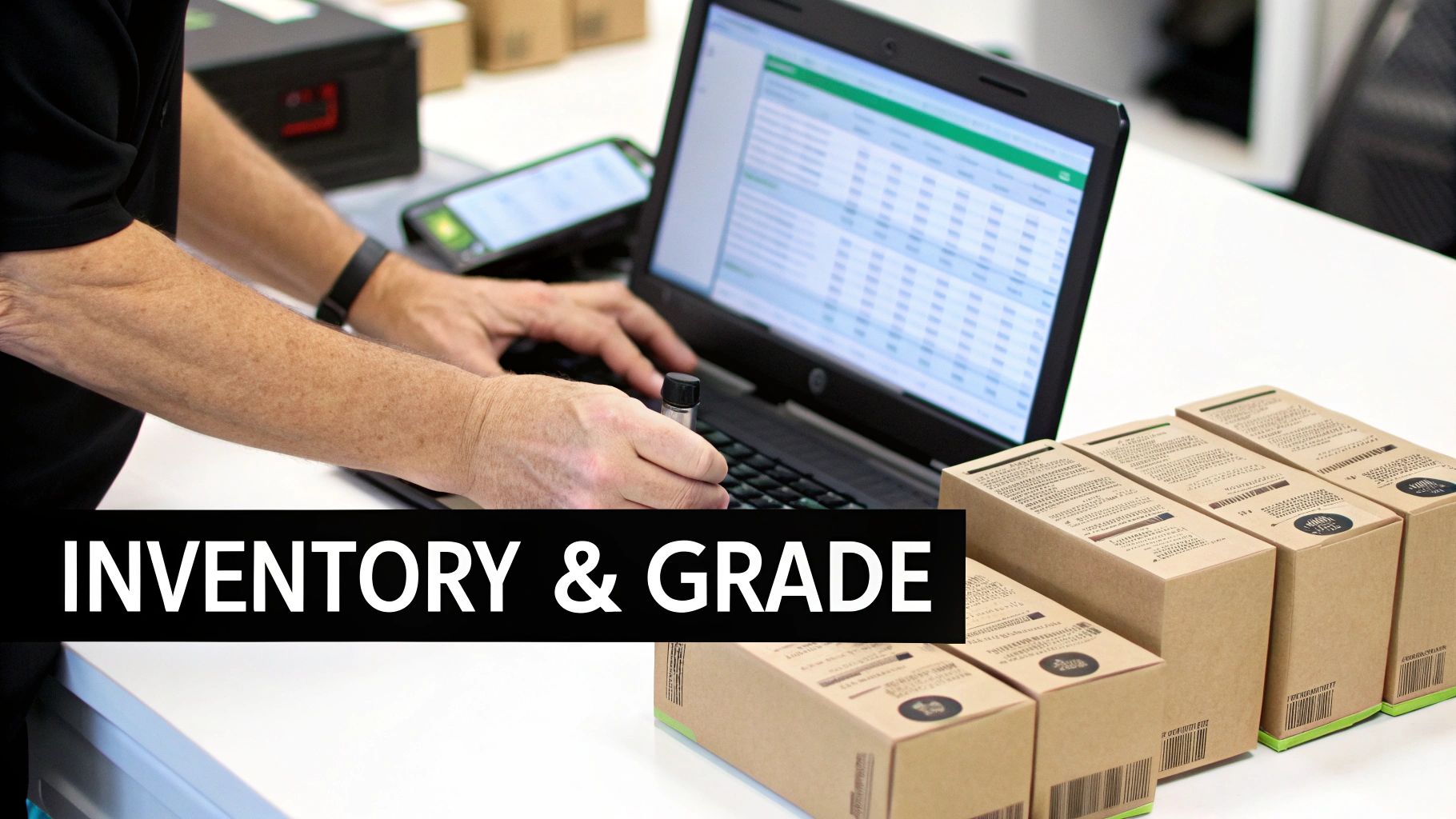
If you want to get the best possible price for your surplus toner, it all starts with an honest and detailed inventory. The value of every single cartridge you have is tied directly to its brand, its condition, and how clean the packaging is. Think of your inventory list as the foundation for a quick, fair deal.
First things first, round up all your extra cartridges. The most important initial step is to separate them into two piles: genuine OEM (Original Equipment Manufacturer) products and everything else. For example, if you find cartridges from HP and Brother alongside some from a third-party brand like "Ink-for-Less," you'll want to set the "Ink-for-Less" ones aside.
OEM cartridges—the ones made by the printer manufacturers themselves like HP, Canon, or Brother—are what buyers are looking for. They will always fetch the highest prices, especially when they're still in perfect, factory-sealed boxes. Since most legitimate buyback companies will only purchase genuine OEM supplies, making this distinction from the get-go saves everyone a ton of time.
Once you have your pile of genuine OEM cartridges, it’s time to put on your inspector hat. The condition of the box is one of the biggest factors that determines its worth, and even what seems like a minor flaw can have a major impact on your payout.
Grab a box and give it a thorough once-over, looking for any of these common issues:
A single crushed corner or a torn pull-tab can be the difference between an 'A-Grade' (mint condition) box and a 'B-Grade' (minor damage) one. That small detail can slash its value by 30% or more, turning a cartridge you thought was worth $100 into one that's only worth $70.
This careful inspection isn't just busywork. It ensures the quote you get is a true reflection of what you have, which means no frustrating surprises or price adjustments down the road.
With all your items sorted and graded, the final step is to get it all down on paper. A simple spreadsheet is your best friend here—it’s the single most valuable tool for this entire process. An organized list is exactly what buyers need to give you a fast and accurate price.
Your spreadsheet should have a few key columns:
Keeping your supply closet in order requires a good system, much like how implementing IT asset management best practices helps companies keep track of their technology.
For even more clarity, snapping a few clear photos of your inventory can be a huge help. You can see the best way to do this by checking out our instructions for submitting images.
Alright, you've got your detailed inventory list in hand. Now comes the crucial part: finding someone to buy it.
A quick Google search for "sell surplus toner" or "toner buyback program" will give you plenty of options. The real trick is sifting through them to find a reputable company you can trust. I always tell people to look for a partner with a long history of positive customer reviews and a process that’s completely transparent from the get-go.
A trustworthy buyer's website won't make you jump through hoops. It should have a straightforward submission form where you can plug in the part numbers and quantities from your spreadsheet. The best in the business make this incredibly easy—for instance, you should be able to submit your toner list online and get a fast, no-obligation offer without a major headache.
Here’s a pro tip: never take the first offer. To make sure you’re getting a fair market price, send your inventory list to at least two or three different buyback companies. For example, submit your list to Company A, Company B, and Company C. This is the only way to truly compare what’s being offered and see who values your specific cartridges the most.
When the quotes start rolling in, it's natural to fixate on the total payout. But be careful—a high initial offer can be a bit of a mirage if it’s hiding steep shipping costs or slow payment terms. You have to look at the entire deal, not just the dollar signs.
Imagine Company A offers you $500 but you have to pay $50 for shipping. Company B offers $475 but provides a free shipping label. Company B is the better deal because your net profit is $475, compared to $450 from Company A. Your time and out-of-pocket costs matter.
Thinking this way protects your bottom line and ensures the whole process is smooth and predictable.
To really evaluate your options, you need to look beyond the cash offer. A good deal is about the total value and convenience of the service.
The market for unused office supplies is bigger than most people realize. In fact, the niche for selling surplus toner cartridges is expected to grow into a $1.1 billion industry by 2033. This just goes to show how much value is sitting on those storeroom shelves.
To reach even more potential buyers, you might also consider listing your items on a specialized platform like the Clearance Central Marketplace. By carefully weighing all these factors—shipping, payment speed, and policies—you can confidently pick a partner who will help you turn that extra toner into cash, efficiently and profitably.
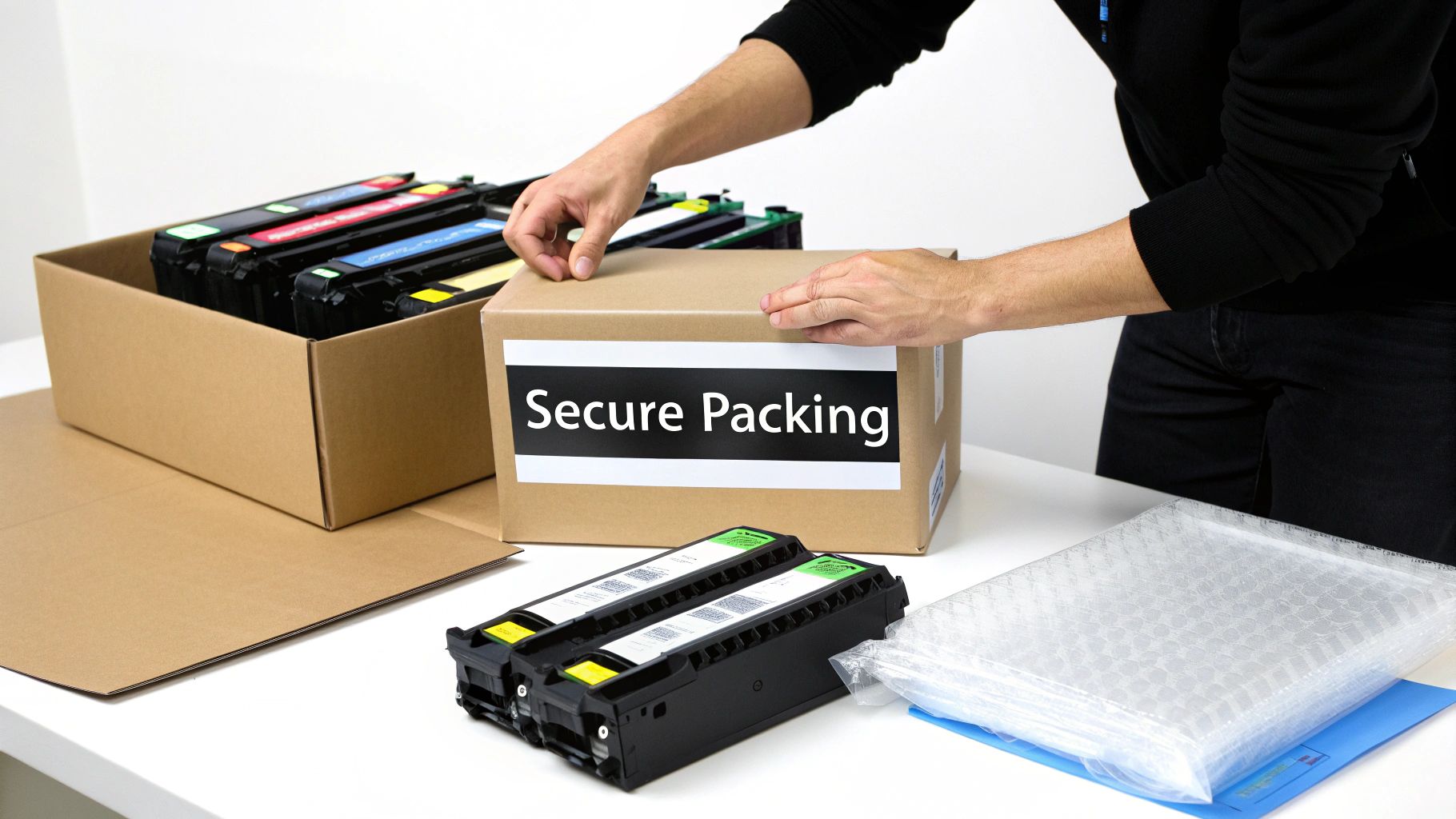
You’ve accepted a quote, and you're on the home stretch. Now, the most important part: making sure your cartridges arrive in the exact same condition you described. This isn’t just about putting things in a box; it’s about protecting your payout.
Think of it this way: a pristine box that gets dented in transit is no longer pristine when it arrives. Proper packing is your best defense against last-minute value adjustments.
Your mission starts with finding the right shipping box. Look for a sturdy, corrugated cardboard box that's just a little bigger than what you're sending. Reusing a flimsy Amazon box that’s seen better days is a bad idea—it’s just asking for trouble. You need something that can take a few bumps without caving in.
The golden rule of packing toner is simple: no movement. If items can shift, they will get damaged.
Arrange the toner boxes inside your shipping box, fitting them together like a puzzle. Any empty space is your enemy. Fill every nook and cranny with packing material—bubble wrap is great, but even crumpled-up paper or packing peanuts will do the trick.
Don’t forget, the inspector on the other end has no way of knowing if a box was damaged before or during shipping. A rock-solid pack job is the only way to ensure what they see is exactly what you sent.
This is the final step in locking in the value when you sell surplus toner.
Once everything is snug and secure, it’s time to seal the deal—literally. Use strong packing tape to seal every seam of the box, top and bottom. Don’t just run one strip down the middle; reinforce all the edges. A practical method is the 'H-Tape' method: tape down the center seam and then tape across both ends, forming the letter 'H'.
The final touch is attaching the prepaid shipping label. Make sure it’s completely flat against the largest side of the box. Any wrinkles or tape covering the barcode can cause scanning errors, delaying your shipment and your payment. A little care here goes a long way.
When you sell surplus toner, getting the best possible price often boils down to avoiding a few common, yet costly, mistakes. These are the little things that can chip away at your payout, but thankfully, they're easy to sidestep once you know what to look for.
The number one mistake I see people make? Waiting too long. Those toner cartridges gathering dust in the supply closet all have expiration dates. The longer they sit, the less they're worth. For example, a popular HP toner cartridge might lose 10-15% of its value each year it sits past its expiration date. Procrastination is the biggest threat to your payout.
Another major pitfall is providing an inaccurate description of your toner boxes. It’s easy to glance at a stack and think everything is in mint condition. But when those boxes arrive at the buyer's warehouse with old shipping labels, dings, or marker scribbles, you're going to get a revised—and lower—offer. That's a frustrating surprise nobody wants.
Here’s how to get ahead of it and lock in an accurate quote from the start:
A buyer who provides free, prepaid shipping isn't just a nice-to-have; it's a non-negotiable for making the deal worthwhile. I'll always take a slightly lower offer with free shipping over a higher one where I have to pay to send the items. It’s a guaranteed win.
Ignoring this detail is probably the fastest way to lose money on a toner buyback deal.
It also helps to understand that you're dealing with a stable market. The global printing toner market was recently valued at around $9.3 billion and is expected to grow to nearly $11.5 billion by 2035. This steady demand means there's always a reliable secondary market for your unused OEM supplies. It's not a fleeting opportunity; it's a consistently smart financial move. You can find more in-depth market data from Archive Market Research.
By sidestepping these common blunders—delaying the sale, fudging the box conditions, and getting stuck with shipping costs—you set yourself up for a smooth, profitable, and hassle-free transaction every single time.
Even with a straightforward process, you're bound to have a few questions. This is especially true if it’s your first time looking to sell surplus toner. You might be wondering about the real value of your cartridges, how long you'll have to wait for payment, or what happens if there's a hiccup along the way.
Let's walk through some of the most common questions we hear from office managers and businesses just like yours. Getting these answers upfront will help you move forward with confidence.
No surprise here: genuine OEM (Original Equipment Manufacturer) cartridges from the big names—think HP, Brother, Canon—will always bring in the most cash. The absolute best prices are reserved for cartridges in pristine, factory-sealed boxes without so much as a scratch or dent.
Market demand is another huge factor. For example, a toner cartridge for a brand new, popular HP LaserJet model could be worth $80, while a cartridge for a 10-year-old, discontinued printer might only be worth $10, even if both are in perfect condition.
On the flip side, compatible or remanufactured cartridges, anything in an open package, or boxes with heavy damage have very little resale value. In fact, most reputable toner buyers won't accept them at all.
The timeline can differ a bit depending on who you sell to, but the process is generally pretty quick and predictable. Once you send over your inventory list, you should get a quote back almost instantly, or at the latest, within 24 hours.
After you've accepted the offer and shipped your items, you'll need to account for transit time, which is usually anywhere from two to seven business days. When your shipment arrives, the buyer will inspect everything to make sure it matches your list. This verification step typically takes another one to three business days.
As soon as your items are confirmed, your payment is on its way. Top-tier buyers offer fast payment options like PayPal, Zelle, or a digital check. All told, you can expect the entire process, from quote to cash, to take about one to two weeks.
This is a common concern, but a revised offer almost always comes down to one thing: the condition of the items received didn't match the original description. For instance, you might have listed a box as A-Grade (perfect condition), but it showed up with a torn seal or deep scuffs from being kicked around a storage closet. In that case, the buyer will have to downgrade its condition and adjust the offer to match.
Any trustworthy buyer will be completely transparent about this. They should contact you right away, explain exactly why the price was adjusted (often providing photos as proof), and give you a new, revised offer.
At that point, the ball is in your court. You can either:
This is exactly why an honest, accurate assessment of your inventory from the start is so crucial. It prevents unwelcome surprises and makes for a smooth, predictable payday. For a deeper dive into other common questions, you can find more answers in our comprehensive FAQ section. This resource can help clear up anything else you might be wondering about.
Ready to turn that pile of unused toner into cash? At Toner Connect LLC, we've made the process as simple as it gets. We give you an instant quote, provide free prepaid shipping, and have the fastest payment turnaround in the industry. Get your no-obligation offer today and find out what your surplus supplies are really worth. Request Your Free Quote Now!
