
In a competitive business environment, small and mid-sized organizations are constantly searching for ways to improve efficiency and reduce operational expenses. One of the most impactful areas for achieving this is through procurement. Effective procurement cost reduction strategies are not about simply buying cheaper goods; they are about smarter purchasing, optimizing processes, and building strategic relationships that deliver long-term value. This approach transforms procurement from a transactional necessity into a powerful tool for financial health and competitive advantage.
This guide moves beyond generic advice to provide a detailed, actionable roundup of 10 proven strategies designed specifically for office managers and decision-makers in growing businesses. We will break down each tactic, from supplier consolidation and strategic sourcing to process automation and Total Cost of Ownership (TCO) analysis. You'll learn not just what each strategy is, but exactly why it saves money and how you can implement it step-by-step. For a comprehensive overview of various approaches to cutting costs, you can also delve into the Top Procurement Cost Reduction Strategies.
Each item in our list includes key performance indicators (KPIs) to measure success, common pitfalls to avoid, and practical examples to illustrate the concepts in action. We'll also highlight how specific actions, like monetizing surplus printer supplies through a buyback program, can directly support several of these strategies by reducing inventory, recovering working capital, and cutting storage costs. Get ready to turn your procurement function from a simple cost center into a strategic value driver for your entire organization.
Supplier consolidation is a powerful procurement cost reduction strategy where an organization deliberately reduces its number of suppliers. Instead of spreading purchases across a wide array of vendors, the focus shifts to building stronger, more strategic relationships with a smaller, curated group of high-performing partners. This approach streamlines operations, enhances negotiating power, and creates a more resilient supply chain.

By channeling a larger volume of business to fewer suppliers, you gain significant leverage. This often translates directly into better pricing, more favorable payment terms, and higher levels of service. Managing 10 vendor relationships is far less complex and time-consuming than managing 50, which reduces administrative overhead related to onboarding, invoicing, and communication.
Practical Example: A mid-sized marketing agency realizes it uses four different vendors for printing services (brochures, business cards, event banners). By consolidating this $50,000 annual spend with a single, high-quality printer, they negotiate a 15% volume discount, saving $7,500 annually. They also reduce the administrative time spent managing multiple invoices and contacts by 75%.
Key Insight: This strategy isn't just about cutting vendors; it's about upgrading them. The goal is to create partnerships that deliver more value, not just a lower price on a single invoice. For distributors and resellers, applying this principle to buyback partners can also streamline operations. Learn more about working with specialized partners to optimize inventory liquidation.
Strategic sourcing is a comprehensive approach that moves beyond simple price negotiation to a deep analysis of spending patterns, market conditions, and supplier capabilities. It organizes procurement activities into logical product or service groups, known as categories. This data-driven strategy allows for optimized sourcing decisions tailored to the specific dynamics of each category, ensuring the best total value, not just the lowest initial cost.
By segmenting spending, you can develop specialized expertise and strategies for different areas. For example, your approach to sourcing IT hardware will be vastly different from how you source office cleaning services. This targeted method uncovers hidden cost-saving opportunities, mitigates supply chain risks, and fosters innovation by partnering with the right suppliers for each specific need.
Practical Example: A regional healthcare provider creates a specific category for "medical disposables" (gloves, masks, gowns). After researching the market, they discover that by bundling these items into a single contract and committing to a two-year term, they can secure a 20% price reduction from a major medical supplier, saving over $200,000 annually and ensuring supply stability.
Key Insight: This strategy transforms procurement from a reactive, transactional function into a proactive, strategic one. It's about making smarter, more informed buying decisions for every single category of spend. Applying this to office supplies, for instance, can help identify surplus inventory like unused toner cartridges, which can be sold to recover working capital and reduce waste.
Competitive bidding is a classic procurement cost reduction strategy that leverages market competition to drive down prices. This process involves inviting multiple qualified suppliers to submit bids for a specific product or service contract. A more dynamic version, the reverse auction, creates a real-time online event where suppliers progressively bid down their prices to win the business. Both methods foster transparency and ensure you are paying a fair market rate.
By creating a competitive environment, you shift the negotiation power in your favor. This strategy is particularly effective for commoditized or standardized goods and services where specifications are clear and price is a primary decision factor.
Practical Example: A school district needs to purchase 500 new Chromebooks. They issue a detailed RFQ to five pre-qualified technology resellers. The competitive pressure of the bidding process drives the final per-unit price down from an initial quote of $350 to $310, resulting in a total saving of $20,000 on a single purchase.
Key Insight: This strategy thrives on clarity and competition. It is most powerful when used for high-volume, standardized items like office supplies or IT hardware, not for complex, relationship-dependent services. When managing the resulting inventory, remember that monetizing any overstock or obsolete items, such as surplus toner cartridges, can further enhance your cost-saving efforts by recovering working capital.
Total Cost of Ownership (TCO) analysis is a critical procurement cost reduction strategy that shifts focus from the initial purchase price to the complete lifecycle cost of an asset. Instead of choosing the cheapest option upfront, this method evaluates all direct and indirect expenses, including acquisition, implementation, operation, maintenance, and disposal. This holistic view prevents organizations from making decisions that seem cheap initially but become expensive over time due to hidden costs.
This comprehensive approach ensures every purchasing decision maximizes value and minimizes long-term financial drain.
Practical Example: When choosing new office printers, a company compares a $500 model with a $900 model. The cheaper printer uses $80 toner cartridges that last for 1,500 pages. The expensive printer uses $120 cartridges that last for 5,000 pages. The TCO analysis reveals the cheaper printer's cost-per-page is 5.3 cents, while the expensive one is just 2.4 cents. Over three years, the initially more expensive printer saves the company over $1,200 in consumable costs.
Key Insight: TCO fundamentally changes the procurement conversation from "What is the cheapest?" to "What offers the best lifetime value?" Applying this mindset to consumables is equally important. Surplus inventory, like unused printer cartridges from an older model, has a holding cost. Monetizing these assets recovers working capital and directly reduces the "total cost" of your printing operations. Learn more about selling surplus supplies to improve your bottom line.
Vendor-Managed Inventory (VMI) is a collaborative supply chain strategy where a supplier takes on the responsibility for managing and replenishing a customer's inventory levels. Instead of the customer placing purchase orders when stock runs low, the supplier monitors inventory data and automatically ships products as needed. This approach shifts inventory ownership and management costs from the buyer to the supplier, creating a highly efficient, just-in-time system.
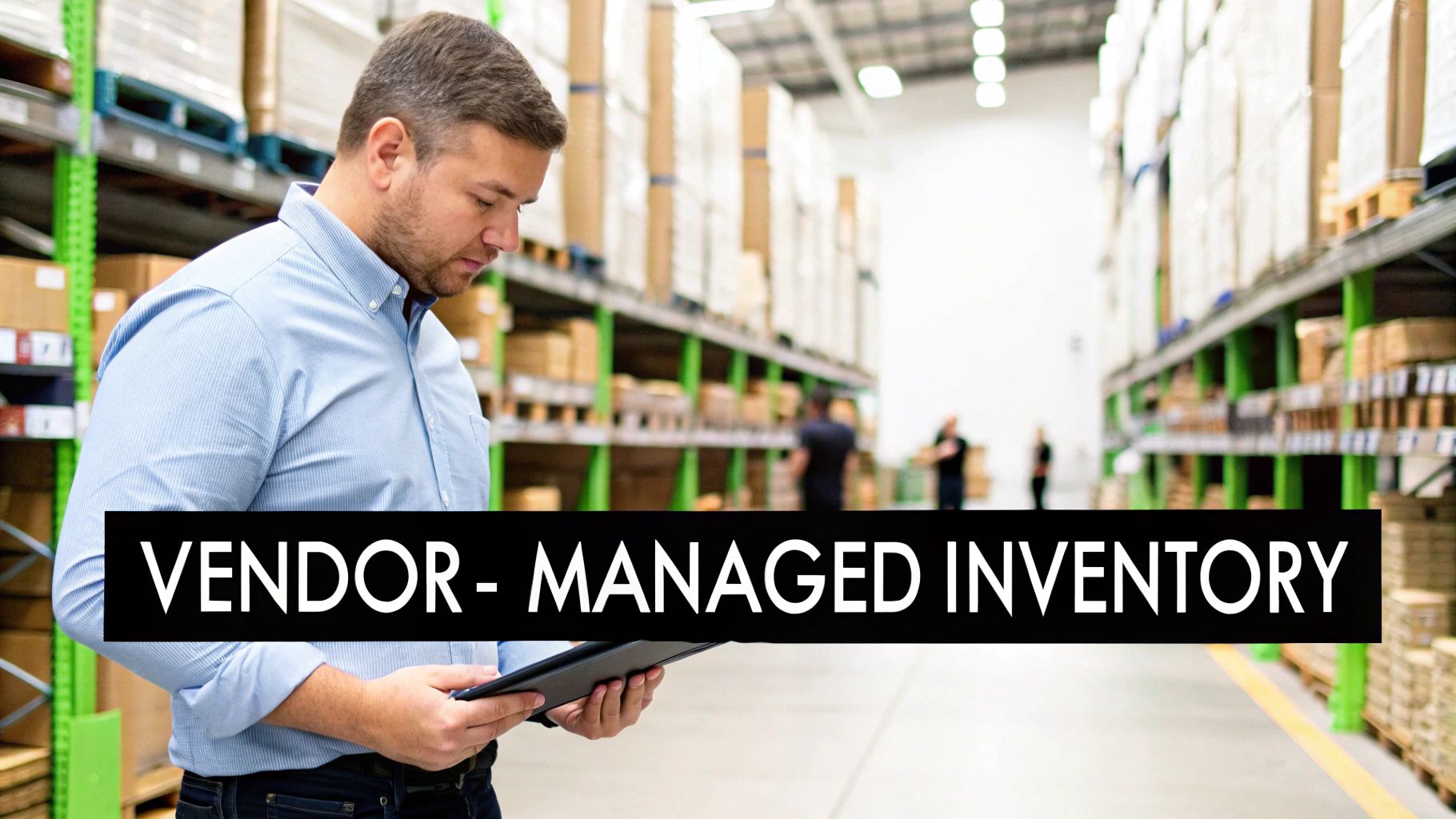
This procurement cost reduction strategy directly lowers carrying costs, such as storage, insurance, and capital tied up in stock. It also drastically reduces the risk of stockouts that can halt operations, and it minimizes the administrative burden of manual ordering.
Practical Example: A small manufacturing plant partners with its primary supplier of nuts and bolts for a VMI program. The supplier installs sensor-equipped bins that automatically report stock levels. This eliminates the need for manual stock checks and purchase orders, freeing up 10 hours of administrative time per month and reducing on-hand inventory by 40%, which improves cash flow.
Key Insight: VMI is about shifting risk and responsibility to the expert: your supplier. This frees up working capital and internal resources. This same principle of optimizing on-hand inventory applies to surplus items; instead of letting excess printer supplies collect dust, you can monetize them to recover capital and reduce storage overhead. Find out how much your surplus toner is worth.
Process automation involves using digital technologies to streamline and automate manual, repetitive procurement tasks. This strategy shifts the focus from administrative paperwork to strategic decision-making by implementing e-procurement platforms, automated invoice processing, and digital purchase order management. By doing so, organizations can significantly reduce human error, accelerate cycle times, and gain real-time visibility into their spending.

Automating workflows from requisition to payment minimizes the direct and indirect costs associated with manual processes. For example, a digital system can automatically flag non-compliant purchases or identify early payment discount opportunities, directly impacting the bottom line.
Practical Example: An accounting department implements an automated invoice processing system. The software uses optical character recognition (OCR) to scan invoices, match them to purchase orders, and route them for digital approval. This reduces the average invoice processing time from 10 days to 2 days and allows the company to capture early payment discounts from 80% of its key suppliers, saving thousands annually.
Key Insight: Automation is not just about efficiency; it’s about control and visibility. An automated system can help manage inventory levels more effectively, preventing the accumulation of surplus items like unused toner cartridges. When surplus does occur, using a specialized service to sell back excess printer supplies can be integrated as a final, value-recovering step in your asset management workflow.
Specification standardization is a strategic approach where an organization reduces the variety of materials, parts, and services it procures by establishing uniform standards. Paired with value engineering, which analyzes product design to cut costs without sacrificing quality or function, this becomes one of the most effective procurement cost reduction strategies for eliminating hidden expenses and improving efficiency. Instead of departments ordering slightly different versions of the same item, a single, optimized standard is used.
This method drives down costs by enabling bulk purchases, reducing inventory complexity, and simplifying maintenance. For instance, an office might use dozens of different printer models, each requiring a unique toner cartridge. Standardizing to just a few models streamlines purchasing, simplifies inventory management, and reduces the risk of obsolete supplies. This creates economies of scale and significantly lowers administrative burdens.
Practical Example: A national hotel chain discovers its properties are purchasing 25 different types of light bulbs. By standardizing to just three energy-efficient LED models, they can negotiate a 30% bulk discount from the manufacturer. This saves money on the initial purchase and also reduces energy consumption and maintenance costs across all locations.
Key Insight: This strategy moves procurement from a reactive role to a proactive, value-adding function. By questioning "what we buy" instead of just "how much we pay," you unlock deeper savings. This same principle applies to managing surplus. Instead of letting standardized, but now unneeded, items like toner cartridges collect dust, sell your surplus toner to recover working capital and reduce waste.
Supply chain risk management involves strategically optimizing supplier locations to balance cost, quality, and resilience. This approach moves beyond simply finding the lowest-cost producer to consider the total cost of ownership, including the risks of disruption. It often involves near-shoring (moving production closer to home markets) or reshoring (bringing production back domestically) to create a more stable and predictable supply chain.
By reducing dependency on distant, single-source suppliers, organizations can mitigate risks from geopolitical instability, natural disasters, and logistical bottlenecks like port congestion. While sourcing from a low-cost country might seem cheaper initially, a single disruption can wipe out those savings through production delays, expedited shipping fees, and lost sales. A diversified and geographically balanced supplier base provides a crucial buffer against these costly interruptions.
Practical Example: After facing significant delays from an overseas supplier, a U.S.-based furniture company decides to move 30% of its production to a supplier in Mexico (near-shoring). While the per-unit labor cost is slightly higher, the reduction in shipping time from six weeks to one week allows them to hold less inventory, respond faster to customer orders, and avoid costly air freight charges, ultimately improving profitability.
Key Insight: Resilience is a critical component of cost reduction. A more resilient supply chain prevents the massive, unexpected expenses that come from disruptions. Even on a smaller scale, managing inventory risk by selling surplus supplies, like unused toner cartridges, can recover working capital and reduce waste-related costs. Find out how to turn surplus inventory into cash.
Early Supplier Involvement (ESI) is a procurement cost reduction strategy that shifts suppliers from being simple vendors to active collaborators. Instead of engaging suppliers only after designs are finalized, ESI brings them into the product development or procurement planning process much earlier. This leverages their specialized expertise in materials, manufacturing, and logistics to optimize designs, prevent costly future changes, and accelerate innovation.
By treating suppliers as partners in innovation, you can identify cost-saving opportunities at the design stage, where they are most impactful. For example, a supplier might suggest using a standard, less expensive component instead of a custom one, or propose a design modification that simplifies manufacturing, saving both time and money. This collaborative approach fosters a win-win relationship focused on mutual growth and continuous improvement.
Practical Example: While developing a new electronic device, an engineering team involves its circuit board manufacturer in the initial design meetings. The supplier suggests a minor layout change that allows for a more automated assembly process. This small tweak reduces the manufacturing cost of each board by 12% and shaves two weeks off the production timeline.
Key Insight: ESI transforms the procurement function from a cost center to a value creation engine. This same partnership mindset can be applied to managing surplus inventory. Instead of viewing unsold toner as a sunk cost, a collaborative partner can help you recover working capital by liquidating those assets, turning a liability into an opportunity. Explore how a buyback program can become a strategic part of your inventory management.
Spend analytics and procurement intelligence represent a data-driven approach to cost reduction. This strategy involves using business intelligence tools and analytics platforms to deeply analyze spending patterns across the entire organization. By transforming raw procurement data into actionable insights, businesses can identify hidden cost-saving opportunities, detect non-compliant (maverick) spending, and make smarter, evidence-based sourcing decisions.
Moving beyond simple spreadsheets, this advanced analysis reveals who is buying what, from whom, and at what price. For example, analytics might uncover that two different departments are buying identical items from the same supplier but at different prices. Armed with this intelligence, procurement teams can negotiate unified pricing, consolidate purchases, and enforce contract compliance, leading to significant savings.
Practical Example: Using a spend analytics platform, a construction company discovers that its various project sites are buying safety vests from 12 different suppliers at prices ranging from $15 to $25 per vest. By consolidating this spend with a single vendor and creating a standardized price of $14 in their e-procurement catalog, they save over $40,000 in the first year and improve safety compliance.
Key Insight: True procurement intelligence goes beyond historical data; it helps forecast future trends. By analyzing past consumption of items like printer supplies, you can better predict future needs, preventing both stockouts and the accumulation of costly surplus. Exploring data-driven inventory management can further enhance these procurement cost reduction strategies. Discover more insights on the Toner Connect blog.
| Strategy | 🔄 Implementation Complexity | 💡 Resource Requirements | 📊 Expected Outcomes | ⚡ Ideal Use Cases | ⭐ Key Advantages |
|---|---|---|---|---|---|
| Supplier Consolidation and Rationalization | Medium–High; change management, 6–12 months | Supplier performance data, negotiation capability, stakeholder alignment | 10–20% procurement savings; simplified vendor base 📊 | Mature supplier ecosystems; high supplier overlap | Greater negotiating power; lower admin costs; improved quality |
| Strategic Sourcing & Category Management | High; per major category 3–6 months | Category managers, market intelligence, analytics tools | 8–25% savings by category; better risk control 📊 | Complex, diverse spend categories; high‑value categories | Data‑driven sourcing; targeted cost & risk strategies |
| Competitive Bidding & Reverse Auctions | Low–Medium; 1–3 months per category | Auction platform, 3–5+ qualified bidders, clear specs | 10–30% price reductions on commoditized items 📊 | Commodity/standard items with many suppliers | Fast price discovery; increased supplier competition; transparency |
| Total Cost of Ownership (TCO) Analysis | Medium–High; 2–4 months | Financial modeling, lifecycle data, cross‑functional inputs | Avoids price‑only mistakes; 15–35% better cost outcomes vs price‑only 📊 | High‑value or long‑life assets, complex purchases | Reveals hidden costs; improves supplier selection and ROI |
| Vendor‑Managed Inventory (VMI) & Consignment | Medium; systems integration 3–6 months | Real‑time inventory systems (EDI/APIs), supplier collaboration | 10–25% supply chain cost reduction; lower carrying costs 📊 | High‑volume, predictable demand (manufacturing, retail) | Reduced inventory; improved cash flow; fewer stock‑outs |
| Process Automation & Digital Procurement Systems | High; 6–18 months; integrations | Technology investment, clean master data, training | 15–30% procurement cost savings; much faster cycle times 📊 | Organizations with high transaction volumes | Labor & error reduction; scalability; improved compliance |
| Specification Standardization & Value Engineering | Medium; 3–9 months | Engineering teams, supplier input, design reviews | 8–20% material cost reduction; faster development 📊 | Product manufacturers seeking cost/design simplification | Lower material costs; improved manufacturability; easier sourcing |
| Supply Chain Risk Mgmt & Near‑Shoring/Reshoring | High; 6–18 months | Supply‑chain mapping, cost/geo analysis, supplier transition planning | 5–15% optimized total landed cost; improved resilience 📊 | Critical supply risk areas; long lead time components | Reduced disruption risk; shorter lead times; regulatory alignment |
| Early Supplier Involvement (ESI) & Collaborative Innovation | Medium; program setup 2–4 months; ongoing | Strong supplier relationships, IP agreements, cross‑functional teams | 10–20% cost reduction via design optimization; faster time‑to‑market 📊 | New product development; innovation‑driven categories | Access to supplier innovation; fewer engineering changes; better alignment |
| Spend Analytics & Procurement Intelligence | Medium; 3–6 months | BI/analytics platforms, data cleansing, analytics expertise | 5–15% identified savings; detection of maverick spend 📊 | Fragmented spend landscapes; need for spend visibility | Identifies hidden opportunities; improves negotiation leverage; monitoring |
The journey toward a leaner, more efficient procurement function is not about a single, revolutionary change. Instead, it is the cumulative effect of implementing deliberate, data-driven procurement cost reduction strategies that transforms your organization’s bottom line. The ten strategies detailed in this article, from Supplier Consolidation and Total Cost of Ownership Analysis to Process Automation and Strategic Sourcing, represent a comprehensive toolkit for small and mid-sized organizations. Each strategy offers a unique lever to pull, allowing you to reduce waste, increase efficiency, and build a more resilient supply chain.
The common thread weaving through all these approaches is a shift from a reactive, transactional mindset to a proactive, strategic one. It's the difference between simply buying what you need today and architecting a procurement ecosystem that delivers sustained value for tomorrow. This means no longer viewing procurement as a mere cost center but as a strategic engine for growth and competitive advantage.
As you move from reading to doing, keep these core principles at the forefront of your efforts:
Implementing a dozen new initiatives at once is a recipe for failure. The key to successful adoption lies in a focused, incremental approach.
Practical Example: An office manager, after conducting a spend analysis, realizes the company spends 15% of its office supply budget with 50 different "one-off" vendors. They decide to tackle Supplier Consolidation first. In the process of cleaning out supply closets to standardize products, they discover five boxes of unopened, genuine HP toner cartridges for printers that were replaced six months ago. Instead of letting this capital sit on a shelf, they use a service like Toner Connect to sell the surplus, instantly recovering hundreds of dollars. This "quick win" not only funds part of their new procurement software subscription but also builds momentum and demonstrates the immediate value of strategic procurement to leadership.
By combining long-range strategic planning with these kinds of tactical, value-recovering actions, you create a powerful flywheel of continuous improvement. The cost savings from one initiative can fund the next, creating a self-sustaining cycle of optimization that strengthens your organization’s financial health and operational agility.
Ready to unlock immediate value from your procurement efforts? If you've discovered surplus, unopened OEM printer supplies during your inventory optimization, Toner Connect LLC can help you convert them into cash. We provide fast, fair buyback offers and prepaid shipping, making it easy to support your procurement cost reduction strategies by recovering working capital and clearing valuable storage space. Visit Toner Connect LLC to get a quote today and turn your surplus into a strategic asset.
