
Finding a source for low cost toner is about more than just grabbing the cheapest box you can find online. It's about figuring out what you’re actually buying. A smart, cost-effective choice balances price with performance and reliability, making sure your office printing runs smoothly without secretly eating away at your budget.
When you start shopping for affordable toner, the options can feel a bit overwhelming. The price differences alone are often huge, and it's not always clear what separates a premium cartridge from a budget one. The trick is to realize that "low cost toner" isn't just one thing—it's a whole spectrum of choices, each with its own pros and cons.
A great way to think about it is like buying parts for your car. You've got three main routes you can go down:
The toner market works almost exactly the same way, with three primary types of cartridges to choose from.
Getting a handle on these categories is the first step to making a smarter purchase. Each one is made differently, which has a direct impact on its price, quality, and overall performance.
Here’s a quick comparison of the three primary toner types to help you understand the key trade-offs.
| Toner Type | Typical Cost | Pros | Cons |
|---|---|---|---|
| OEM | Highest | Top-tier quality and reliability. Guaranteed compatibility. | Most expensive option by a wide margin. |
| Compatible | Low to Medium | Significant cost savings. Quality can be very good. | Performance can vary by brand. May void printer warranty. |
| Remanufactured | Lowest | Most budget-friendly and eco-conscious. | Higher chance of defects or lower print quality. |
As you can see, there’s a give-and-take with each option.
The growing popularity of compatible and remanufactured cartridges is a major trend, largely because they can offer savings of 30-50% compared to OEM prices. As the technology behind them has gotten better, these alternatives have become far more reliable, making them a really practical choice for many businesses. If you want to dive deeper, you can read the full research about the global ink and toner market.
By learning the fundamental differences between these options, you can move beyond simply looking at the sticker price. The goal isn't just to find the cheapest cartridge; it's to find the one that delivers the best value for your specific printing needs, whether that means flawless marketing materials or simple internal memos.
Don't let the price tag on a toner cartridge fool you. A low upfront cost feels like a win, but it’s only a small piece of the puzzle. If you want to get a handle on your printing budget, the only number that truly matters is your Cost Per Page (CPP).
Thinking in terms of CPP completely changes how you look at a purchase. It’s no longer about a one-time expense; it’s about the long-term operational cost of keeping your printer running. It’s a lot like buying a car—that cheaper model looks great on the lot, but if it guzzles gas, it'll end up costing you a fortune down the road. Toner works the exact same way.
Calculating your CPP is surprisingly simple. You don't need a fancy spreadsheet, just a basic formula that cuts through the marketing and shows you how efficient any cartridge truly is, whether it's a pricey OEM or a low cost toner alternative.
The Formula: Cartridge Price ÷ Page Yield = Cost Per Page (CPP)
Let’s run the numbers on a scenario that plays out in offices every day. You're looking at two toner options for your printer.
Option A: The Name-Brand (OEM) Cartridge
Option B: The Compatible Cartridge
The OEM cartridge boasts an extra 200 pages, which might seem tempting. But the CPP tells the real story. The compatible cartridge costs nearly half as much for every single page you print.
A business printing 5,000 pages a month would shell out $200 for the OEM toner but only $105 for the compatible. That one choice adds up to $1,140 in savings over a year—for just one printer.
This quick calculation gives you the power to buy based on genuine long-term value, not just an appealing sticker price.
That page yield number on the packaging? Think of it as an "in-a-perfect-world" estimate, not a guarantee. It’s calculated using an industry-standard test of 5% page coverage. To put that in perspective, that’s about the same as a short, double-spaced letter with no bold text or images. Your real-world results will almost always be different.
Several things have a big impact on how many pages you actually get:
Keeping these factors in mind is key to forecasting your budget accurately. While the official page yield is crucial for calculating your baseline CPP, remember to adjust for your office's actual printing habits. If you print a lot of high-coverage documents, your real CPP will be higher, which makes the savings from a lower-CPP cartridge even more significant. Once you start focusing on the cost per page, you'll see just how much you can save with the right low cost toner.
So, you've done the math on your cost-per-page. Smart move. Now comes the real decision: which type of toner cartridge is going to give you the best bang for your buck? It's a choice that goes beyond the price tag, touching on everything from print quality to your company's environmental impact.
Let’s break down the main players: OEM, compatible, and remanufactured cartridges. Think of it this way: OEM is the original, name-brand stuff. Compatibles are like a high-quality generic version, brand new but made by someone else. And remanufactured cartridges are the refurbished originals, getting a second chance to print. Each has its place, but the right one for you depends entirely on what you’re printing.
Original Equipment Manufacturer (OEM) cartridges come straight from the company that made your printer—think Brother, Canon, or HP. Their biggest selling point? Guaranteed quality. You know for a fact that the colors will be spot-on and the text will be crisp, from the very first page to the last. No surprises.
Of course, that kind of reliability isn’t cheap. OEM is almost always the most expensive option. But if your business relies on producing flawless, client-facing materials like marketing brochures or detailed architectural plans, that premium price can be worth it. For example, a graphic design agency printing a final proof for a major client's branding package should use OEM toner to ensure perfect color matching. You're paying for peace of mind.
If you're interested in the nitty-gritty of how these products are made, it's worth a look into understanding OEM and ODM manufacturing processes.
Compatible toner cartridges are brand-new units built from scratch by a third-party company. Their primary mission? To save you money. The cost savings can be dramatic, leading to a much lower cost-per-page than their OEM counterparts. For the bulk of everyday office printing—think invoices, internal reports, and memos—a good compatible cartridge is often indistinguishable from the original. A law firm, for instance, could use compatible toner for all internal drafts of legal documents, saving thousands of dollars a year without affecting their workflow.
The catch is that quality can be a bit of a lottery. Some brands are fantastic, while others might produce slightly faded colors or have a higher chance of defects. The golden rule here is to buy from a reputable supplier that stands behind their product with a warranty. Using a compatible shouldn't void your printer’s warranty, but if a faulty cartridge causes damage, the printer manufacturer won’t cover it.
The global market for ink and toner was valued at USD 25 billion in 2023 and is projected to reach approximately USD 35 billion by 2032. This growth is fueled by sustained demand in both corporate and home office settings, where low cost toner options play a significant role.
Remanufactured cartridges start their life as used OEM cartridges. They’re professionally taken apart, cleaned, and any worn-out parts are replaced before they're refilled with fresh toner. This makes them the greenest choice by far, as it keeps a whole lot of plastic and metal out of landfills. They also offer a fantastic value, often priced even lower than compatibles.
The quality, however, depends entirely on who’s doing the remanufacturing. A top-notch operation will replace key components like the drum and wiper blade to ensure performance is on par with a new cartridge. A shoddy one might just drill a hole, pour in some toner, and call it a day—a recipe for leaks and lousy prints. For example, a school district printing daily worksheets for students could use high-quality remanufactured cartridges to meet its budget and sustainability goals.
This handy decision tree shows why chasing a high-yield cartridge—a common trait of low cost toner options—is a smarter financial move than just grabbing the one with the lowest upfront price.
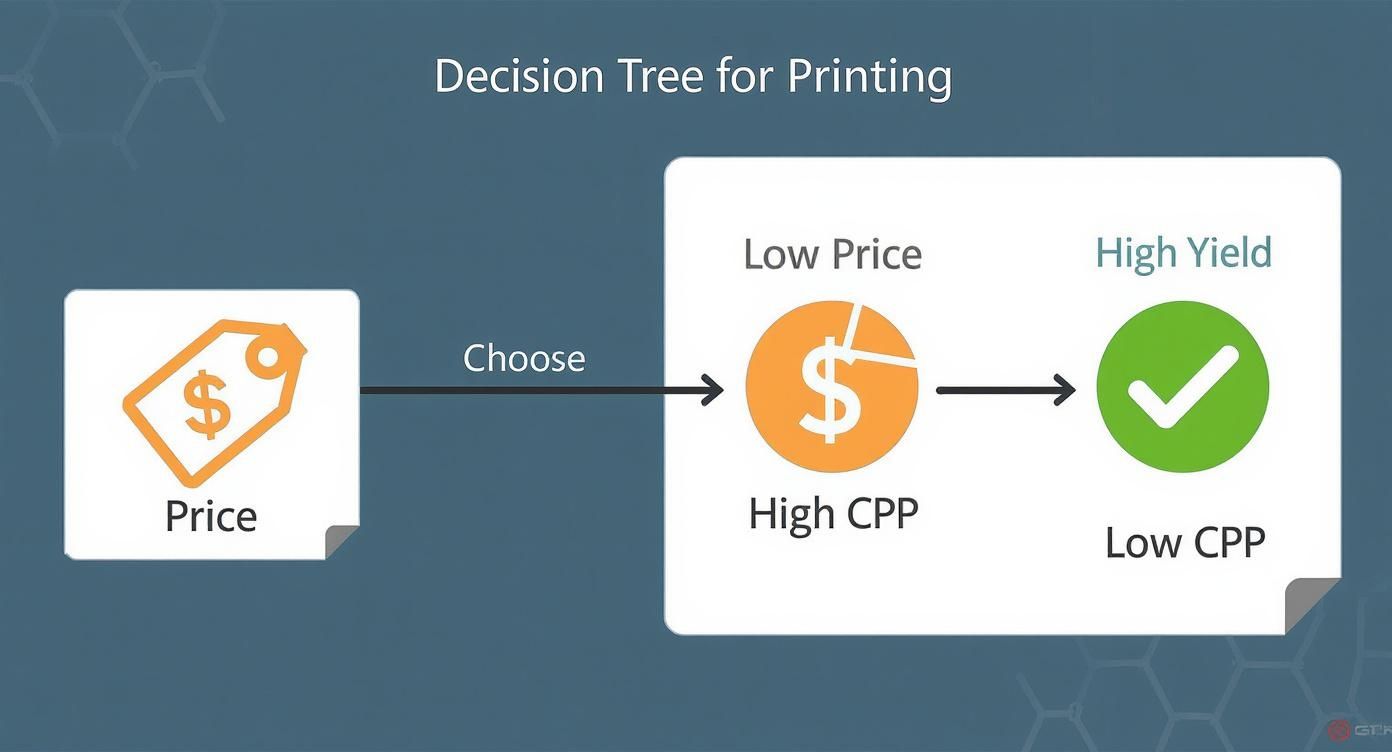
The real takeaway here is that efficiency—getting more pages out of a single cartridge—is where the long-term savings are found, not just in the initial sticker price.
There’s no single "best" toner. The right choice is the one that aligns with your business's priorities. Here's a quick cheat sheet to help you decide.
Honestly, a lot of businesses end up using a mix-and-match strategy. They might splurge on OEM for the big color jobs but lean on compatible or remanufactured cartridges for their high-volume black-and-white printers. It's all about saving money where it makes the most sense.
Choosing a low cost toner is only half the battle. The other, and arguably more important, part is finding a supplier you can trust. The market is absolutely flooded with options, from massive online marketplaces to tiny specialized dealers, and believe me, they are not all created equal.
A great supplier becomes a partner in your business, making sure you get consistent quality and real value. A bad one? They can leave you with constant printer jams, faded prints, and a pile of wasted money. The goal here isn't just to snag a cheap price—it's to lock in a reliable source that actually stands behind its products. That's how you turn a simple purchase into a smart, long-term strategy.
Finding a dependable supplier starts with knowing where to look. Each type of vendor offers different perks, whether you’re just buying a single cartridge or stocking up an entire office.
Dedicated Online Retailers: These are often the sweet spot for small and mid-sized businesses. They live and breathe printer supplies, so they usually offer competitive pricing on everything—OEM, compatible, and remanufactured cartridges. Since their reputation is on the line, you’ll typically find better customer service and much clearer warranties.
Wholesale Suppliers: If you’re printing in high volume, buying from a wholesale distributor can unlock some serious bulk-pricing discounts. For example, a company with 50 printers might order 100 toner cartridges at a time to get a significant per-unit discount. These suppliers are perfect for businesses that want to stock up and spend less time reordering. If you're new to buying in bulk, learning how to partner with toner distributors can give you a leg up on building those valuable relationships.
Authorized Resellers: Think of these as the officially approved vendors for manufacturers like HP or Canon. While their prices on genuine OEM cartridges might be a bit higher, you get a rock-solid guarantee that you're receiving authentic, factory-sealed products. No guesswork involved.
Once you've got a few potential vendors in mind, it’s time to do a little digging. A few minutes of research now can save you from a world of headaches later. Think of it like you're hiring someone—you want a partner who is professional, transparent, and dependable.
Use this checklist to size up any potential supplier:
Check Customer Reviews and Ratings: Don’t just look on their website. Go to third-party sites like Trustpilot or Google Reviews to see what real customers are saying. A few bad reviews are normal for any business, but widespread complaints about quality, shipping delays, or poor customer service are a huge red flag. For instance, if you see multiple reviews saying "cartridge leaked after 100 pages," that's a clear warning.
Verify Warranty and Return Policies: A supplier worth their salt will have a clear, easy-to-find policy that guarantees their products. If the language is vague or the returns process feels like a maze, it’s a sign they don’t have much confidence in what they're selling. Look for a simple "100% satisfaction guarantee" or a "one-year warranty."
Look for Quality Certifications: This is especially important for compatible and remanufactured cartridges. Look for certifications like ISO 9001 (which covers quality management) or STMC (Standardized Test Methods Committee). These credentials show that the manufacturer is committed to meeting high industry standards.
Assess Their Professionalism: Does their website look like it was built yesterday? Is it impossible to find a phone number or a physical address? A legitimate business invests in its online presence and makes it easy for customers to get in touch.
Knowing what to look for is great, but knowing what to avoid is just as critical. Some deals really are too good to be true, and a rock-bottom price can easily hide shoddy quality or even counterfeit products.
A price that is 50-70% lower than every other competitor isn't a bargain; it's a warning. For example, if the standard OEM cartridge is $150 and most compatibles are $70, a seller offering it for $25 should be viewed with suspicion. Extreme discounts often point to counterfeit, expired, or poorly remanufactured cartridges that can do real damage to your printer.
Keep an eye out for these common warning signs. This table breaks down what to watch for and why it should make you think twice.
| Red Flag | Why It's a Concern | What to Do |
|---|---|---|
| "Too Good to Be True" Pricing | This often indicates counterfeit, expired, or extremely low-quality products that will perform poorly or even damage your printer. | Compare the price against several reputable retailers. If it's a massive outlier, proceed with extreme caution or just walk away. |
| No Warranty or Vague Return Policy | A supplier who won’t stand behind their product is basically telling you they know it’s unreliable. | Only buy from vendors who offer a clear satisfaction guarantee or a straightforward return policy for defective items. |
| Unprofessional Packaging | If the box is damaged, unsealed, or just plain generic with no branding, you could be looking at a counterfeit or mishandled cartridge. | Inspect packaging the moment it arrives. Genuine products come in professionally sealed boxes with clear branding and security seals. |
| Poor or Non-Existent Reviews | A total lack of customer feedback or a sudden wave of negative reviews points to an untrustworthy or inexperienced seller. | Stick with suppliers who have a proven track record of positive customer experiences on independent review platforms. |
Ultimately, finding a reliable supplier for low cost toner comes down to doing your homework. By taking a thoughtful and deliberate approach, you can lock in the savings your business needs without ever having to sacrifice quality or peace of mind.
Choosing the right low cost toner is a huge step toward getting your printing budget in check, but the savings don't have to end there. By building a few smart habits and making some simple adjustments, you can dramatically lower your overall costs and squeeze more life out of every single cartridge.
Think of your toner cartridge like the gas tank in a car. Your driving habits directly impact your mileage, right? The same principle applies here. Aggressive, high-speed printing habits burn through toner, while smarter, more efficient printing conserves it.
Most printers come out of the box with settings cranked for maximum quality, not maximum efficiency. The good news is that a few simple changes can immediately cut your toner and paper use without a noticeable drop in quality for everyday documents.
These small adjustments really add up over time.
A well-maintained printer is an efficient printer. When you neglect basic upkeep, you're just asking for wasted supplies and frustrating errors. Streaky prints, paper jams, and smudges often mean you have to reprint things, which eats up extra toner and paper.
Regular, simple maintenance—like cleaning the printer's interior and ensuring rollers are dust-free—prevents misprints and ensures every page you print is a usable one. For example, spending five minutes each month to wipe down the inside of your printer with a lint-free cloth can prevent the paper jams that force you to reprint a 20-page document. This small time investment protects your larger investment in low cost toner and paper.
Thinking even bigger, broader office initiatives can make a real difference. For example, you can transform your small business to go green by cutting down on overall paper consumption, which naturally leads to less toner use.
If your business is juggling a whole fleet of printers, managing supplies and maintenance can turn into a massive time sink. This is where Managed Print Services (MPS) can be a real game-changer. An MPS provider steps in and takes over the management of your entire printing setup.
This often includes:
For example, a regional bank with 20 branches could use an MPS provider to ensure every location always has the right toner on hand, without branch managers having to place orders themselves. An MPS can streamline your whole operation, freeing up your IT staff and giving you a clear, fixed cost for all your printing needs.
Finally, here's a strategy most people overlook: turning your surplus supplies into cash. If you have unused, unopened OEM toner cartridges from old printers lying around, you can sell them. Programs that let you sell your unused toner for cash provide a simple way to recover value from inventory that would otherwise just collect dust.
Thinking about switching to low-cost toner is a smart move for cutting office supply costs, but it's completely normal to have a few questions before diving in. Worries about print quality, how reliable the cartridges are, and what it might mean for your printer's warranty are all valid concerns. Let's tackle these head-on so you can make a confident choice.
Getting the full picture helps you find that sweet spot between saving money and keeping your office printing running smoothly.
This is probably the number one question on everyone's mind, and the answer is refreshingly simple: no.
In the United States, there's a law called the Magnuson-Moss Warranty Act. This federal law makes it illegal for a manufacturer to void your printer's warranty just because you used a non-OEM toner cartridge. So, feel free to shop around.
There is one small caveat, though. If a poorly made third-party cartridge actually breaks your printer—say, it leaks toner all over the sensitive internal parts—the manufacturer doesn't have to cover the repairs for that specific damage.
This is exactly why it’s so critical to buy from a supplier you trust. A reputable vendor will stand behind their products with their own guarantee, giving you a safety net that protects both your toner purchase and your printer.
The quality you get from low-cost toner really comes down to who you buy it from. For the bulk of your office printing—internal reports, invoices, drafts, and emails—a well-made compatible or remanufactured cartridge will produce text that looks identical to the OEM version. The savings are huge, and for everyday black-and-white printing, there's often zero trade-off in quality.
Where you might notice a difference is with highly detailed, color-critical jobs.
A good approach is to match the toner to the job. Use affordable, reliable compatibles for your day-to-day workhorse printers. Save the pricier OEM cartridges for those important, client-facing marketing materials where perfect color is a must. For example, a marketing team might use compatible toner for internal review copies of a brochure but switch to OEM for the final print run that goes to clients.
When it comes to remanufactured cartridges, it’s all about the process. A top-tier remanufactured cartridge isn't just a quick refill. It's a complete overhaul. The best suppliers take the empty cartridge, disassemble it entirely, give it a deep, professional cleaning, and replace key wear-and-tear parts like the photoreceptor drum and wiper blade.
Look for suppliers who are transparent and have the credentials to back up their claims. Certifications like ISO 9001 (for quality management) or STMC (Standardized Test Methods Committee) are great signs. STMC, in particular, confirms the cartridge has been tested to meet specific standards for page yield and performance. These certifications are your assurance that you're not just buying a refilled cartridge, but a professionally rebuilt one.
If you have more questions, you can find additional answers on our comprehensive FAQ page.
Ready to turn your surplus printer supplies into cash? At Toner Connect LLC, we make it simple and profitable to sell your unused, genuine OEM toner and ink cartridges. We offer competitive quotes, free prepaid shipping, and fast, reliable payments. Clean out your supply closet and recover value from your excess inventory today. Get Your Free Quote Now
