
If your office has ever upgraded its printers or over-ordered supplies, chances are you’ve got a pile of old or surplus toner cartridges sitting in a closet. Instead of letting them gather dust—or worse, throwing them away—you can sell toner cartridge inventory for real cash. Many businesses don’t realize that buyback programs will pay for OEM toner cartridges, even if they’re used or incompatible with current equipment.
It’s one of the easiest ways to clear out storage space, generate an unexpected revenue stream, and reduce electronic waste at the same time.
Your Office E-Waste Could Be Worth More Than You Think
Think about the empty toner cartridges sitting in the back of your office. They’re not just trash—they’re a hidden asset. Specialized buyback companies actively purchase these cartridges because they can refurbish, refill, or remanufacture them for resale.
For example, an empty HP 414A toner cartridge could still be worth a few dollars to a remanufacturer. Multiply that by a stack of 20 or 30 cartridges, and suddenly your “trash” becomes meaningful income.
When you sell toner cartridge stock through a reputable buyback program, you’re not just decluttering—you’re tapping into a profitable, sustainable system built around reuse and recycling.
Why Your Used Cartridges Have Value
EM (Original Equipment Manufacturer) cartridges—brands like HP, Brother, Canon, and Dell—are built with long-lasting, high-quality components. Even when empty, they make excellent “cores” for remanufacturing. A recycling specialist can take an empty OEM cartridge, clean it, replace worn parts, refill it with toner, and resell it at a lower cost than a new one.
That’s why they’re willing to pay for your empties. A durable OEM core is the foundation of a good remanufactured product.
In contrast, generic or third-party cartridges usually have low-quality parts and aren’t built to be reused. Because of this, they typically have no value in buyback programs.
Key Takeaway If you want to sell toner cartridge units successfully, stick to OEM cartridges. They’re the ones buyers want and will pay the most for.
What Impacts Cartridge Payouts?
Here’s a quick look at what determines how much your empty cartridges are worth:
| Cartridge Factor | Condition Requirement | Payout Impact |
|---|
| Manufacturer | Must be OEM | High |
| Model Popularity | Common, in-demand printers | High |
| Physical Condition | No cracks or major damage | Medium |
| Virgin Status | Never remanufactured before | High |
| Box Condition | Applies only to unused cartridges | Medium |
The better the condition and the more popular the model, the more money you’ll receive.
The global toner recycling market is already worth billions. In 2023, it was valued at USD 2.5 billion and is projected to reach USD 4.8 billion by 2033. With only 15% of cartridges being recycled today, the opportunity is massive for businesses that want to sell toner cartridge surplus responsibly.
How to Prepare Your Toner Cartridges for Sale
To get the highest payout, you need to spend a few minutes preparing your inventory. Think of it like getting items ready for resale—condition and presentation matter.
1. Separate OEM From Compatibles
This is the most important step. Only send OEM cartridges—HP, Brother, Canon, Dell, Lexmark, Xerox, etc. Compatible or generic brands won’t be accepted.
2. Inspect for Damage
Buyback companies reject damaged cartridges, so check each one for:
-
Cracks
-
Broken tabs
-
Deep scratches
-
Signs of previous refilling
-
Non-OEM labels
A “virgin” OEM core will always earn the highest payout.
3. Make a Simple Inventory List
Create a quick spreadsheet that includes:
-
Brand
-
Model number
-
Quantity
-
Condition (for new/unopened items)
That’s all buyers need to give you an accurate quote.
4. Take Clear Photos
A few well-lit photos of your cartridges—grouped by model—help buyers confirm condition and speed up the quoting process.
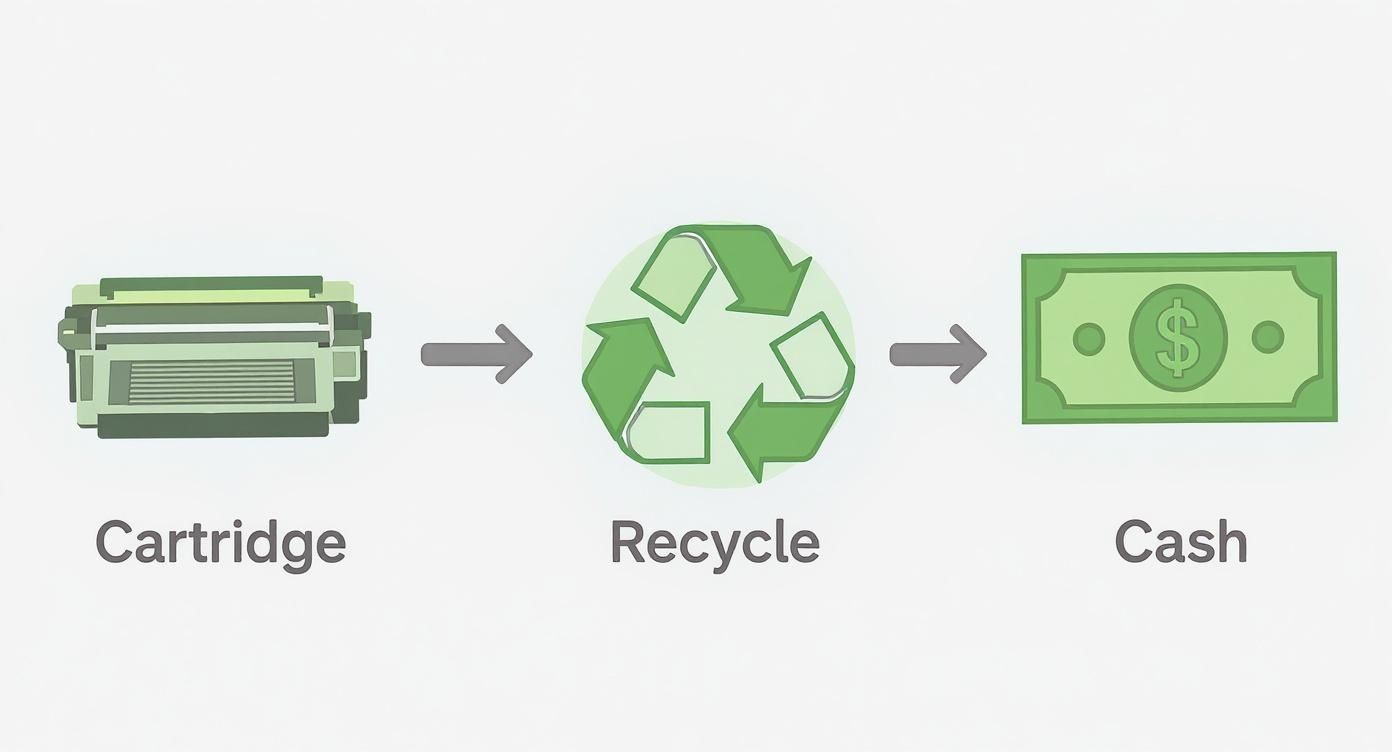
As you can see, it’s a direct path from identifying your cartridges to getting paid. It really is a clear, value-driven process.
Finding a Reputable Buyer
Once your list is ready, the next step is choosing who to sell to. Your payout depends heavily on the buyer you choose.
Two Types of Buyers:
1. National e-waste recyclers – convenient, but often lower payouts
2. Toner specialists – pay more because they focus exclusively on toner
A specialist understands which models have high demand and will typically pay more when you sell toner cartridge stock.
Packing and Shipping Your Cartridges
Proper packing ensures you get paid. Damaged cartridges = no payout.
Packing Tips:
-
Use a sturdy, double-walled box
-
Wrap each cartridge individually
-
Fill all empty spaces with bubble wrap or paper
-
Ensure no cartridges can move during transit
-
Never tape directly onto the cartridge or OEM box
Before sealing the box, shake it gently. If anything moves, add more cushioning.
Most buyback programs offer free, prepaid, insured shipping labels, so you never pay out of pocket.
Inspection and Payment
Once your shipment arrives, buyers inspect each cartridge to verify:
-
OEM status
-
Model accuracy
-
Physical condition
-
Virgin core status
If everything matches your list, you get the exact payout quoted.
Typical payment options include:
-
PayPal
-
Company check
-
Bank transfer
Most businesses receive payment within 3–10 business days.
Pro Tip: If you have cartridges in their original, unopened boxes, leave them that way! A new, in-box OEM cartridge can be worth 50-100% more than the same cartridge without its packaging. The box is proof that it’s genuine and unused.
Snapping a few clear photos of your inventory is also a fantastic way to get a quick and precise offer. For some guidance, check out our quick guide on how to submit images for the fastest toner quote.
Finding a Reputable Buyer and Getting a Quote
With your inventory list in hand, you’re ready to find a company that will turn those surplus cartridges into cash. This step is crucial. The partner you choose determines not only how much you get paid but also how smooth the whole process is.
Think of it this way: you’re not just offloading old stock. You’re building a relationship that can provide a reliable, ongoing revenue stream. A little research now will save you from major headaches down the road.
Why Selling Toner Cartridges Helps the Planet
Selling used toner is more than just earning money—it’s a sustainability win. Each remanufactured cartridge:
-
Reduces plastic waste
-
Saves up to a liter of oil
-
Lowers carbon emissions
-
Diverts e-waste from landfills
It’s a simple, meaningful way to make your operations greener.
Key Questions to Vet Potential Buyers
To protect your investment and avoid any unpleasant surprises, you need to ask a few pointed questions. A trustworthy buyer will have direct, confident answers. If you get vague responses or a runaround, that’s a serious red flag.
Here’s what I always ask before committing to a buyback partner:
- Do you cover all shipping costs? You should never pay for shipping. A reputable company will provide free, prepaid, and insured shipping labels. That insurance is vital—it protects your payout if a box gets damaged on its way to them.
- What’s your typical damage or rejection rate? Honest companies are transparent about this. A low percentage tells you they have solid packaging guidelines and fair inspection standards.
- How and when do I get paid? Pin down their payment terms. Do they pay in 3 days or 30? What are the payment options? Most offer choices like PayPal, Zelle, or a traditional company check.
- Can you point me to customer reviews? Any company with a solid track record will be proud to show off their happy clients. Don’t just take their word for it; look for reviews on independent sites like Google to get the real story.
Putting in the effort to find a great partner really pays off. You’ll get more cash for your cartridges and establish a reliable contact for all your future surplus.
Getting Your Cartridges Packed and Shipped Securely
Once you’ve locked in a great price with a buyer, the next part is crucial for protecting that payout. I can’t stress this enough: how you pack your cartridges can be the difference between getting a full check and ending up with a box of worthless, broken plastic. A toner cartridge that gets damaged in transit is one you simply won’t get paid for.
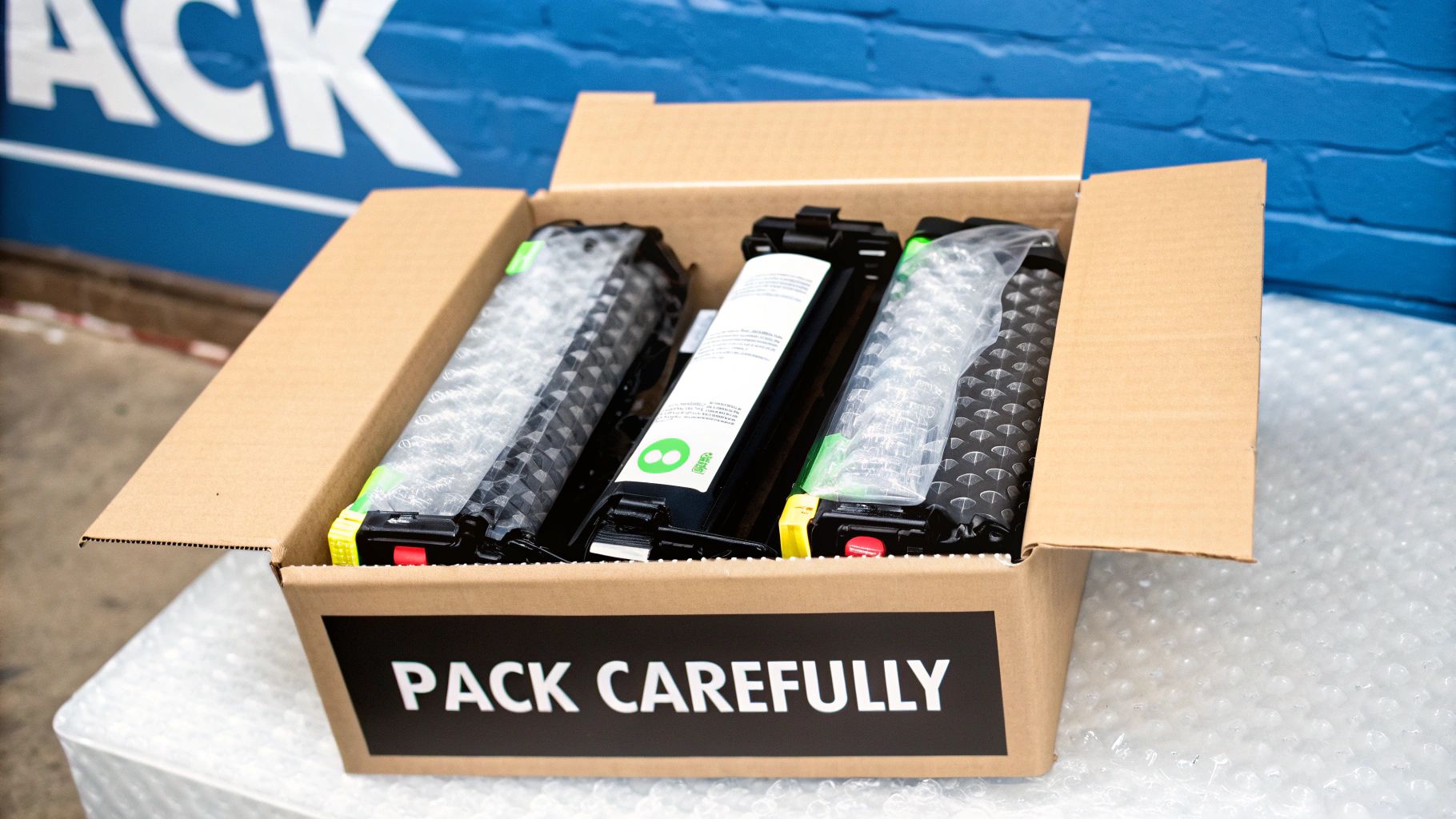
Taking a few extra minutes to prepare your shipment correctly ensures everything shows up in the exact same condition you sent it. The main goal here is simple: eliminate any and all movement inside the box. From my experience, the number one cause of damage is cartridges knocking against each other during their journey.
How to Build a Damage-Proof Box
First things first, grab a sturdy, double-walled cardboard box. You want one that’s the right size for what you’re sending—not so big that things are swimming around, but not so small that you have to cram them in. Flimsy, thin-walled boxes are a no-go; they crush way too easily.
Now for the golden rule of packing: cartridges should never touch each other. Period.
Let’s say you have five HP toner cartridges to ship. Just tossing them into a box is a recipe for disaster. You’ll almost certainly end up with five broken items and a zero-dollar payout. The right way is to wrap each cartridge individually with a generous amount of bubble wrap.
Once you’ve placed the first layer of wrapped cartridges on the bottom, fill any and all gaps with packing peanuts, crumpled paper, or even more bubble wrap. Then, add your next layer and repeat the process. The box should be packed tight enough that nothing can shift, slide, or rattle around.
Pro Tip: Before you tape it up, give the sealed box a gentle shake. If you feel or hear anything moving, open it back up and add more cushioning. Zero movement is what you’re aiming for.
For some excellent general principles on protecting valuables in transit, you can check out this detailed packaging guide.
Don’t Forget the Right Shipping Labels
One of the best parts about working with a professional company when you recycle toner cartridge for cash is that they provide free, prepaid, and insured shipping labels. Always use these labels. Think of them as your financial safety net.
If the package gets lost or damaged by the shipping company, the insurance covers the value of your inventory. This means you still get paid, no matter what happens on the truck. To learn more, check out our insights on what to look for at https://tonerconnect.net/learn-more-shippers.
This careful process isn’t just about the money, either. It’s a huge environmental win. The plastic in a single printer cartridge can take up to 1,000 years to decompose in a landfill. By packing them correctly for reuse, you’re doing your part to keep them in the circular economy and out of the ground.
Ready to Sell Toner Cartridge Inventory?
If you’ve got unused, surplus, or empty OEM toner cartridges, now is the perfect time to turn them into cash. With the right buyer, the process is quick, profitable, and environmentally responsible.
Beyond Cash: The Full Value of Toner Recycling
Getting paid to recycle your toner cartridges is obviously a huge perk, but the real benefits go much deeper than just the cash. When you participate in a buyback program, you’re not just clearing out a supply closet—you’re boosting your company’s green credentials and building a stronger public image. It turns a simple cleanup task into something genuinely impactful.
Every single cartridge you send back to be remanufactured is a win for the environment. It takes a surprising amount of resources to create a new toner cartridge—think about a liter of oil just for the plastic parts. By keeping perfectly good cartridges in the loop, you’re directly cutting down on the consumption of those finite resources.
Plus, you’re actively keeping hazardous e-waste out of landfills. A printer cartridge is a complex mix of plastic, metal, and leftover toner powder. That stuff can stick around for up to 1,000 years before it even begins to decompose. Diverting it from the trash is a fundamental part of being a responsible business.
Turning Recycling into a Sustainability Story
Here’s where it gets interesting for your business reporting. A good buyback partner won’t just send you a check; they’ll provide a detailed report of everything you sent in. This isn’t just a receipt. It’s hard evidence of your commitment to sustainability.
This kind of documentation is gold for your Corporate Social Responsibility (CSR) reports. You can move beyond vague statements about “being green” and use real numbers to back it up.
- For example: Instead of a generic claim, you can report, “This quarter, we successfully recycled 150 OEM toner cartridges, keeping them out of landfills and conserving an estimated 150 liters of oil.”
Suddenly, that box of old toner becomes a powerful story. It’s a narrative you can share with customers, investors, and your own team to show that your company is serious about its values.
By partnering with a program that provides clear records, you gain more than just cash. You gain a verifiable sustainability metric that enhances your brand reputation and showcases a genuine commitment to the planet.
The True Bottom Line
When you get down to it, selling your surplus toner cartridges is a win-win-win. Your business gets money back for items it can’t use. The environment is protected from waste and resource drain. And your company builds a stronger, more authentic story of corporate responsibility. That holistic value makes the small effort of packing up a box of cartridges one of the smartest operational decisions you can make.
Common Questions We Hear About Selling Toner
If you’re new to selling surplus toner, you probably have a few questions. That’s completely normal. We’ve put together some straightforward answers to the questions we get asked most often by businesses just like yours. This should help clear things up and give you a good idea of what to expect.
Do You Buy Every Type of Toner Cartridge?
This is a big one, and the short answer is no. We—and any other reputable buyback company—are almost exclusively interested in Original Equipment Manufacturer (OEM) cartridges. Think genuine HP, Canon, or Brother products that are still in their original, sealed boxes and have never been used, refilled, or tampered with.
We can’t accept compatible, generic, or remanufactured cartridges for payment. The simple reason is quality; their components just aren’t built to the same rigorous standards, which makes them a gamble.
What’s a Realistic Payout for My Cartridges?
This really depends on what you have. The value of a toner cartridge is all about the specific model, the condition of the box, and what the current market demand looks like.
For a common, in-demand OEM cartridge in a pristine box, you might see a payout of over $50. On the other hand, an older but still usable model might only be worth a few dollars. A small office might clear $50 to $200 a year, but we’ve seen larger organizations with a lot of printers generate thousands by regularly selling their surplus.
Expert Tip: The #1 mistake we see is poor packaging. If you just toss loose cartridges into a big box, they’re going to get damaged in shipping and become worthless. Take a moment to wrap and cushion each one individually. It’s the single best thing you can do to protect your payout.
Where Can I Find More Specifics?
We’ve worked hard to make our process as simple as possible, but we know you might have more questions about how we handle quotes, shipping, or payments. Getting familiar with the details upfront is always a smart move.
For a deep dive into our entire process, we’ve put together a comprehensive resource. You can find answers to just about everything on our full toner buyback FAQ page. It covers all the details, from payment timing to shipping insurance.
Ready to see what that pile of boxes in your supply closet is actually worth? At Toner Connect LLC, we turn your extra OEM toner and ink into cash. We offer fast, fair quotes and even cover the cost of insured shipping. Get your free quote from Toner Connect today!