Ever thought about flipping office supplies for a profit? Probably not. But there's a surprisingly lucrative side hustle hiding in plain sight: selling printer cartridges. This isn't just about collecting e-waste; it's a real business where you source new or used cartridges for cheap (or free) and sell them to a market that's always in need.
Why Selling Printer Cartridges Is a Smart Side Hustle
When most people brainstorm side businesses, their minds go to things like freelancing or driving for a rideshare app. But I've seen countless people quietly turn surplus ink and toner into a steady, reliable income.
The whole concept is beautifully simple. You find printer cartridges that a business or individual no longer needs and connect them with someone who does. This could be anything from sealed, unopened toner left over after an office upgrades its printers, to empty name-brand cartridges that recycling companies actually pay you for.
The Untapped Market Potential
It's easy to underestimate the scale of this opportunity. The global market for ink and toner is massive—we're talking a projected value of over $21 billion by 2025. You don't need to capture much of that to make a real difference in your bank account.
Think about it: snagging even 0.01% of that market translates to around $2,100 a year. That's a solid start for a side gig that doesn't require a huge operation. If you're curious, you can dig into more data on the ink and toner market's growth to see the full picture.
What really makes this hustle work is how accessible it is. You don’t need a fancy degree or a pile of cash to get started. It’s more about being persistent and knowing where to look for deals.
This business is all about solving a simple problem. Companies have surplus supplies they see as clutter, and buyers are looking for a deal. You become the essential bridge between the two, creating value for everyone involved.
Why This Hustle Works So Well
The real appeal is in a few key advantages that make it stand out from other side gigs. It’s a flexible model that you can easily fit around your day job or other commitments.
Here’s a quick rundown of what makes it such a great choice:
- Low Startup Costs: You can literally start with zero inventory. For example, a local accounting firm might give you a box of 10 old toner cartridges for free just to clear out their storage closet.
- High Profit Margins: When your cost to acquire something is zero, or close to it, your potential for a great return on each sale is huge. For instance, getting a free OEM toner cartridge that sells for $50 online is 100% pure profit.
- Consistent Demand: Offices, schools, and millions of people working from home are constantly printing. That creates a steady, predictable demand for both new and remanufactured cartridges.
- Scalability: Start small. Sell a few cartridges a month to get the hang of it. As you learn the ropes, you can easily ramp up your sourcing and expand your sales channels.
To give you a clearer picture, here's a simple breakdown of what the journey looks like from start to finish.
Your Printer Cartridge Hustle at a Glance
| Phase | Your Action | Primary Goal |
|---|---|---|
| Sourcing | Find free or deeply discounted cartridges from offices, online, or locally. | Build an inventory of valuable items at the lowest possible cost. |
| Evaluation | Check cartridge condition, model numbers, and expiration dates. | Identify the most profitable items and filter out anything unsellable. |
| Listing & Selling | Photograph items, write clear descriptions, and list them for sale. | Attract buyers and convert your inventory into cash. |
| Fulfillment | Pack and ship orders securely and professionally. | Deliver a great customer experience to encourage repeat business. |
| Scaling | Reinvest profits, find new sources, and explore different sales platforms. | Grow your income stream from a small side gig to a serious business. |
As you can see, the process is logical and repeatable. It’s a true hustle where your effort directly translates into profit.
Building Your Cartridge Inventory Like a Pro
A profitable cartridge-selling business starts long before you make your first sale. It all begins with building a solid inventory, and the savviest sellers know exactly how to find valuable stock for little to no cost. Forget dumpster diving—the real money is in smart, professional sourcing.
The key is to find businesses and people who see their extra cartridges as a problem. To them, it's just clutter or e-waste. To you? It's the foundation of your side hustle. This mental shift is what separates the pros from the amateurs.
Partnering with Local Businesses
One of the best ways to get a steady flow of inventory is to network with local businesses. Think about it: offices are constantly upgrading their printers, leaving them with stacks of perfectly good, unopened cartridges that are now incompatible. They usually just want them gone.
Instead of just asking for their leftovers, position yourself as a solution. Put together a simple, professional email or flyer offering "free e-waste removal" or a "surplus supply liquidation service." This makes you look like a problem-solver, not someone asking for a handout.
Here’s a partnership pitch I’ve seen work wonders:
- Subject: Quick Question about Your Surplus Office Supplies
- Body: Hi [Office Manager Name], My name is [Your Name], and I run a local service that helps businesses like yours clear out old, unused printer cartridges. If you have any surplus ink or toner from previous printer models taking up storage space, I can pick them up free of charge. It's a simple way to declutter and ensure they are properly repurposed. Let me know if this is something you'd be interested in.
This approach is a natural fit for schools, law offices, and accounting firms—any place that does a ton of printing and refreshes its hardware every few years. Just a few of these relationships can keep you well-stocked.
Scouting for Undervalued Deals
Beyond direct partnerships, you can absolutely find hidden gems at liquidation sales and on local online marketplaces. This route requires a bit more of a treasure-hunting spirit, but the payoff can be huge.
- Office Liquidation Sales: When a business closes or moves, everything must go, often in big, messy lots. Keep an eye on local auction sites for these sales. You might find a box of miscellaneous office supplies with a few high-value, sealed OEM toner cartridges that everyone else has overlooked.
- Online Marketplaces: Sites like Facebook Marketplace or Craigslist are fantastic for finding people selling off supplies from a home office. Search for vague listings like "office stuff" or "printer ink." These sellers often have no idea what they're sitting on. For example, someone might list "Lot of HP ink" for $20, and inside you spot a sealed, high-capacity cartridge that sells for $40 on its own.
To make this work, you need to know what you're looking for. Do some quick research on the current demand for different cartridges, especially for popular HP OfficeJet models. Knowing which models are hot will keep you from ending up with a pile of duds.
Distinguishing OEM from Third-Party Cartridges
As you start collecting inventory, learning to tell the difference between OEM and third-party cartridges is non-negotiable. This is probably the single most important skill for staying profitable in this game.
OEM (Original Equipment Manufacturer) cartridges are the real deal, made by the same company that built the printer (like HP, Canon, or Brother). These are your money-makers—they're the most valuable and easiest to sell.
Third-party (or compatible/remanufactured) cartridges are knock-offs made by other companies. They might work, but their resale value is dramatically lower, and most reputable buyback companies won't even touch them.
Pro Tip: Always, always prioritize genuine OEM cartridges. The packaging is a dead giveaway—it's typically high-quality with crisp branding, security seals, and even holograms. For example, a genuine HP box feels sturdy and has a security label you can scan, while a compatible version might come in a plain white or generic-looking box with flimsy cardboard. If the box has a brand you've never heard of, it’s almost certainly a third-party product with very little profit potential.
This one simple check will save you so much time and effort. While you might be able to offload a few compatible cartridges on eBay, the payout is usually peanuts and not worth the hassle when you're just starting out. Stick to OEM, and you'll be dealing with the most valuable and in-demand part of the market.
Once you have a few OEM items, you can see what they’re worth in about two minutes by filling out a quick online submission form with a buyback company.
How to Price Your Cartridges for the Most Cash
Alright, so you’ve started to get your hands on some toner and ink. Now for the fun part: turning that inventory into actual money. Getting your pricing right is probably the single most important factor in whether this side hustle takes off or fizzles out.
Price too high, and your cartridges will just sit there collecting dust. Price too low, and you're leaving free money on the table. The goal is to find that sweet spot—the absolute most someone is willing to pay right now. This isn't guesswork; it's a bit of detective work you can master in a few minutes.
My Go-To Three-Point Pricing Check
Let's walk through a real-world example. Say you just scored a brand-new, sealed HP 63XL Black Ink Cartridge. This is a super common one, which is great because it means there's a ton of data out there. Here’s how I figure out its real value in less than five minutes.
1. What's the Retail Price?
First, I do a quick search to see what big box stores are charging. A quick look at Staples, Best Buy, or even HP's own website will show you the top-dollar price. You’ll probably see it listed for around $45-$50. This is your anchor, but don't get hung up on it—you're not going to sell it for that much.
2. What's the Real Market Price on eBay?
This is the most critical step. Head over to eBay, search for "HP 63XL Black sealed," and then—and this is the key—use the filters on the left-hand side to show only "Sold Items." This is the magic button. It cuts through the noise of what sellers hope to get and shows you what people are actually paying. You'll likely see a clear pattern of them selling for $25 to $30. That's your true market value.
3. What's the Instant Buyback Offer?
Finally, I check what a direct buyback company would give me. With services like Toner Connect, you can just punch in the model number and get an instant quote. For that same HP 63XL, they might offer $12. Sure, it's lower, but that’s the price for zero hassle, instant cash, and free shipping. It’s your safety net.
So now you have the full picture: $45 retail, $28 eBay, $12 buyback. You can immediately see that selling it yourself will net the most profit, but you also know you have a guaranteed floor price if you just want to move it fast.
Adjusting Your Price Based on Condition
Not everything you find will be in a perfect, store-ready box. You have to be flexible and adjust your pricing strategy based on the condition of your inventory.
-
Sealed & Mint Condition: If the box is pristine, you can confidently price it at the high end of that eBay "sold" range. Buyers want a deal, but they'll pay a little more for an item that looks like it just came off a store shelf.
-
Damaged or Open Box: A crushed corner, some writing on the box, or a broken outer seal (as long as the internal cartridge seal is intact) means you need to offer a discount. I usually knock 15-25% off the mint-condition price. The key here is total transparency—take clear photos of the damage so the buyer knows exactly what they're getting.
-
Expired Inkjet Cartridges: Yes, inkjet cartridges have expiration dates. But don't toss them! They are still sellable, just at a steep discount. We're talking 50-70% off the price of an in-date cartridge. For example, if a new HP 63XL sells for $28, you might list an expired one for $10 to $12.
-
Empty OEM Cartridges: Never, ever throw away empty genuine (OEM) cartridges. Recycling and remanufacturing companies pay for these. You might only get $1 to $5 a piece depending on the model, but that adds up fast. I find it’s best to sell these in lots of 10 or more to make the shipping cost-effective.
Think of it this way: you're not just selling cartridges; you're managing a portfolio. Every item, from pristine to empty, has a specific market and a price point. Getting a feel for this is what separates the dabblers from the people making real money.
Even with lower-priced items, the margins here can be fantastic. For instance, if you source remanufactured color cartridges for $6 and sell them for $18, that's a $12 gross margin. Selling just 100 of those a month brings in $1,200 in gross profit before fees and shipping. You can dig into the printer cartridge market's financial dynamics to see the bigger picture, but the principle is simple. It works whether you're flipping remanufactured units or finding OEM cartridges for free and selling them for their full market value.
Choosing the Right Place to Sell Your Cartridges
Alright, you've found some cartridges and figured out what they're worth. Now for the most important part: where do you actually sell them? This isn't a small decision. The platform you pick will directly affect how much money you make, how much work you have to put in, and how fast you get paid.
Honestly, choosing the right sales channel is just as crucial as sourcing good inventory in the first place. The best place to sell a single, high-dollar toner cartridge is probably the worst place to offload a big lot of common inkjets. Let's break down your three main options so you can match your cartridges to the right buyers.
Option 1: Direct Buyback Programs (The Path of Least Resistance)
This is the "easy button" for selling printer supplies. Direct buyback companies, like our service at Toner Connect, are designed for one thing: making it incredibly simple for you to turn your cartridges into cash. The process is a breeze—you tell them what you have, they give you a quote, and if you like the price, they email you a prepaid shipping label.
This is the perfect route for anyone who values their time and wants a guaranteed, no-fuss sale. If you're sitting on new, sealed OEM cartridges and the thought of creating listings, taking photos, and answering customer questions makes you tired, this is your answer.
So, why go with a buyback service?
- Speed: Forget waiting for an auction to end. You can get a quote and a shipping label within hours. Most services, including ours, pay out the same day they receive and inspect your items.
- Simplicity: No need to become a marketing expert. You just list your items on their form and ship them out. That's it.
- Zero Fees: The good ones cover all shipping costs and don't hit you with listing fees or commissions. The price you’re quoted is what lands in your bank account.
Of course, there's a trade-off. The payout will be lower than what you might get selling directly to a consumer on a marketplace. These companies are resellers, after all, so they have to build in their own profit margin to keep the lights on.
Option 2: Online Marketplaces (Reaching a Massive Audience)
Big platforms like eBay put your cartridges in front of millions of potential buyers around the globe. This is where you have the highest potential for profit, especially if you've found a rare or high-demand model. You're effectively cutting out the middleman and selling straight to the person who needs it.
But that higher profit comes at the cost of your time and effort. You’re the one responsible for everything: taking clear, high-quality photos, writing a detailed description, pricing it right, and managing the entire packing and shipping process. And don't forget the fees—they can take a significant bite out of your earnings.
Let's look at that HP 63XL cartridge again. You might be able to sell it for $28 on eBay. After their 13.25% final value fee and a $0.30 transaction fee, you're left with about $23.99—before you even pay for shipping. The buyback offer might have been $12, but it was pure profit with zero extra work.
That’s the classic reseller's dilemma: do you want more work for more potential profit, or less work for a smaller, guaranteed payout?
This little decision tree can help you visualize the thought process from the moment you find an item to deciding where to sell it.
The main takeaway here is that a quick price check is the first, most critical step. It tells you immediately if something is worth the effort of selling online.
Option 3: Local Selling Platforms (For Quick Cash Sales)
Never underestimate the power of selling right in your own backyard. Platforms like Facebook Marketplace and Craigslist are fantastic for moving common inkjet cartridges or any item where the shipping costs would just kill your profit margin.
The huge advantage? No shipping fees and no logistical headaches. You can list an item in the morning and have cash in your hand by the afternoon. Many local buyers are just looking for a deal on common supplies they need today, and they're happy to avoid waiting for a delivery.
If you're going to sell locally, just be smart about it:
- Meet in public. Your safety is non-negotiable. The lobby of a police station, a busy grocery store, or a well-lit coffee shop are all great choices.
- Price for a quick sale. People on local platforms are hunting for bargains. For instance, if an ink cartridge sells for $20 on eBay, listing it for $15 cash locally will get it sold fast.
- Be brutally honest about condition. Just like an online listing, be upfront about any box damage or expiration dates. It builds trust and avoids problems during the handoff.
Local selling isn't the best for those high-value, niche toner cartridges, simply because your audience is limited to your city. But for quick flips on common stuff, it’s a strategy you can’t afford to ignore.
Comparing Your Selling Channel Options
To make things even clearer, I've put together a table that breaks down the pros and cons of each channel. Think about your own goals—is it all about max profit, or is convenience king? This should help you decide.
| Selling Channel | Best For | Profit Potential | Effort Required | Biggest Drawback |
|---|---|---|---|---|
| Direct Buyback | Sellers who want speed, convenience, and guaranteed sales. Great for bulk lots. | Lower | Very Low | Lower payout compared to marketplaces. |
| Online Marketplace | Sellers with in-demand or rare items who want to maximize profit and don't mind the work. | Highest | High | Platform fees and the time spent on listing, packing, and shipping. |
| Local Selling | Quick cash sales of common items where shipping costs are a concern. | Moderate | Low | Limited audience and potential safety concerns if not careful. |
Ultimately, the best resellers I know don't stick to just one channel. They use all three, matching the right cartridge to the right platform to get the best possible return for their time and effort.
Mastering Shipping and Fulfillment
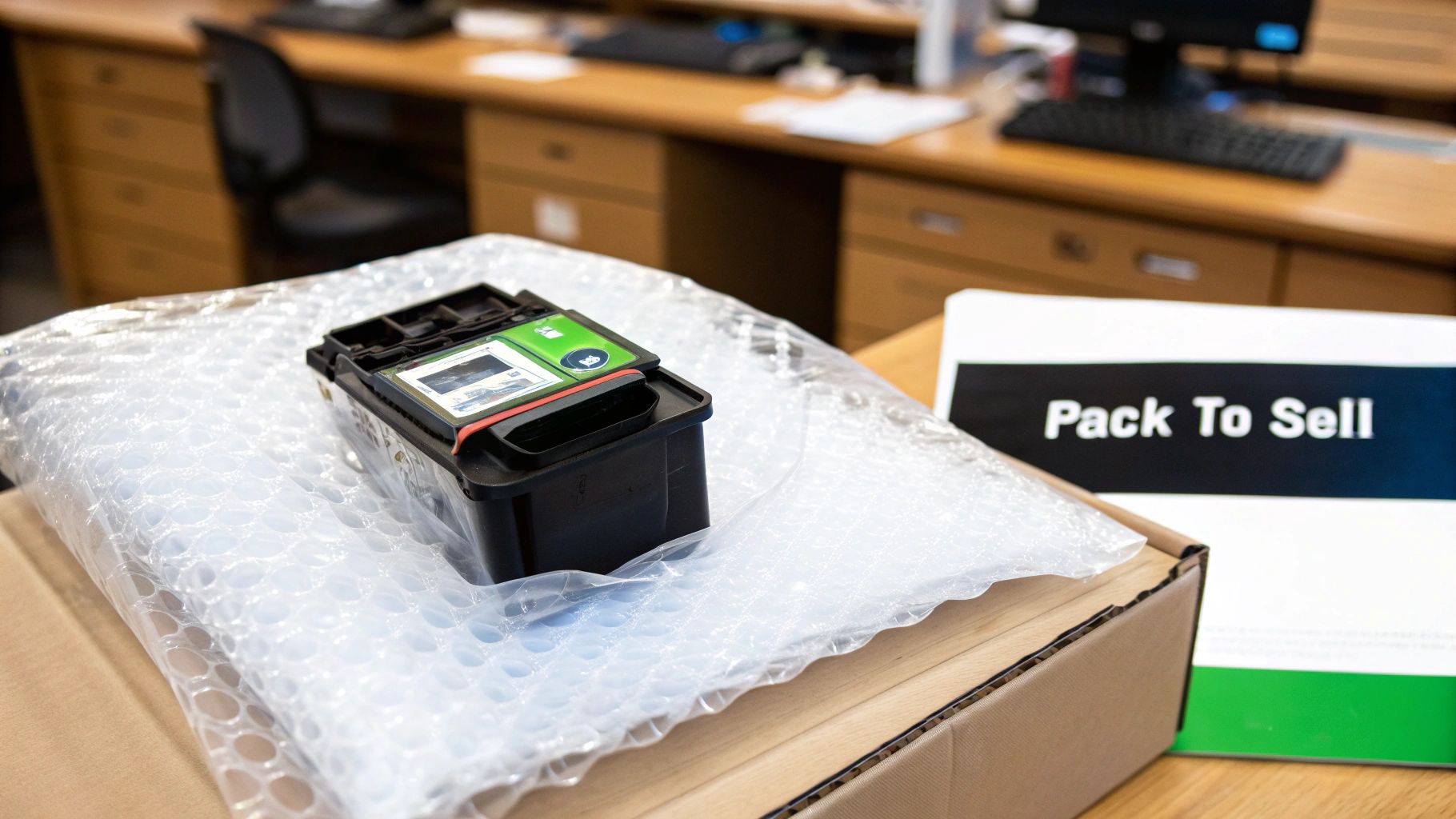
Getting a great price for your cartridges is a fantastic start, but it’s only half the job. All that effort sourcing and listing goes right out the window if your toner cartridge shows up cracked or an inkjet leaks all over the box.
Nailing your packing and shipping process is absolutely crucial. It’s the only way to protect your profit, keep buyers happy, and avoid the headache of returns and damage claims. The goal is simple: make sure the cartridge arrives in the exact same condition it was in when you packed it.
How to Pack Your Cartridges Like a Pro
You can't just toss a cartridge in a box and hope for the best. Different types have different weak points, and your packing strategy needs to account for them. A small inkjet cartridge and a hefty toner cartridge require totally different approaches.
Inkjets are small, but their biggest weakness is leaking. Even if it's factory-sealed, a rough journey can pop the packaging. Thankfully, the fix is easy.
- The Ziploc Rule: Before you do anything else, put each inkjet cartridge in its own sealed Ziploc-style bag. This simple step is your best defense against a mess that could ruin the entire shipment.
- Wrap It Up: Once bagged, give it a generous wrapping of bubble wrap. You want a thick, protective cushion that can absorb any bumps or drops along the way.
- Find a Snug Box: The final piece is a sturdy box where the wrapped cartridge fits snugly. For a single inkjet, a small 6x4x4 inch box is perfect. If there's too much room to rattle around, you’re just asking for trouble.
Toner cartridges are bigger, heavier, and more prone to cracking from a hard impact.
A common question I get is whether to ship a toner cartridge in its original box. Here’s my rule of thumb: If the original box is in mint condition, protect that value by shipping it inside a slightly larger, plain brown box. Your buyer will appreciate it. If the original box is beat up, it's better to just pack the toner itself directly into a new, well-padded shipping box.
Choosing the Smartest Shipping Option
With your cartridges packed and ready, it’s time to ship them without killing your profit margin. Walking into the post office and paying retail rates is a rookie mistake that will eat up your earnings fast.
Services like USPS Ground Advantage are a solid, budget-friendly choice for packages that don't need to be there overnight—which is pretty much every cartridge sale. But to really maximize your savings, you need to use a third-party shipping platform.
My Go-To Shipping Tools
- Pirate Ship: This is a fantastic free tool. It taps into commercial pricing from the postal service and passes those deep discounts on to you.
- Shippo: Another great platform that lets you compare discounted rates from several carriers at once, ensuring you always get the best price.
These services aren't just a small savings; they're a game-changer. A small two-pound package that might cost $12 at the post office counter can easily be shipped for just $8 using a service like Pirate Ship. Those dollars add up fast. Once your volume picks up, you can explore more shipping options to optimize your process even further.
One last thing: never ship without tracking. It’s your proof of delivery and your main line of defense if a buyer claims a package never arrived. Luckily, tracking is now standard and included for free with most shipping services.
Your Top Questions About Selling Printer Cartridges
Once you start digging into the world of reselling printer cartridges, you're bound to have questions. It's totally normal. Getting the right answers upfront is the best way to build confidence and dive in without second-guessing yourself.
Think of this section as a quick Q&A with someone who's already been down this road. We'll tackle the big stuff, from the legality of it all to which brands will actually make you money.
Is It Actually Legal to Resell Printer Cartridges?
Let's get this one out of the way immediately. Yes, it is absolutely legal to resell new, unopened printer cartridges you've legally purchased. This is all thanks to something called the "first-sale doctrine," a legal concept that says once a manufacturer sells a product, the new owner can resell that specific item without getting permission.
It's the same reason you can sell a book you bought at a bookstore. You own the physical object, and you're free to do what you want with it. The only way you'd get into hot water is if you were trying to deceive people—for example, passing off a third-party knockoff as a genuine OEM cartridge. As long as you're honest, you're in the clear.
Should I Focus on Ink or Toner?
This is a classic crossroads for new sellers, and honestly, the right answer depends on what you're trying to achieve. Both have their upsides and downsides.
-
Inkjet Cartridges: You'll find these everywhere because they're used in most home printers. They're small, light, and cheap to ship, which means they tend to sell quickly. The catch? The profit on each one is pretty low, and you have to be super careful about checking expiration dates.
-
Toner Cartridges: This is where the real money is. Toners are used in bigger office laser printers and have a much higher resale value, often fetching $50 to $100+ per cartridge. They're heavier and will cost more to ship, but the game-changer is that they don't expire, making them a much safer item to hold onto.
My Two Cents: Just start with what you can easily get your hands on. If you stumble upon a great local source for inkjets, go for it! It's a great way to learn the business. But for long-term growth, you'll want to pivot your focus to sourcing high-value OEM toner cartridges. That’s how you turn this from a small side-gig into a serious income stream.
Which Brands Are Worth the Most?
Not all cartridges are created equal—not by a long shot. While there are dozens of brands out there, only a handful consistently bring in good money and have buyers lined up. Focusing on these will give you the best bang for your buck.
Keep your eyes peeled for the top-tier brands:
- HP (Hewlett-Packard)
- Brother
- Canon
- Xerox
- Lexmark
These guys dominate the market, so there's always a steady demand for their supplies. Cartridges for more obscure printer models can be tough to move and might not even be accepted by the major buyback companies. For a detailed rundown, it's always a good idea to check a company's accepted models list or a comprehensive https://tonerconnect.net/faq to see what's currently in demand.
What Should I Do with Damaged or Expired Cartridges?
Don't toss that cartridge with a crushed box or an old expiration date just yet! It might not be a total loss. You can still sell these items, but the key is being 100% transparent.
If the box is damaged, take clear photos from every angle and describe the damage in your listing. For example, your listing title could be "New Sealed HP 952XL Ink – DAMAGED BOX." If the ink is expired, state the expiration date right up front. There are plenty of bargain hunters who are willing to take a risk for a steep discount, but they need to know exactly what they're buying. Just be prepared to sell them for 30-70% less than a perfect, in-date cartridge.
As your printer cartridge side hustle starts to take off, you might begin thinking about the best way to structure your business. It's smart to learn how to choose between a sole proprietorship and incorporation to protect your personal assets and set yourself up for future growth.
Ready to turn those surplus printer supplies into cash without all the hassle? At Toner Connect LLC, we've made the process incredibly simple. You get a fast, fair quote for your unused OEM cartridges, a free prepaid shipping label, and quick payment. Join thousands of others who have unlocked cash from their excess inventory with us. Get your free quote from Toner Connect today!